Culinary Explorer
A cooking platform built around craft, culture, and the stories behind what we eat.
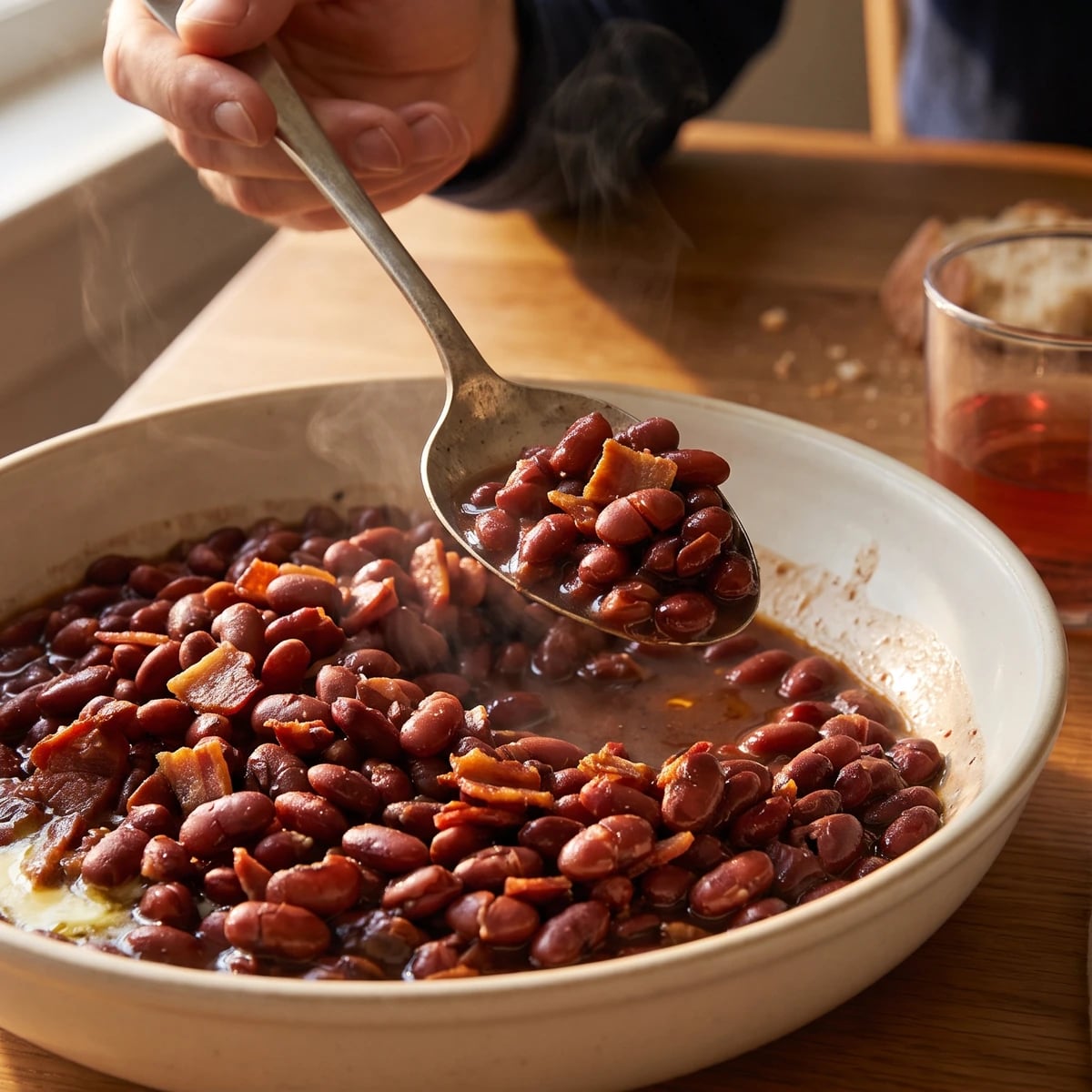
Red Beans (Haricots Rouges)
Created by Chef Juliette
Red wine, lean bacon, and a clove-stuck onion turn modest red beans into a proper French side, while Manied Butter (No. 151) teaches the quiet art of binding without boiling.
Haricots Rouges (red beans) teach one clean lesson in liaison (binding): tender beans first, liaison last. The beans must be creamy all the way through before beurre manié (kneaded butter), given in the book as Manied Butter (No. 151), touches the pot, and once it does, the sauce must never boil. That final restraint turns the wine-dark cooking liquor glossy without smothering the beans.
The source formula assumed a quart of dried beans, brigade portions, an overnight mise en place nobody bothered to write down, and a saucier free to bind the pot at service. For four side portions, the scalable quantities are quartered; a one-hour hot soak replaces that unspoken staging, and the source's tied herb bundle becomes a petit bouquet garni (small herb bundle). The brigade's scale and spare pair of hands are scaffolding, so they go. The red-wine simmer, removal of the bacon as soon as it is cooked, its butter frizzle, and the last-minute liaison are the dish, so they stay. One cook, one stove, one evening.
Expect brick-red beans with creamy centers, little bronze cubes of bacon, and enough garnet sauce to cling rather than puddle. The step that matters most comes at the end: warm the liaison gently, watch for its first gloss, and deny it the boil.
Ingredients
dried red beans
Quantity
1 cup (240 ml / 200 g)
sorted and rinsed
water
Quantity
9 cups (2.16 L / 2.16 kg), divided, plus more as needed
dry, light-bodied red wine
Quantity
1/2 cup (120 ml / 120 g)
| Ingredient | Quantity |
|---|---|
| dried red beanssorted and rinsed | 1 cup (240 ml / 200 g) |
| water | 9 cups (2.16 L / 2.16 kg), divided, plus more as needed |
| dry, light-bodied red wine | 1/2 cup (120 ml / 120 g) |
Where cooking meets culture.
Culinary guides, cultural storytelling, and the editorial depth that makes cooking meaningful.
Discover Culinary Explorer