Culinary Explorer

A cooking platform built around craft, culture, and the stories behind what we eat.
Discover Culinary Explorer
Cèpes à la Crème

Cèpes à la Crème

Created by Chef Juliette

Based on No. 2069, Cèpes à la Crème, from Le Guide Culinaire (1907) by Auguste Escoffier

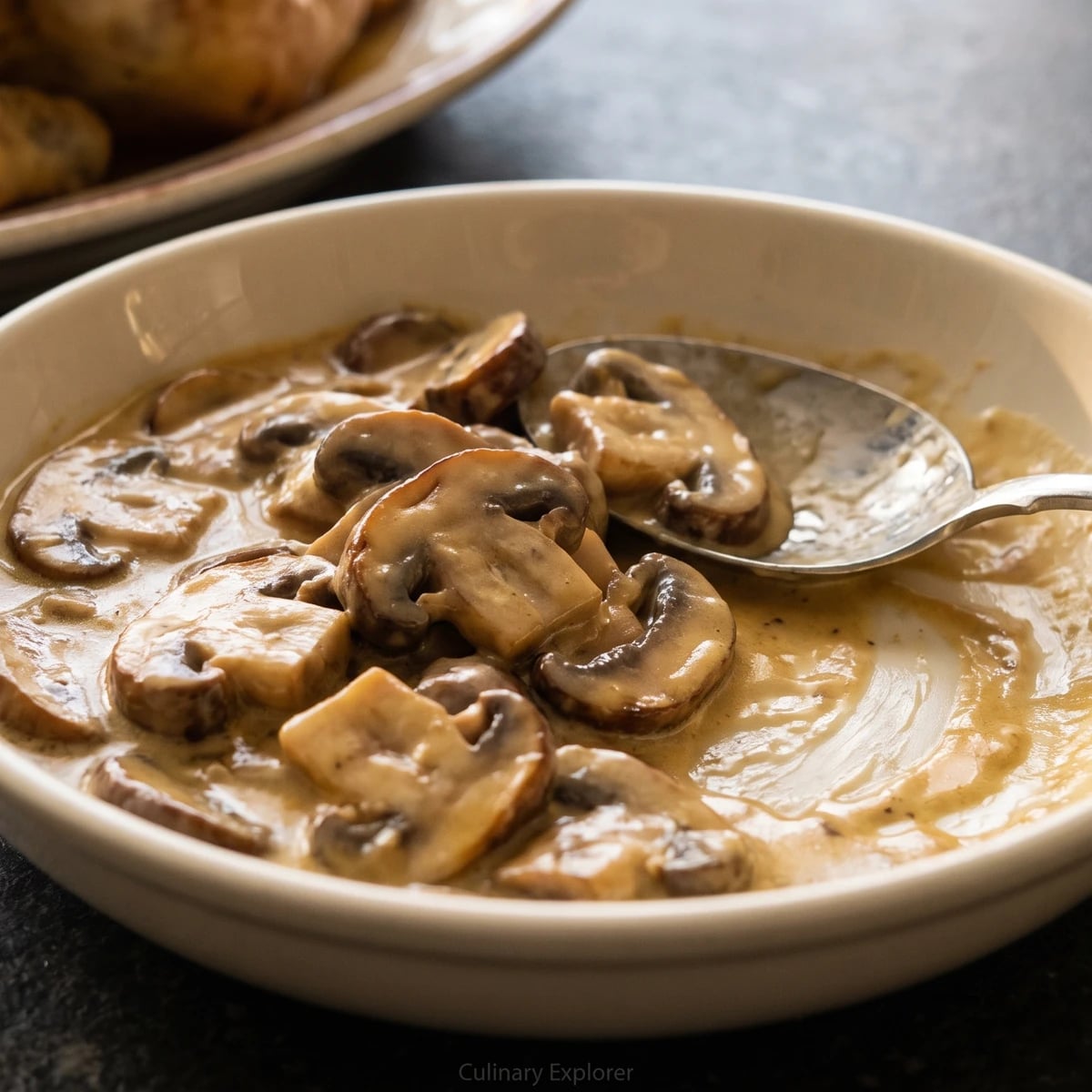
Cèpes cooked gently in butter, drained of every drop they release, then cloaked in cream reduced to a glaze: a quiet French lesson in keeping mushroom water out of the sauce.

Side Dishes
French
Comfort Food
Dinner Party
20 min
Active Time
30 min cook50 min total
Yield4 servings

Cèpes à la Crème (porcini mushrooms in cream) teaches one exact lesson: let the cèpes give up their water, then drain them before cream ever enters the pan. Mushroom liquor has flavor, but here it thins the cream and dulls its reduction. Keep the stages apart and you get tender slices wrapped in a sauce that tastes distinctly of cèpes, butter, and cream.

The original formula assumed a saucier watching a wide sautoir, hot cream ready in a second pan, brigade quantities, and a metal timbale waiting for service. No stockpot or salamander has any work here. For four servings, a wide skillet, a small saucepan, a strainer, and a warmed bowl do the same work. The old dessertspoon measure becomes 4 teaspoons of onion for 450 g of cèpes, preserving the book's ratio so the onion supports the mushrooms without announcing itself. The service choreography is scaffolding and can go; the draining and two-stage cream finish are the dish and must stay. One cook, one stove, one evening.

The decisive moment comes before the sauce begins. Let the cooked cèpes drain for five full minutes without pressing them, then pour boiling cream over mushrooms that are tender but no longer carrying a puddle into the pan.

Cèpes are closely tied to the oak and chestnut woods of southwestern France, especially Périgord and the country around Bordeaux, where Boletus edulis reaches the market under its French name rather than as a generic mushroom. The à la crème treatment belongs to the national classical kitchen that carried woodland produce onto bourgeois and grand tables; cream here does not make the dish Norman, a common confusion when French regions are blurred together. Its defining refinement is practical rather than grand: the cooked cèpes are drained so their liquor cannot dilute the cream reduction.

The technique, the tradition, and the story behind every dish.

Discover Culinary Explorer

Ingredients

fresh cèpes (Boletus edulis)

Quantity

6 cups sliced (1.4 L / 450 g)

cleaned and cut into 1/4-inch (6 mm) collops

unsalted butter

Quantity

4 tablespoons (60 ml / 57 g)

divided

yellow onion

Quantity

4 teaspoons (20 ml / 15 g)

very finely chopped

heavy cream, about 35% fat

Quantity

1 cup (240 ml / 240 g)

light pouring cream, about 20% fat

Quantity

1/4 cup (60 ml / 60 g)

fine sea salt

Quantity

3/4 teaspoon (4 ml / 4 g)

divided

finely ground white pepper

Quantity

1/8 teaspoon (0.6 ml / 0.3 g)

Equipment Needed

  • 12-inch (30 cm) wide sauté pan with lid
  • 1-quart (1 L) saucepan
  • Fine-mesh strainer or small colander
  • Soft mushroom brush
  • Warmed deep porcelain serving bowl

Instructions

  1. 1

    Clean and collop

    Trim away the earthy ends and brush the cèpes clean, wiping stubborn soil with a barely damp cloth. If they truly need water, rinse them quickly and dry them at once; never leave them soaking. Cut caps and stems crosswise into even 1/4-inch (6 mm) collops, the classical word for broad slices. Even thickness matters because every piece must soften and release its water at roughly the same moment.

    Separate any very thick stems and slice them a little more finely than the caps. They are firmer and otherwise lag behind in the pan.
  2. 2

    Soften the onion

    Melt 1 tablespoon of the butter in a wide 12-inch (30 cm) sauté pan over low heat. Add the finely chopped onion and cook for 4 to 5 minutes, stirring often, until completely soft and translucent without coloration. If the edges begin to catch, add 1 teaspoon of water and lower the heat; this stops the browning before it runs away. The onion should disappear into the finished dish, not freckle the cream.

  3. 3

    Stew the cèpes

    Add the remaining butter, the colloped cèpes, and half the salt. Turn everything gently until the slices are glossed with butter, cover the pan, and cook over medium-low heat for 4 minutes. Uncover and continue cooking for 6 to 8 minutes, turning occasionally, until the cèpes are tender and have released a generous amount of liquid. Keep them pale and supple rather than bronzed. This is a butter stew, not a hard sauté.

  4. 4

    Drain them fully

    Tip the cèpes into a strainer set over a bowl and leave them for 5 full minutes, turning them once but never pressing. The liquid must leave now or it will water down the cream later. Save the fragrant mushroom liquor for a soup or another sauce if you like, but do not return it to this dish. While the cèpes drain, bring the heavy cream to a full boil in a small saucepan, watching closely so it does not climb over the rim.

    A hurried drain is the usual reason this sauce refuses to concentrate. Five quiet minutes in the strainer does more for the dish than frantic boiling afterward.
  5. 5

    Reduce the cream

    Pour any remaining liquid from the sauté pan and return the drained cèpes to it. Cover them with the boiling heavy cream, bring everything to a gentle boil, and cook uncovered for 6 to 10 minutes. Stir more frequently as the cream tightens. It is completely reduced when no loose cream runs across the pan as you tilt it and every collop wears a thick ivory coating. If yellow butterfat beads at the edge or the sauce turns grainy, pull the pan off the heat and stir in 1 tablespoon of the cold light cream until it becomes smooth again. Ça se rattrape. Return it only to gentler heat.

  6. 6

    Finish and serve

    Lower the heat and fold in 3 tablespoons of the light cream. Let it come together for 30 to 60 seconds, then use the final tablespoon only if the sauce needs loosening. Season with the remaining salt and the white pepper. The sauce should nap the cèpes in a glossy coat, not gather as a pale puddle underneath them. Spoon everything at once into a warmed deep serving bowl, the honest home equivalent of the classical timbale. À table!

Chef Tips

  • Choose firm cèpes with dense flesh and pale, tight pores underneath. An olive-colored, spongy pore layer signals an older mushroom; trim it away before slicing or it will collapse into the sauce.
  • Fresh cèpes are seasonal. When they are absent, frozen sliced cèpes are the honest preserved choice: use the same weight, thaw them in a strainer, and dry them well before cooking. Dried porcini bring splendid flavor but cannot replace the fleshy collops in this preparation.
  • No garlic, parsley, wine, or stock belongs in this particular formula. Their absence isn't timidity. The reduced cream is built to carry the cèpes themselves, with only enough onion to deepen them.
  • Serve beside roast chicken, veal, beef, or a plain omelette, anything willing to share its plate with cream. A dry white Burgundy has enough breadth for the sauce, while a restrained red Bordeaux answers the earthiness of the cèpes.

Advance Preparation

  • The onion can be softened without coloration up to 1 day ahead, cooled promptly, and refrigerated in a covered container.
  • The cèpes can be stewed, drained, cooled, and refrigerated up to 4 hours ahead. Rewarm them gently before adding the boiling heavy cream, then complete the reduction immediately before serving.
  • The finished dish is best brought straight to the table. Refrigerate leftovers within 2 hours and keep them for up to 2 days; reheat over low heat with a spoonful of light cream if the sauce has tightened.

Frequently Asked Questions

Nutrition Information

1 serving (about 155g)

Calories
375 calories
Total Fat
37 g
Saturated Fat
23 g
Trans Fat
1 g
Unsaturated Fat
12 g
Cholesterol
110 mg
Sodium
465 mg
Total Carbohydrates
8 g
Dietary Fiber
3 g
Sugars
4 g
Protein
7 g

Note: Chef personas and recipes are created with AI assistance. Cook with care: follow safe food-handling practices, check doneness with a thermometer when needed, and adapt for allergies and your kitchen.

Where cooking meets culture.

Culinary guides, cultural storytelling, and the editorial depth that makes cooking meaningful.

Discover Culinary Explorer

More from Vegetables and Farinaceous Products - Carrots, Cêpes and Mushrooms

Browse the full collection