
Chef Juliette
Mayonnaise de Volaille
Cold roast chicken, ciseled lettuce, and a shining coat of homemade mayonnaise, arranged with capers, olives, anchovies, eggs, and lettuce hearts, then tossed at the table as the canon intends.
A cooking platform built around craft, culture, and the stories behind what we eat.
Created by Chef Juliette
Based on No. 1996, Compound Salads, from Le Guide Culinaire (1907) by Auguste Escoffier
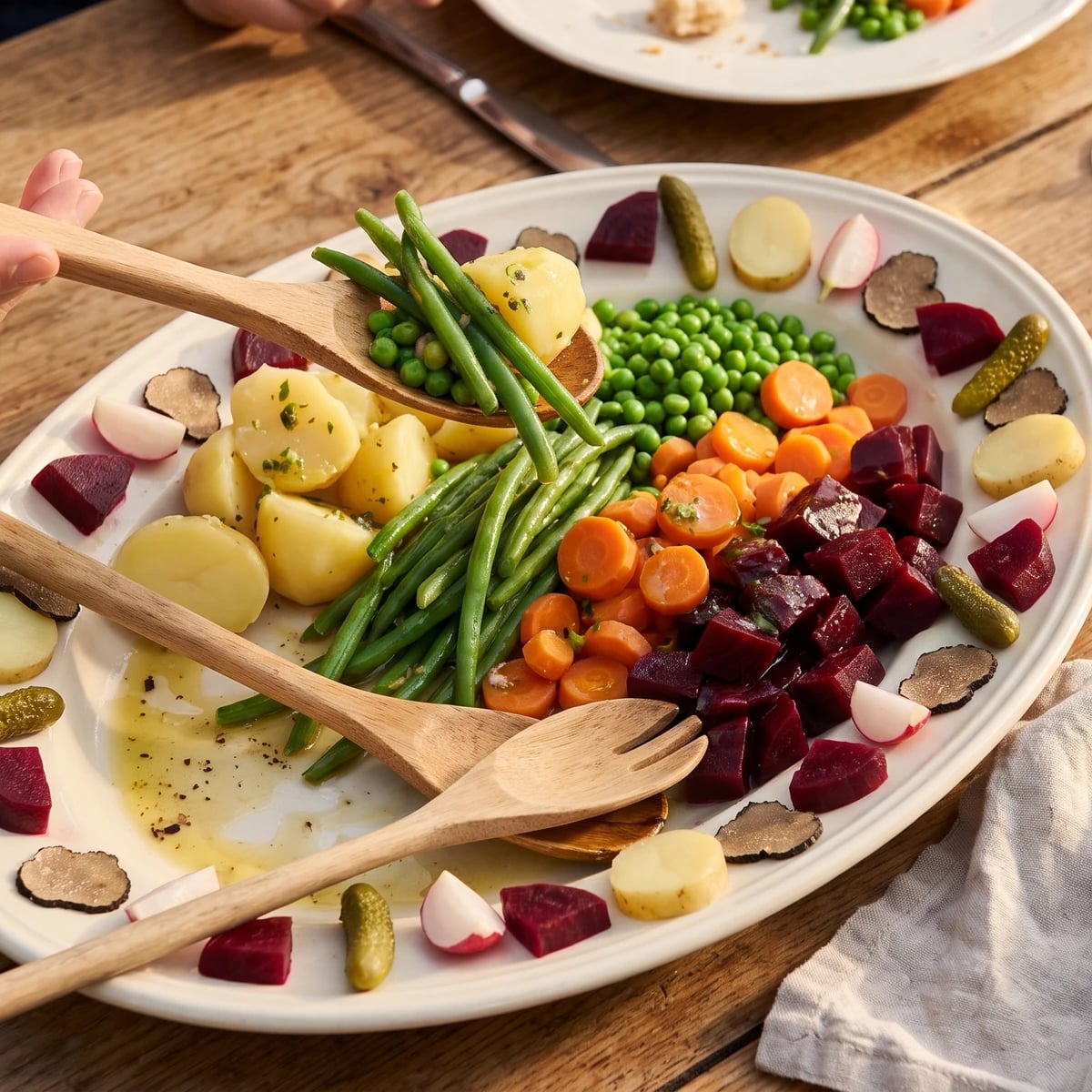
A vivid salade composée for the generous table: five vegetables seasoned separately, arranged in contrasting heaps, and bordered without moulding, so every color stays clear and every bite tastes of itself.
Salade composée (compound salad) teaches restraint in arrangement: season every constituent on its own, then keep the colors apart until the platter reaches the table. That is the one true thing to know before a pan comes out. Mix everything early and the beet stains the potatoes, the beans lose their clean green, and every bite tastes of the same dressing. Set them in distinct heaps and each vegetable keeps its voice.
The professional garde-manger, the cold pantry, kept trays of cooked vegetables ready, had several hands for separate seasoning, and could spare aspic for a decorated jelly border. Your kitchen has one saucepan, a few bowls, and one cook. We use that pan in sequence, begin with plain cooked beetroot from the preserved pantry, and make a generous platter for four. The jelly border and moulded display are brigade scaffolding, so they go. Separate seasoning, contrasted color, and an unmixed arrangement are the dish, so they stay. One cook, one stove, one evening.
The canon gives a method rather than a compulsory shopping list. Potatoes, carrots, green beans, peas, and beetroot supply the intended contrasts, while cornichons, radishes, potato rounds, and a little truffle retain the old border vocabulary. The vinaigrette is their shared foundation, but it must meet each vegetable separately. That individual seasoning is the step that decides the salad.
La salade composée has no single regional birthplace; its precise home is the French garde-manger and the bourgeois dining table, where cooked vegetables were chilled, seasoned, and arranged before service. It entered the canon as a method rather than a fixed list of ingredients: contrasting colors remain in separate heaps, while beetroot, gherkins, truffle, potato rounds, and radishes may furnish the border. Moulding is a misconception born of display, because compression dulls texture and forces the seasonings together, while the classical instruction itself favors the simplest platter.
Quantity
4 medium (about 3 cups / 720 ml / 450 g)
scrubbed
Quantity
2 medium (about 1½ cups / 360 ml / 200 g)
peeled and cut into ⅓-inch dice
Quantity
2 cups (480 ml / 225 g)
trimmed and cut into 1½-inch lengths
Quantity
1 cup (240 ml / 150 g)
Quantity
2 small (about 1½ cups / 360 ml / 225 g)
peeled
Quantity
8 (about ⅓ cup / 80 ml / 60 g)
halved lengthwise
Quantity
6 (about ¾ cup / 180 ml / 85 g)
trimmed and quartered
Quantity
1 small (about 2 tablespoons / 30 ml / 15 g)
thinly sliced
Quantity
2 tablespoons (30 ml / 30 g)
Quantity
1 tablespoon (15 ml / 15 g)
Quantity
6 tablespoons (90 ml / 82 g)
Quantity
2 tablespoons plus 1 teaspoon (35 ml / 42 g)
divided
Quantity
½ teaspoon (2.5 ml / 1 g)
| Ingredient | Quantity |
|---|---|
| waxy potatoesscrubbed | 4 medium (about 3 cups / 720 ml / 450 g) |
| carrotspeeled and cut into ⅓-inch dice | 2 medium (about 1½ cups / 360 ml / 200 g) |
| green beanstrimmed and cut into 1½-inch lengths | 2 cups (480 ml / 225 g) |
| frozen peas | 1 cup (240 ml / 150 g) |
| plain cooked red beetspeeled | 2 small (about 1½ cups / 360 ml / 225 g) |
| cornichonshalved lengthwise | 8 (about ⅓ cup / 80 ml / 60 g) |
| red radishestrimmed and quartered | 6 (about ¾ cup / 180 ml / 85 g) |
| preserved black truffle (optional)thinly sliced | 1 small (about 2 tablespoons / 30 ml / 15 g) |
| red wine vinegar | 2 tablespoons (30 ml / 30 g) |
| Dijon mustard | 1 tablespoon (15 ml / 15 g) |
| sunflower or grapeseed oil | 6 tablespoons (90 ml / 82 g) |
| fine sea saltdivided | 2 tablespoons plus 1 teaspoon (35 ml / 42 g) |
| freshly ground black pepper | ½ teaspoon (2.5 ml / 1 g) |
Whisk the red wine vinegar, Dijon mustard, 1 teaspoon of the salt, and the pepper until the salt dissolves. Add the oil in a thin stream while whisking, stopping when the vinaigrette looks lightly creamy but remains fluid enough to coat without smothering. If it splits while it waits, put 1 teaspoon of cold water in a clean bowl and whisk the separated vinaigrette into it a spoonful at a time. Ça se rattrape.
Put the whole potatoes in a 4-quart saucepan, cover them with cold water by 1 inch, and add 1 tablespoon of the salt. Bring up gently and simmer until a small knife enters the center with little resistance, 18 to 25 minutes depending on their size. Drain and let them cool only until they can be handled. Peel them if the skins are coarse, then cut one potato into neat ¼-inch roundels for the border and the others into ½-inch dice. While still faintly warm, season the diced potatoes and roundels separately with just enough vinaigrette to give them a fine sheen.
Refill the saucepan with fresh water, add the remaining tablespoon of salt, and bring it to a lively boil. Cook the carrots until tender but still defined, about 3 minutes, then lift them into ice water with a slotted spoon. Repeat with the green beans for 3 to 4 minutes and the frozen peas for about 1 minute, returning the water to a boil between batches. Chill each vegetable promptly, then spread it on clean towels and dry it thoroughly. Water left clinging to the vegetables weakens the vinaigrette and leaves the platter weeping.
Put the carrots, green beans, and peas in separate bowls. Dress each with a small spoonful of vinaigrette, toss gently, and taste before adding more. Cut three-quarters of the beetroot into ½-inch dice and the remainder into small border pieces, then season both in their own bowl last so their garnet juice touches nothing else. The vegetables should glisten, not swim. If one bowl is overdressed, lift its vegetables out with a slotted spoon and leave the excess behind.
If the salad will not be served immediately, cover and chill every constituent in its own container. Keep the cornichons, radishes, truffle, and border pieces undressed. Bring the cooked vegetables out about 15 minutes before arranging them, because refrigerator-cold potatoes and carrots surrender half their flavor.
Spoon the potatoes into a broad, loose heap at the center of a large oval platter. Arrange the green beans, carrots, peas, and diced beetroot around them in distinct low heaps, placing contrasting shades beside one another and keeping the beetroot toward the outer edge. Do not mould or compress them. If a heap slumps, gather it gently with two serving spoons; the small gain in symmetry is never worth mashed vegetables and mingled dressing.
Finish the edge with an unfussy alternating border of beetroot pieces, cornichon halves, potato roundels, and radish quarters. Tuck in the truffle slices if using them, keeping them visible and undressed. Carry the platter directly to the table with the remaining vinaigrette offered separately, so each guest may mingle a serving on the plate while the salad itself remains bright and legible. À table!
1 serving (about 385g)
Culinary guides, cultural storytelling, and the editorial depth that makes cooking meaningful.
Discover Culinary Explorer
Chef Juliette
Cold roast chicken, ciseled lettuce, and a shining coat of homemade mayonnaise, arranged with capers, olives, anchovies, eggs, and lettuce hearts, then tossed at the table as the canon intends.

Chef Juliette
Cold roast or poached chicken with fine ribbons of lettuce, dressed at the final moment with oil and vinegar: a composed salad whose freshness depends entirely on timing.

Chef Juliette
Five leaves, one living rule: laitue, romaine, chicorée, mâche, or pissenlit must be washed, dried, and dressed only as they go to the table, while every leaf still carries its light vinaigrette.

Chef Juliette
Salade de Betteraves proves that baking, not boiling, is the whole argument: concentrated garnet sweetness, tender baked onion, sharp mustard, and herbs cut into a weeknight salad worth making ahead.