
Chef Juliette
John Dory (St. Pierre)
John Dory has the delicacy of sole and the firmness of turbot. A light flouring, a quick butter sauté, and nut-brown beurre noisette show exactly why looks never mattered.
A cooking platform built around craft, culture, and the stories behind what we eat.
Created by Chef Juliette
Based on No. 1916, Cailles à la Vendangeuse, from Le Guide Culinaire (1907) by Auguste Escoffier
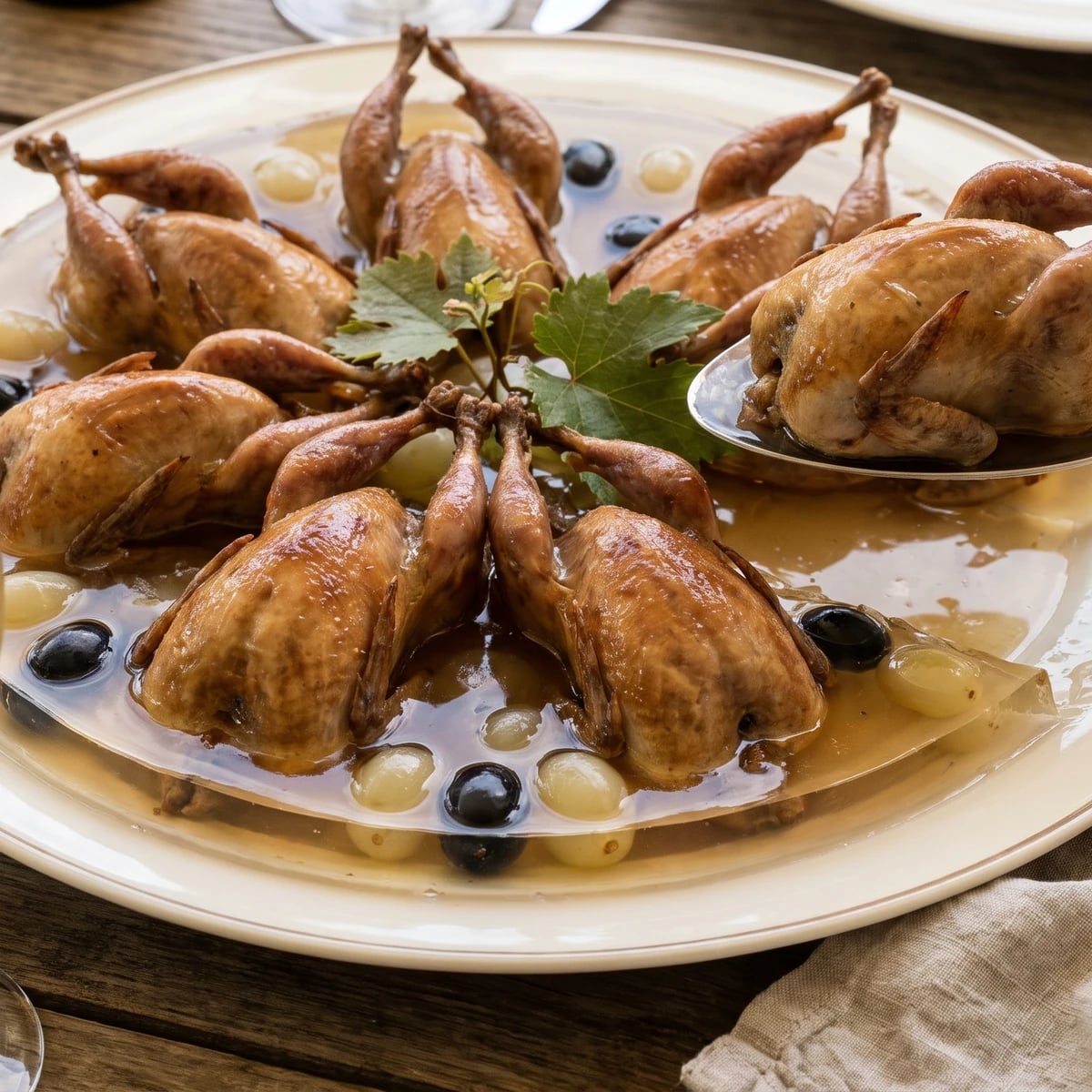
Burnished quails rest cold beneath a tender Cognac aspic, encircled by peeled white and black grapes. This harvest-table spectacle depends on quiet precision: clear jelly, dry fruit, and no grape skin left behind.
Cailles à la Vendangeuse (vintner's quail) teaches the discipline of cold presentation. Clear aspic magnifies everything beneath it, which is why the one true thing to know before touching a pan concerns the grapes: peel and pip every one, then dry them completely. Skins turn cloudy beneath the jelly, and trapped water makes the aspic slide away.
The original recipe assumed a garde-manger with clear aspic ready, a stockpot never off the fire, and spare hands to build little dry-paste dossers and a decorative cushion. Here, good clear chicken stock and measured gelatin make the aspic, while a broad chilled platter replaces the pastry architecture. The dossers and cushion were scaffolding for formal service, so they go. The roasted quails, white and black grapes, leafy vine shoot, and brandy-scented jelly are the dish, so every one stays. One cook, one stove, one evening.
When it is right, the cold quails remain burnished beneath a trembling, pale-amber glaze, with the peeled grapes shining like stones around them. The aspic should yield to a spoon, not bounce under it. Before you touch the pan, make room for the work that decides the platter: peel, pip, and dry every grape.
Cailles à la Vendangeuse belongs to the cold buffet and formal dining table of French grande cuisine, where small game birds were matched to the abundance of the grape harvest and protected beneath clear aspic. Its name evokes the vendange rather than claiming Burgundy, Bordeaux, or any single wine region: white and black grapes, a leafy vine shoot, and fine brandy turn the platter into a portrait of harvest. Decorative pastry supports came from the service kitchen, while the essential marriage of roast quail, grapes, and spirit-scented jelly traveled intact to the home table.
Quantity
8 (about 4 to 5 oz / 115 to 140 g each)
giblets removed and birds dried well
Quantity
2 tablespoons (30 ml / 28 g)
Quantity
1 tablespoon (15 ml / 14 g)
Quantity
2 teaspoons (10 ml / 12 g)
divided
Quantity
½ teaspoon (2.5 ml / 1 g)
Quantity
3 cups (720 ml / 720 g)
Quantity
1 tablespoon plus 1½ teaspoons (22.5 ml / 14 g)
Quantity
¼ cup (60 ml / 60 g)
Quantity
¼ cup (60 ml / 57 g)
Quantity
1 teaspoon (5 ml / 3 g)
Quantity
2 cups (475 ml / 300 g)
Quantity
2 cups (475 ml / 300 g)
Quantity
1 small sprig
| Ingredient | Quantity |
|---|---|
| whole quailsgiblets removed and birds dried well | 8 (about 4 to 5 oz / 115 to 140 g each) |
| unsalted butter | 2 tablespoons (30 ml / 28 g) |
| neutral oil | 1 tablespoon (15 ml / 14 g) |
| fine sea saltdivided | 2 teaspoons (10 ml / 12 g) |
| finely ground white pepper | ½ teaspoon (2.5 ml / 1 g) |
| clear unsalted chicken stock | 3 cups (720 ml / 720 g) |
| unflavored powdered gelatin | 1 tablespoon plus 1½ teaspoons (22.5 ml / 14 g) |
| cold water | ¼ cup (60 ml / 60 g) |
| Cognac or fine grape brandy | ¼ cup (60 ml / 57 g) |
| unflavored powdered gelatin for correcting a weak set (optional) | 1 teaspoon (5 ml / 3 g) |
| large firm white grapes | 2 cups (475 ml / 300 g) |
| large firm black grapes | 2 cups (475 ml / 300 g) |
| food-safe, unsprayed grapevine sprig bearing leaves and grapes (optional) | 1 small sprig |
Heat the oven to 425°F (220°C). Season the quails inside and out with 1½ teaspoons of the salt and all the white pepper. Heat the oil and butter in a wide ovenproof skillet until the butter foams, then place the quails breast-side down in batches and brown them for about 2 minutes without shifting them. Turn and brown the backs for 1 minute. Arrange all eight breast-side up in the skillet or a shallow roasting pan and roast for 8 to 12 minutes, until deeply golden and the thickest part of a thigh reaches 165°F (74°C). Do not cook by colour alone: a browned quail may still be underdone beside the bone.
Transfer the quails to a rack and let them stand for 10 minutes, then refrigerate them uncovered until cold through, about 1 hour. Blot away any beads of moisture or roasting fat before assembly. Warm birds melt the aspic, and damp birds reject it; the surface must be cold and dry.
While the quails cool, simmer the chicken stock in a clean saucepan until reduced from 3 cups to 2½ cups (600 ml). Skim the surface carefully rather than stirring sediment back into it. Sprinkle the 14 g gelatin over the cold water and leave it to bloom for 5 minutes. Remove the reduced stock from the heat, stir in the bloomed gelatin until completely dissolved, then add the Cognac and remaining ½ teaspoon salt. Pass the aspic through a dampened fine sieve and cool it until fluid but no longer warm.
Spoon a tablespoon of aspic onto a chilled saucer and refrigerate it for 10 minutes. It should tremble when nudged yet hold a clean trail where a spoon passes. If it remains liquid, bloom the optional gelatin in 1 tablespoon of cold water, dissolve it in 1 cup of gently warmed aspic, then combine it with the rest. If the aspic has become firm in the bowl, warm it over barely simmering water until fluid again. Never boil it. Ça se rattrape.
Bring a saucepan of water to a boil and prepare a bowl of ice water. Lower the grapes into the boiling water in small batches for 8 to 10 seconds, then chill them immediately. Slip off every skin. Make a tiny slit at the stem end or on the side that will face downward, then tease out every pip with the point of a small paring knife and a fine skewer. If a skin clings, dip that grape again for 3 seconds rather than tearing at it. Pat every grape completely dry before it approaches the aspic.
Chill a broad, shallow round platter at least 15 inches (38 cm) across. Pour in enough fluid aspic to make a thin base, about ¾ cup (180 ml), and refrigerate for 15 to 20 minutes, until set but still slightly tacky. This layer anchors the arrangement without the original dry-paste dossers.
Arrange the cold quails breast-side up in a radial pattern, with their legs pointing toward the rim. Ring them generously with alternating white and black grapes, keeping the tiny pipping slits underneath. If using the grapevine sprig, place it in the centre with its cut stem hidden beneath a cluster of grapes. Press each element lightly into the tacky base so nothing floats when the next aspic is added.
Spoon a thin coat of cool, syrupy aspic over every quail and grape, then refrigerate for 10 minutes. Repeat twice, letting each coat set before adding the next, and finally pour the remaining aspic around the base so the grapes sit nested in clear jelly. If a coat slides off, the food is too warm or damp. Blot any exposed moisture, chill the platter for 10 minutes, and begin again with a thinner coat. Keep the bowl of aspic fluid over lukewarm water if necessary.
Refrigerate the completed platter uncovered until the aspic is fully set, at least 4 hours, then cover it loosely without touching the surface. Bring it from the cold only 10 minutes before serving. Cut through the aspic around each pair of quails with a warm knife and lift them with grapes and a spoonful of jelly. Two quails make one generous serving. À table!
1 serving (about 500g)
Culinary guides, cultural storytelling, and the editorial depth that makes cooking meaningful.
Discover Culinary Explorer
Chef Juliette
John Dory has the delicacy of sole and the firmness of turbot. A light flouring, a quick butter sauté, and nut-brown beurre noisette show exactly why looks never mattered.

Chef Juliette
Fresh haddock proves its delicacy in the meunière pan: a fine flour crust, moist pearly flakes, and beurre noisette sharpened with lemon and parsley, ready from one skillet in half an hour.

Chef Juliette
Éperlans à l’Anglaise turns small fish into a lesson in disciplined coating: boned smelts under a close, crisp crumb, pan-fried in clarified butter and finished with bright, half-melted maître d’hôtel butter.

Chef Juliette
Tiny smelts, shallot, mushrooms, white wine, gratin sauce, and fine bread raspings meet a fierce oven, where the fish must turn tender in the same breath the buttered crust bronzes.