Culinary Explorer

A cooking platform built around craft, culture, and the stories behind what we eat.
Discover Culinary Explorer
Cailles sous la Cendre

Cailles sous la Cendre

Created by Chef Juliette

Based on No. 1897, Cailles sous la Cendre, from Le Guide Culinaire (1907) by Auguste Escoffier

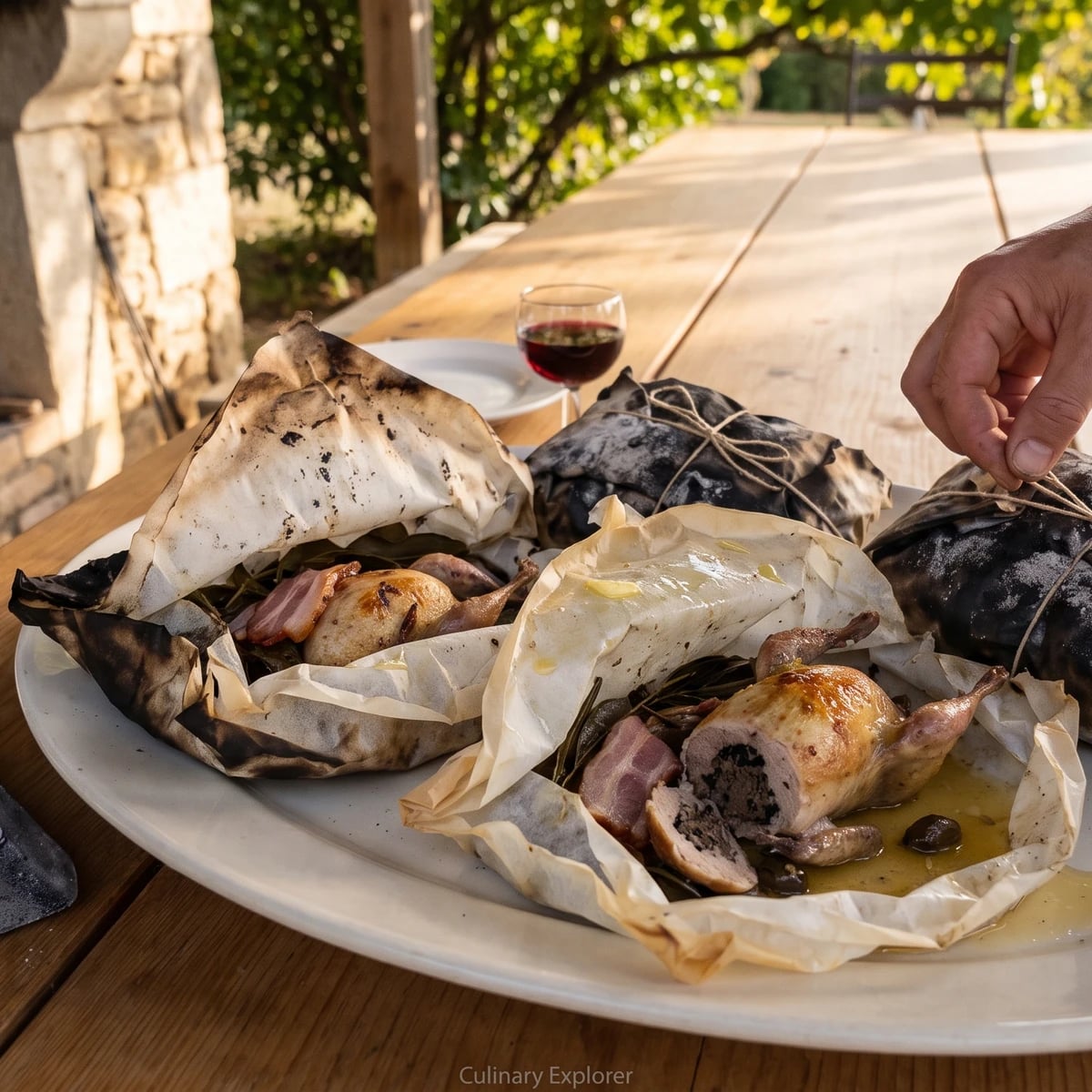
Truffled quail wrapped in vine leaf, bacon, and two buttered papers, then buried beneath renewed wood cinders: a classical hearth method that cooks the bird gently inside its charred armor.

Main Dishes
French
Outdoor Dining
Special Occasion
Dinner Party
1 hr
Active Time
35 min cook1 hr 35 min total
Yield4 servings

Cailles sous la Cendre (quail cooked beneath cinders) teaches how fierce heat can cook gently when every protective layer does its work. The cinders never touch the bird. A buttered vine leaf holds moisture, bacon bastes the flesh, and two buttered papers form a sacrificial envelope: the outer sheet chars so the quail cannot. The one true thing to know before touching a pan is that an intact wrapping matters more than anything else.

The original entry assumed a working hearthstone, a log fire tended long enough to supply renewed cinders, and smooth truffled game forcemeat waiting in the garde-manger. At home, use a cooking-safe masonry hearth or fire pit with a dry firebrick or cast-iron floor, and make one small duck forcemeat in a processor. The prepared farce and brigade quantity were scaffolding, so they shrink. The log fire, vine leaf, bacon, two buttered papers, and thirty-five minutes beneath renewed cinders are the dish, so none of them goes.

When the method lands, the blackened outer paper comes away to reveal a pale inner sheet slick with butter and quail juices. Beneath it sit glossy bacon, a dark olive vine leaf, tender quail, and a truffled center. No sauce is added because the entry calls for none; the parcel makes its own. Wrap every seam twice and tie it securely. That is the step that decides dinner.

Cailles sous la cendre belongs to France's table de chasse, the game table built around a working hearth rather than one provincial larder. Country cooks used hot ash as enveloping heat, while classical kitchens enriched the method with truffled game forcemeat and the precise succession of vine leaf, bacon, and buttered paper. The cinders are not a seasoning and should never touch the bird; the double paper is the technique, not mere packaging.

The technique, the tradition, and the story behind every dish.

Discover Culinary Explorer

Ingredients

oven-ready whole quail

Quantity

8 birds (about 5 to 6 oz / 140 to 170 g each)

necks and giblets removed; cavities patted dry

skinless duck breast

Quantity

3½ oz (100 g)

diced and thoroughly chilled

large egg white

Quantity

1 (about 1 fl oz / 30 ml / 30 g)

thoroughly chilled

heavy cream

Quantity

3 tablespoons (45 ml / 45 g)

thoroughly chilled and divided

black truffle

Quantity

2 tablespoons (30 ml / 20 g)

finely chopped; fresh or preserved and drained

fine sea salt

Quantity

1½ teaspoons (7.5 ml / 9 g)

divided

freshly ground black pepper

Quantity

½ teaspoon (2.5 ml / 1 g)

divided

large vine leaves

Quantity

8

fresh and blanched or preserved, rinsed and patted dry

thin unsmoked streaky bacon

Quantity

8 slices (about 7 oz / 200 g total)

unsalted butter

Quantity

6 tablespoons (90 ml / 85 g)

melted and divided

plain unwaxed food-safe cooking paper

Quantity

24 squares, each about 12 inches / 30 cm square

two per bird, with spares for rewrapping

Equipment Needed

  • Outdoor masonry cooking hearth, vented wood-burning fireplace, or wood-fire pit approved for cooking, with a dry firebrick or cast-iron floor large enough for 8 parcels
  • Seasoned untreated hardwood logs
  • Long-handled ember shovel or fire rake
  • Long heat-resistant gloves and long tongs
  • Mini food processor with bowl and blade
  • Instant-read food thermometer
  • Pastry brush
  • Untreated cotton kitchen twine

Instructions

  1. 1

    Build the log fire

    Light a fire of seasoned, untreated hardwood on a cooking-safe masonry hearth or in a wood-fire pit with a dry firebrick or cast-iron floor. Feed it until you have an active log fire to one side and a deep supply of gray cinders holding dull red heat beneath their surface. Rake a level bed about 2 inches (5 cm) deep onto the cooking floor, keeping open flame away from it. The continuing log fire is essential because it supplies fresh hot cinders throughout the cooking.

    Never use accelerant, treated or painted wood, charcoal briquettes, or a damp natural stone that can fracture under heat. Use a hearth or fire pit intended for cooking and keep long gloves, an ember shovel, and a metal lid nearby.
  2. 2

    Make the farce

    Chill the processor bowl and blade for ten minutes. Pulse the duck with ¼ teaspoon (1.25 ml / 1.5 g) of the salt and a pinch of the pepper until finely minced and sticky. Add the cold egg white and process until smooth, then add 2 tablespoons (30 ml / 30 g) of the cream gradually. Add the remaining cream only as needed to make a cold, satin-smooth paste, then fold in the truffle. If the farce turns loose or develops a greasy shine, stop immediately. Ça se rattrape: chill the bowl and mixture for ten minutes, then pulse briefly while adding the reserved cold cream a teaspoon at a time.

  3. 3

    Test and stuff

    Cook a teaspoon of the farce in a small pan with a little of the measured butter, then taste it and correct the salt or pepper. Never taste forcemeat raw. Season the quail lightly inside and out with the remaining salt and pepper, remembering that the bacon and preserved vine leaves carry salt of their own. Spoon about 1 level tablespoon (22 g) of farce loosely into each cavity. Do not pack it tight because the forcemeat expands as it cooks. Tuck the legs close to the bodies and keep the birds cold while the fire matures.

  4. 4

    Wrap every layer

    Brush a vine leaf generously with melted butter, set one quail in its center, and fold the leaf snugly around the bird. Wrap one slice of bacon around the leaf-covered quail. Brush a sheet of cooking paper with butter, enclose the bird with the buttered face inward, and fold every edge tightly. Repeat with a second buttered sheet, turning the parcel so its seams do not align with those underneath. Tie securely with untreated cotton kitchen twine. Repeat with all eight birds. Replace any torn leaf or paper now; a gap gives the cinders a path to the food.

  5. 5

    Bury beneath cinders

    Set the parcels seam-side down on the hot hearthstone or cast-iron floor, leaving a little space between them. Cover them completely with 2 to 3 inches (5 to 7.5 cm) of very hot cinders and ash. Cook for thirty-five minutes without turning, renewing the covering with fresh hot cinders from the log fire every ten to twelve minutes. The outside paper should blacken and char. If a parcel catches flame, smother it immediately with loose ash and move it away from the flame. If only the outer sheet has charred, continue; that sheet is sacrificial. If fire has pierced the inner sheet, lift the parcel, enclose it in two fresh buttered papers, and rebury it. Ça se rattrape.

  6. 6

    Check the centers

    Lift each parcel with the ember shovel or long tongs and brush away every trace of loose ash before opening it. Remove the charred outer sheet from the largest parcel and insert an instant-read thermometer through the inner paper into the center of the forcemeat and the thickest part of the thigh. Both must reach 165°F (74°C). Check the remaining birds quickly. If any are below temperature, fold their inner papers closed, add a fresh buttered outer sheet, and return them beneath renewed cinders for five minutes before testing again.

  7. 7

    Open at the table

    Cut away the twine and discard only the blackened outer paper, exactly as the method intends. Leave each quail nested in its pale inner paper with the bacon and vine leaf still around it, then arrange the parcels on a warm platter. Serve at once and let each diner open a parcel, spooning the trapped butter and quail juices over the bird. À table!

Chef Tips

  • A log fire is not negotiable here. Oven heat can roast a wrapped quail, but it cannot reproduce the enveloping heat of renewed cinders or the sacrificial charring that defines sous la cendre.
  • Use plain unwaxed, unprinted food-safe cooking paper. Waxed paper melts, ordinary wrapping paper may contain inks or adhesives, and a single sheet offers too little protection. Two buttered sheets are the dish.
  • Fresh black truffle is splendid in season, but properly preserved whole truffle is the classical pantry's honest answer at other times. Drain it well and chop it finely so every small portion of forcemeat carries some.
  • Unsmoked bacon matters. Smoke would dominate the quail and truffle, while thin unsmoked streaky bacon melts gently around the vine leaf and supplies the basting fat the method requires.
  • Keep the stuffed parcels refrigerated or in a well-iced cooler below 40°F (4°C) until the cinders are ready. The hearth may be rustic; raw poultry safety is not.
  • Serve two quail per person with pommes fondantes or small buttered potatoes and a bitter green salad. A supple red Burgundy or a mature Loire Cabernet Franc has enough freshness for the bird and enough earthiness for the truffle.

Advance Preparation

  • The truffled duck farce can be made up to 6 hours ahead and kept tightly covered below 40°F (4°C). Stir it once before filling the birds; if it has softened, chill it again rather than working with a warm farce.
  • The quail can be stuffed and fully wrapped up to 2 hours before cooking. Refrigerate them on a tray, then bring them directly to the prepared hearth so the forcemeat stays cold until cooking begins.
  • Rinse and dry the vine leaves, cut the paper, and portion the bacon earlier in the day. Allow about 1 hour for the hardwood fire to produce a deep supply of cinders while you prepare the farce and parcels.

Frequently Asked Questions

Nutrition Information

1 serving (about 330g)

Calories
720 calories
Total Fat
54 g
Saturated Fat
22 g
Trans Fat
1 g
Unsaturated Fat
28 g
Cholesterol
265 mg
Sodium
1550 mg
Total Carbohydrates
3 g
Dietary Fiber
2 g
Sugars
0 g
Protein
56 g

Note: Chef personas and recipes are created with AI assistance. Cook with care: follow safe food-handling practices, check doneness with a thermometer when needed, and adapt for allergies and your kitchen.

Where cooking meets culture.

Culinary guides, cultural storytelling, and the editorial depth that makes cooking meaningful.

Discover Culinary Explorer

More from Poultry (Volaille) - Partridge (Perdrix et Perdreaux)

Browse the full collection