
Chef Juliette
John Dory (St. Pierre)
John Dory has the delicacy of sole and the firmness of turbot. A light flouring, a quick butter sauté, and nut-brown beurre noisette show exactly why looks never mattered.
A cooking platform built around craft, culture, and the stories behind what we eat.
Created by Chef Juliette
Based on No. 1877, Salmis de Bécasse, from Le Guide Culinaire (1907) by Auguste Escoffier
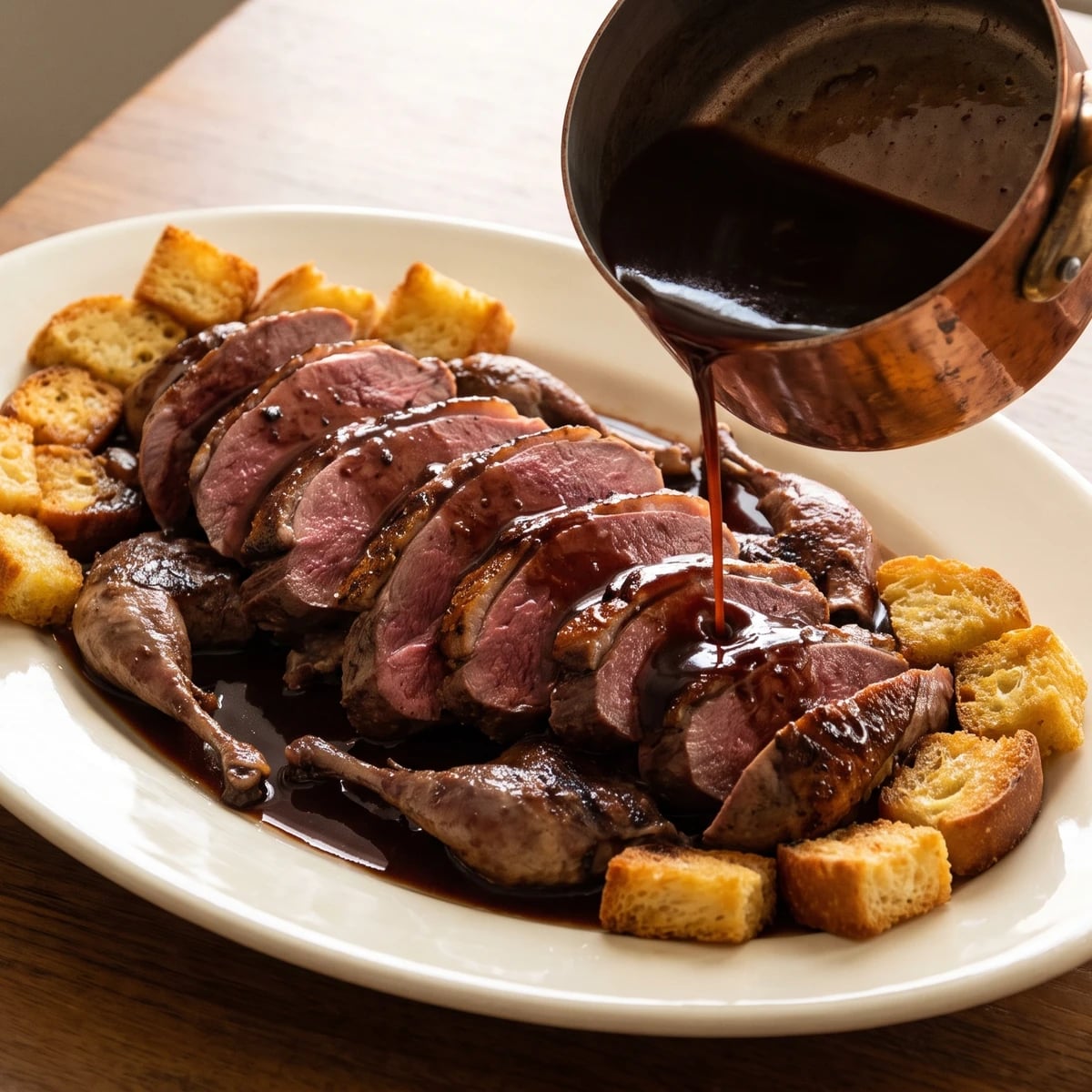
Roast woodcock underdone, carve it cleanly, and fold its intestines into a wine-dark carcass reduction. This is salmis at full strength, rich, exacting, and meant to move straight from stove to table.
Salmis de bécasse (woodcock in a reduced game sauce) teaches one uncompromising principle: the bird must remain rosy while its carcass gives everything to the sauce. This is not a method for disguising yesterday's roast. The woodcock is deliberately roasted underdone, carved while supple, then warmed only long enough to meet its dark, glossy sauce.
The original formula assumed a saucier on staff, game stock never off the fire, and a salamander waiting to heat the serving dish. Here, strong unsalted brown poultry stock is fortified with the freshly chopped carcasses, one saucepan replaces the separate sauce station, and a gently warmed platter does the salamander's work. I have scaled the brigade preparation to four birds and one cook. Those arrangements were scaffolding. The underdone roasting, the intestines worked into the sauce, and the swift final service are the dish, and they stay.
When it lands correctly, each small joint is tender and rosy beneath a wine-dark glaze, with the faint mineral depth that belongs only to woodcock. Have every sauce ingredient measured before the birds enter the oven. The carving and carcass reduction must move without delay, because guarding the meat from a second cooking is the one step that decides the salmis.
Salmis belongs to French hunting tables, particularly those of Sologne, Gascony, and the wooded Atlantic regions where bécasse is pursued, before passing into the classical dining rooms of Paris. Contrary to the common idea that salmis revives leftover roast game, the bird is intentionally roasted only partway so it can finish gently in its sauce without drying. Woodcock holds a singular place in this family because its carefully retained intestines enrich the sauce, giving the preparation its unmistakable depth.
Quantity
4 birds (8 to 10 oz / 225 to 280 g each)
plucked, undrawn, cold-handled, and lawfully obtained
Quantity
Reserved from the 4 birds
kept cold and separate
Quantity
8 tablespoons (120 ml / 113 g)
divided, with 2 tablespoons chilled for finishing
Quantity
1½ teaspoons (7.5 ml / 9 g)
divided
Quantity
¾ teaspoon (4 ml / 2 g)
divided
Quantity
3 (about ½ cup / 90 g)
finely sliced
Quantity
1 (about ⅓ cup / 50 g)
finely diced
Quantity
½ stalk (about ¼ cup / 30 g)
finely diced
Quantity
1 tablespoon (15 ml / 8 g)
Quantity
1½ cups (360 ml / 360 g)
Quantity
2 cups (475 ml / 480 g)
Quantity
1
thyme, parsley stems, and bay leaf
Quantity
8 slices (about 4 oz / 120 g)
| Ingredient | Quantity |
|---|---|
| whole woodcockplucked, undrawn, cold-handled, and lawfully obtained | 4 birds (8 to 10 oz / 225 to 280 g each) |
| usable woodcock livers, hearts, and intestineskept cold and separate | Reserved from the 4 birds |
| unsalted butterdivided, with 2 tablespoons chilled for finishing | 8 tablespoons (120 ml / 113 g) |
| fine sea saltdivided | 1½ teaspoons (7.5 ml / 9 g) |
| freshly ground black pepperdivided | ¾ teaspoon (4 ml / 2 g) |
| small shallotsfinely sliced | 3 (about ½ cup / 90 g) |
| small carrotfinely diced | 1 (about ⅓ cup / 50 g) |
| celery stalkfinely diced | ½ stalk (about ¼ cup / 30 g) |
| plain flour | 1 tablespoon (15 ml / 8 g) |
| dry red wine | 1½ cups (360 ml / 360 g) |
| strong unsalted brown poultry or game stock | 2 cups (475 ml / 480 g) |
| bouquet garnithyme, parsley stems, and bay leaf | 1 |
| thin baguette slices | 8 slices (about 4 oz / 120 g) |
Heat the oven to 450°F (230°C). Working on one bird at a time, open the cavity carefully and remove the viscera without puncturing them. Separate the liver, heart, and slender intestinal tract from the muscular gizzard, keeping only clean, intact organs that an experienced hunter or game processor has identified as suitable for consumption. If an organ has ruptured, smells sour, or was not kept properly cold, discard the viscera. Do not guess. Keep the usable organs covered below 40°F (4°C), wipe the cavities with paper, and inspect every bird carefully for shot.
Rub the birds with 2 tablespoons (30 ml / 28 g) of the butter, then season inside and out with most of the salt and pepper. Arrange them breast-up in a snug ovenproof skillet and roast for 10 to 14 minutes, basting once with the browned butter, until the skin is burnished and the deepest part of each breast reaches 151°F (66°C). Rest the birds for at least 3 minutes while keeping them at or above that temperature. This is underdone in the classical sense, rosy and yielding rather than raw. For pregnant, elderly, immunocompromised, or otherwise vulnerable guests, cook the birds to 165°F (74°C). Do not roast by the clock alone; overcooked woodcock cannot be rescued.
Transfer the birds to a board, leaving every drop of roasting fat and fond in the skillet. Remove the legs cleanly at the hip, then take each breast half from the keelbone with a narrow knife. Place the joints on a plate and cover them loosely so their crust does not soften. Chop the necks, wing tips, skin trimmings, and carcasses into small pieces with poultry shears. The meat now waits for the sauce, but it must not sit in a hot oven and continue cooking.
Set the roasting skillet over medium-high heat and add 2 tablespoons (30 ml / 28 g) butter. Add the chopped carcasses and brown them deeply for 6 to 8 minutes, turning until the bones and trimmings smell roasted rather than merely warm. Add the shallots, carrot, and celery, then cook for 4 minutes. Sprinkle over the flour and stir for 2 minutes, letting this small roux turn hazelnut-brown. It gives the sauce body without making it heavy.
Pour in the wine by thirds, scraping the skillet floor thoroughly after each addition so every dark speck of fond dissolves. Boil until the wine has reduced to about ½ cup (120 ml / 120 g), then add the stock and bouquet garni. Hold the sauce at a lively but controlled simmer for 20 minutes, pressing the carcasses beneath the liquid occasionally. Strain it through a fine sieve into a small saucepan, pressing firmly on the solids, then skim the surface and reduce to about 1¼ cups (300 ml / 300 g). It should nap the back of a spoon. If it tightens too far, loosen it with a spoonful of stock; if it runs like broth, reduce it further.
While the carcasses simmer, melt 2 tablespoons (30 ml / 28 g) butter in a clean skillet over medium heat. Fry the baguette slices until crisp and evenly golden on both sides, then season them lightly with salt. Hold the croûtons uncovered. Covering them traps moisture and steals the crisp edge the sauce needs beside it.
Mince the chilled liver, heart, and usable intestines repeatedly until they form a fine paste. Whisk several spoonfuls of the hot sauce into this paste, then return the mixture to the saucepan. Bring it to a controlled simmer and cook for at least 2 minutes, ensuring it reaches 165°F (74°C), then pass the sauce through the fine sieve once more. Take it off the heat and whisk in the remaining 2 tablespoons (30 ml / 28 g) chilled butter, a small piece at a time. If the sauce looks grainy, strain it while hot. If the butter separates, whisk in 1 tablespoon (15 ml / 15 g) cold stock off the heat, then add the butter again gradually. Ça se rattrape.
Warm an oval serving platter in a low oven, then bring the sauce just below a simmer. Add the carved breasts and legs in one layer and turn them gently for 60 to 90 seconds, only until warmed through. Never let them boil in the sauce; the meat will tighten and the finished emulsion may split. Arrange the joints immediately on the warm platter, spoon over enough sauce to glaze them generously, and set the croûtons around the edge. Carry the remaining sauce separately and serve at once. À table!
1 serving (about 250g)
Culinary guides, cultural storytelling, and the editorial depth that makes cooking meaningful.
Discover Culinary Explorer
Chef Juliette
John Dory has the delicacy of sole and the firmness of turbot. A light flouring, a quick butter sauté, and nut-brown beurre noisette show exactly why looks never mattered.

Chef Juliette
Fresh haddock proves its delicacy in the meunière pan: a fine flour crust, moist pearly flakes, and beurre noisette sharpened with lemon and parsley, ready from one skillet in half an hour.

Chef Juliette
Éperlans à l’Anglaise turns small fish into a lesson in disciplined coating: boned smelts under a close, crisp crumb, pan-fried in clarified butter and finished with bright, half-melted maître d’hôtel butter.

Chef Juliette
Tiny smelts, shallot, mushrooms, white wine, gratin sauce, and fine bread raspings meet a fierce oven, where the fish must turn tender in the same breath the buttered crust bronzes.