Culinary Explorer

A cooking platform built around craft, culture, and the stories behind what we eat.
Discover Culinary Explorer
Salmis de Faisan

Salmis de Faisan

Created by Chef Juliette

Based on No. 1847, Salmis de Faisan, from Le Guide Culinaire (1907) by Auguste Escoffier

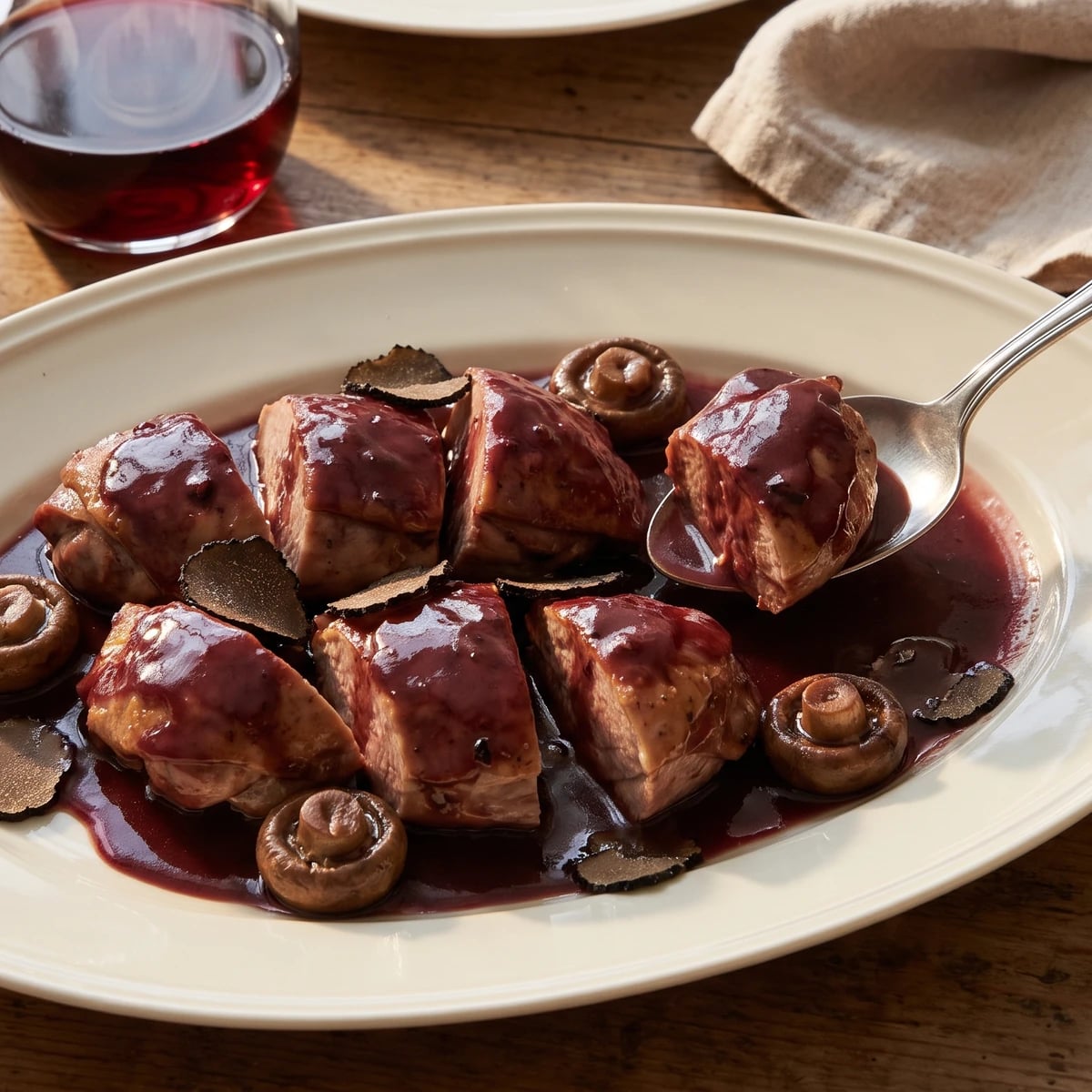
Salmis de Faisan makes one bird build its own sauce: roast it deliberately underdone, crush the carcass into reduced wine and game Espagnole, then finish the pieces once, glossy, hot, and fragrant with truffle.

Main Dishes
French
Dinner Party
Special Occasion
Holiday
35 min
Active Time
1 hr 5 min cook1 hr 40 min total
Yield4 servings

Salmis de Faisan (pheasant finished in a sauce drawn from its own carcass) teaches the most exact lesson in game cookery: the first roasting must stop early. Cook the bird through before making the sauce and the final warming becomes reheating, which is how pheasant turns dry and salmis earned an undeserved reputation as a treatment for leftovers. Roast deliberately underdone, then let the meat finish once in its own concentrated sauce.

The grand kitchen assumed a saucier at the next burner, a game stockpot never off the fire, and a salamander waiting to gratinate elaborate forcemeat-coated croûtons. This preparation itself rejects the bread cushion and its decoration. They were service scaffolding, not the dish. At home, you need one large pheasant for four diners, a small quantity of finished game Espagnole and meat glaze, one saucepan, and a fine sieve. One cook, one stove, one evening.

When it is right, the sauce is wine-dark and glossy, clinging closely rather than flooding the platter, with black truffle and six buttered mushroom caps tucked among the eight pieces. Move quickly once the bird leaves the oven, but don't let the pace frighten you. The one step that matters most is pulling the pheasant while it is still moderately underdone; everything afterward exists to finish it without stealing its moisture.

Salmis belongs to the French game table and the Parisian classical kitchen, where birds from hunting estates were portioned and sauced for immediate service. It traveled from the hunting-house table into the grand repertoire as a planned second cooking: the pheasant was roasted underdone, while its carcass and trimmings built the sauce that would finish the meat. Salmis is neither a casual use for a cold leftover nor specifically Burgundian because red wine appears; the name belongs to the method.

The technique, the tradition, and the story behind every dish.

Discover Culinary Explorer

Ingredients

whole pheasant

Quantity

1, about 2½ to 3 pounds (1.1 to 1.4 kg)

neck and giblets retained if supplied

fine sea salt

Quantity

1 teaspoon (5 ml / 6 g)

unsalted butter

Quantity

1 tablespoon (15 ml / 14 g)

softened, for roasting

dry red wine

Quantity

½ bottle (1½ cups / 375 ml / 375 g)

medium shallots

Quantity

3 (about ½ cup / 120 ml / 90 g)

chopped

mignonette

Quantity

½ teaspoon (2.5 ml / 1 g)

coarsely crushed black pepper

Cognac or French brandy

Quantity

2 teaspoons (10 ml / 9 g)

clear meat glaze, glace de viande

Quantity

1 tablespoon (15 ml / 18 g)

melted

good game Espagnole sauce

Quantity

A generous ½ cup (140 ml / 145 g)

finished and ready to use

small button mushroom caps

Quantity

6 (about 3 ounces / 85 g)

trimmed and grooved

unsalted butter

Quantity

2 teaspoons (10 ml / 9 g)

for the mushrooms

small black truffle

Quantity

1 (about ¾ ounce / 20 g)

thinly sliced

cold unsalted butter

Quantity

1½ tablespoons (22 ml / 21 g)

diced, for finishing

Gratins (optional)

Quantity

Not required; Gratins (No. 268) belongs only to the discarded croûton garnish

Equipment Needed

  • Heavy roasting pan or ovenproof skillet
  • 2 to 3-quart saucepan
  • Poultry shears and sharp carving knife
  • Sturdy pestle or small heavy pan for crushing the carcass
  • Fine-mesh sieve and heatproof bowl
  • Instant-read thermometer
  • Covered shallow sauté pan or heatproof serving dish

Instructions

  1. 1

    Set the service

    Heat the oven to 450°F (230°C) with a rack in the centre. Have a covered shallow sauté pan or heatproof serving dish ready, and set a fine-mesh sieve over a bowl. Leave Gratins (No. 268), the fried bread cushion, and the forcemeat-coated croûtons out. The canonical preparation discards them because they delay service; the carcass sauce is the dish, while the bread architecture was brigade scaffolding.

    A salmis waits for no garnish. Arrange the tools before roasting so the bird can be carved and sauced without a long pause.
  2. 2

    Roast moderately underdone

    Pat the pheasant completely dry, season it with the salt, and rub the softened butter over the breast and legs. Roast breast-side up until richly bronzed and deliberately underdone, about 22 to 30 minutes depending on the bird. An instant-read thermometer should show 136 to 140°F (58 to 60°C) in the breast and about 145°F (63°C) at the inner thigh. This is the principle that decides the dish: the pheasant must still have cooking left for the sauce. If the breast reaches 150°F (65°C), remove and carve it immediately rather than giving it a customary rest. Ça se rattrape, provided you stop the heat now. As soon as the bird enters the oven, combine the red wine, chopped shallots, and mignonette in the saucepan. Boil briskly until reduced to about 1 cup (240 ml), then hold it at a low simmer until the carcass is ready.

  3. 3

    Cut eight pieces

    Rest the pheasant for only 3 minutes. Remove the two legs, then the two wings, separating and reserving the pinions with the carcass. Lift both breasts from the bone and cut each lengthwise into two neat pieces, giving eight portions in all. Pull away the skin, trim the pieces neatly, and save every bone, scrap, pinion, skin, and roasting juice for the sauce. Place the meat in the covered shallow pan. Warm the Cognac in a very small saucepan, remove it from the heat and away from the bottle, then ignite it with a long match and let the flame die. If an open flame is impractical, boil the Cognac hard for 30 seconds. Spoon this burnt brandy and the melted meat glaze over the pheasant, cover, and hold in an oven reduced to 170°F (75°C) for no more than 15 minutes.

  4. 4

    Pound the carcass

    Cut the warm carcass into manageable pieces with poultry shears. Add the reserved skin, pinions, trimmings, neck, heart, gizzard, and roasting juices, but reserve the liver for another use because it can make the sauce muddy. Crush the joints firmly with a pestle or the flat bottom of a heavy pan. Crack them open without pulverising them; a home food processor is not made for bones. Add everything to the partially reduced wine. Boil hard, pressing the carcass down occasionally, until the wine has almost disappeared and only 2 to 3 tablespoons (30 to 45 ml) of dark syrup remain. Watch the final minute closely. If the reduction begins catching at the edge, pull it from the heat and stir in a spoonful of hot water before it scorches. Ça se rattrape before the wine turns black, never afterward.

  5. 5

    Add the Espagnole

    Stir the finished game Espagnole sauce into the crushed carcass and reduced wine. Bring it to a bare simmer and cook for exactly 10 minutes, pressing and turning the bones several times so the sauce extracts their roasted flavour without boiling itself dull. While the sauce simmers, melt the butter for the mushrooms in a small pan. Sauté the six grooved caps over medium heat until tender and lightly gilded, about 4 minutes, then keep them warm. Slice the truffle as thinly as the knife allows, but do not cook it yet.

  6. 6

    Press and finish

    Tip the carcass mixture into the sieve and press firmly with the back of a ladle until the bones and shallots are nearly dry. Note the quantity of strained sauce, return it to a clean saucepan, and reduce it briskly until roughly one-third of that volume remains. Dépouiller, meaning skim away the foam and excess surface fat, as it reduces. Pass the concentrated sauce through the finest sieve once more. Take the pan off the heat and monter au beurre, finish by whisking in the cold diced butter one piece at a time, until the sauce is glossy and coats the back of a spoon. If it has tightened beyond pouring, loosen it with hot water a teaspoon at a time. If the butter leaves an oily rim, whisk in a teaspoon of cold water away from the heat. Ça se rattrape.

  7. 7

    Finish only once

    Arrange the sliced truffle and six buttered mushroom caps among the pheasant pieces, then pour the sauce over everything. Cover and warm over the lowest heat, turning each piece once, until the thickest portions reach 165°F (74°C), about 3 to 6 minutes. The sauce should barely quiver and must not boil. If the breast pieces reach temperature first, lift them onto the warm platter while the legs finish. Bring the salmis to the table immediately, with the sauce gleaming over the meat rather than pooled in excess. This is one roast and one deliberate finish, never a reheated leftover. À table!

Chef Tips

  • The source asks for pheasant that is somewhat high, meaning properly matured or hung by a knowledgeable game dealer, not a bird left aging in an uncertain home refrigerator. It should smell deep and gamey, never sour, sticky, or ammoniacal.
  • Have the game Espagnole and meat glaze ready before the pheasant meets the oven. A good frozen homemade supply is ideal; a properly made game demi-glace loosened to sauce consistency is the honest home equivalent. Thin stock or canned gravy cannot carry this preparation.
  • Fresh black truffle gives the fullest perfume. Outside its season, use a small whole preserved black truffle, drained and sliced, and accept that its aroma will be quieter. An honest preserved ingredient is better than a tired fresh one.
  • Use a dry, supple red wine with acidity rather than heavy tannin. Pinot Noir or Gamay works in the pan and at the table, where the same bottle meets the pheasant without bullying it.
  • Serve with purée de pommes de terre or plain buttered noodles to catch the concentrated sauce. Nothing needs stacking, moulding, or arranging on fried bread. Cooking well is not cooking fancy.

Advance Preparation

  • Prepare or obtain the game Espagnole and clear meat glaze in advance. Both keep for several days in the refrigerator and freeze well in small measured portions.
  • The shallots may be chopped and the mushroom caps trimmed and grooved up to 4 hours ahead. Keep both covered and refrigerated; slice the truffle only shortly before it enters the dish.
  • Do not roast the pheasant ahead. Salmis depends on moving directly from the deliberately underdone roast to the final warming in sauce, and a chilled cooked bird changes the preparation into the very leftover treatment this method corrects.

Frequently Asked Questions

Nutrition Information

1 serving (about 230g)

Calories
470 calories
Total Fat
28 g
Saturated Fat
11 g
Trans Fat
0 g
Unsaturated Fat
15 g
Cholesterol
155 mg
Sodium
880 mg
Total Carbohydrates
7 g
Dietary Fiber
1 g
Sugars
3 g
Protein
47 g

Note: Chef personas and recipes are created with AI assistance. Cook with care: follow safe food-handling practices, check doneness with a thermometer when needed, and adapt for allergies and your kitchen.

Where cooking meets culture.

Culinary guides, cultural storytelling, and the editorial depth that makes cooking meaningful.

Discover Culinary Explorer

More from Poultry (Volaille) - Venison and Ground Game

Browse the full collection