
Chef Juliette
John Dory (St. Pierre)
John Dory has the delicacy of sole and the firmness of turbot. A light flouring, a quick butter sauté, and nut-brown beurre noisette show exactly why looks never mattered.
A cooking platform built around craft, culture, and the stories behind what we eat.
Created by Chef Juliette
Based on No. 1840, Faisan Kotschoubey, from Le Guide Culinaire (1907) by Auguste Escoffier
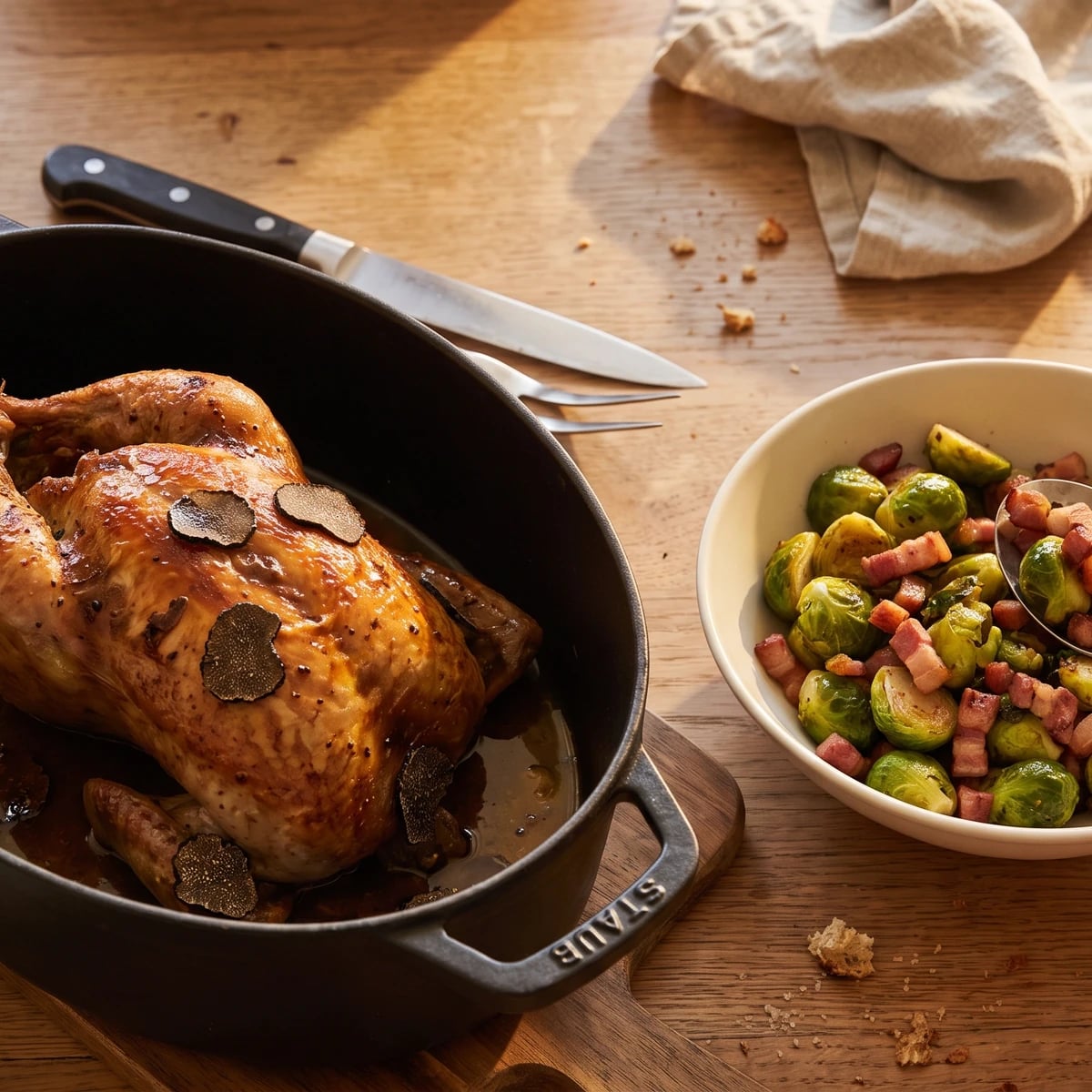
Pheasant cooked en casserole, raw truffle, and clear game glaze share the pot, while frizzled bacon and Brussels sprouts arrive apart: a grand composition brought within reach of one attentive home cook.
Faisan Kotschoubey (pheasant cooked in butter in its covered serving casserole, with truffle and game glaze) teaches coordination. The bird must finish juicy at the same moment the separate bacon-and-sprout garnish finishes its slow butter stew; if you make the pheasant wait for the vegetables, its lean breast pays the bill. The one true thing to know before touching a pan is this: begin cooking the sprouts when the bird has about forty minutes left, so their thirty-minute stew meets the pheasant at the table.
The original assumed the apparatus and staff behind Poëlings (No. 250), a saucier with excellent game glaze standing ready, a stockpot never off the fire, and another pair of hands to manage Blanchings (No. 273). At home, a heavy lidded cocotte replaces the dedicated earthenware vessel, a small quantity of prepared glaze replaces the permanent stockpot, and one wide skillet carries the garnish. The only things cut are separate hands and hot-holding, which were brigade scaffolding rather than the dish.
The source formula already centers on one pheasant, so scaling is honest rather than theatrical: a large bird serves four, while the two ounces of truffle, four ounces of bacon, pound of sprouts, and two ounces of butter for their stew remain untouched. Those proportions, the final short cooking with truffle, and the separate garnish are the dish and must stay. Watch the pheasant closely as it approaches doneness; that nearly-done moment is where the glaze and truffle belong.
Faisan Kotschoubey belongs to the Parisian grand-kitchen repertory, not to a French regional larder, and its title follows the habit of naming composed dishes for prominent patrons. Kotschoubey is the French rendering of the Kochubey family name, while the dish itself speaks entirely in French technique: game en casserole, black truffle, concentrated glaze, and a garnish served apart. Its path to the home table runs from codified service downward, and the substantial Brussels-sprout garnish corrects the notion that such named dishes were all decoration and no supper.
Quantity
about ½ cup loosely packed thin slices (120 ml / 57 g)
sliced at the last moment
Quantity
3 tablespoons (45 ml / 45 g)
Quantity
1 tablespoon (15 ml / 14 g)
diced for monter au beurre
Quantity
about ⅔ cup (160 ml / 113 g), prepared by Blanchings (No. 273)
cut into ½-inch (1.25 cm) dice
Quantity
1 tablespoon (15 ml / 14 g)
for frizzling the bacon
Quantity
about 4 cups whole (950 ml / 454 g), freshly cooked by Blanchings (No. 273)
well drained, left uncooled, and roughly chopped
Quantity
¼ cup (60 ml / 57 g)
for stewing the garnish
Quantity
¼ teaspoon (1.25 ml / 0.6 g)
Quantity
⅛ teaspoon (0.6 ml / 0.25 g)
| Ingredient | Quantity |
|---|---|
| oven-ready pheasantcooked en casserole | 1, 2½ to 3 lb (1.1 to 1.4 kg), for Poëlings (No. 250) |
| fresh raw black trufflesliced at the last moment | about ½ cup loosely packed thin slices (120 ml / 57 g) |
| excellent clear game glaze | 3 tablespoons (45 ml / 45 g) |
| cold unsalted butterdiced for monter au beurre | 1 tablespoon (15 ml / 14 g) |
| fresh breast of bacon, such as unsmoked slab bacon or lightly salted pork bellycut into ½-inch (1.25 cm) dice | about ⅔ cup (160 ml / 113 g), prepared by Blanchings (No. 273) |
| unsalted butterfor frizzling the bacon | 1 tablespoon (15 ml / 14 g) |
| Brussels sproutswell drained, left uncooled, and roughly chopped | about 4 cups whole (950 ml / 454 g), freshly cooked by Blanchings (No. 273) |
| unsalted butterfor stewing the garnish | ¼ cup (60 ml / 57 g) |
| freshly ground black pepper | ¼ teaspoon (1.25 ml / 0.6 g) |
| freshly grated nutmeg | ⅛ teaspoon (0.6 ml / 0.25 g) |
Have the bacon completed through Blanchings (No. 273), cooled, and cut into ½-inch (1.25 cm) dice. Trim the Brussels sprouts but leave them uncooked, keep the truffle whole and cold, and have the game glaze ready beside the stove. Do not slice the truffle yet; exposed slices surrender their perfume quickly.
Heat the oven to 350°F (180°C). Season and cook the pheasant en casserole according to Poëlings (No. 250), using a heavy 4-quart (3.8-liter) lidded cocotte as the home equivalent of the dedicated earthenware vessel. Begin checking the thickest part of the breast after about 35 minutes. When it reaches 155°F (68°C), the bird is nearly done and ready for its truffle and glaze; do not carry it to full doneness before that final addition.
About 10 minutes after the pheasant enters the oven, freshly cook the Brussels sprouts through Blanchings (No. 273). Drain them thoroughly without cooling, shake away every clinging drop, and chop them roughly while still hot. This state matters: cold sprouts would halt the butter stew, while wet ones would boil in it.
Melt the tablespoon of butter in a wide skillet over medium heat. Add the diced bacon prepared by Blanchings (No. 273) and fry until properly frizzled, with curled edges and a light bronze color. Add the hot chopped sprouts, the full ¼ cup (60 ml / 57 g) butter, pepper, and nutmeg. Toss, cover, and stew over the gentlest heat for 30 minutes, stirring two or three times. If liquid pools beneath the sprouts, uncover and let it evaporate before lowering the heat again. Ça se rattrape. The finished garnish should be tender, buttery, and moist without being watery.
When the pheasant cooking through Poëlings (No. 250) reaches the nearly-done stage, warm the game glaze in a small saucepan only until fluid. Take it off the heat and monter au beurre, finish it by swirling in the cold diced butter a piece at a time, until the glaze is clear, glossy, and well buttered. If it turns oily, whisk in 1 teaspoon (5 ml / 5 g) cold water off the heat, then resume with the remaining butter. Slice the truffle thinly, add all of it to the cocotte with the glaze, and spoon the glaze around the bird. Cover and return to the oven for 5 to 10 minutes, just until the thickest breast reaches 165°F (74°C) and the thigh reaches at least 170°F (77°C).
Lift the pheasant to a warm board and rest it loosely covered for 10 minutes. Keep the truffle glaze in the cocotte over the lowest heat, without boiling. If it tightens too far, loosen it with a teaspoonful of hot water; if an obvious layer of grease gathers, spoon off only the excess and leave the butter gloss intact. If the pheasant reached temperature before the garnish was ready, resting is the rescue. Never hold the bird in a hot oven while the vegetables catch up.
Return the whole pheasant to its cocotte or carve it into four portions, then spoon the truffle slices and clear game glaze over the meat. Transfer the bacon and Brussels-sprout garnish to a warmed serving dish and bring it separately, exactly as the composition intends. Each guest takes the buttery garnish beside the lean game and catches both with the glaze. À table!
1 serving (about 325g)
Culinary guides, cultural storytelling, and the editorial depth that makes cooking meaningful.
Discover Culinary Explorer
Chef Juliette
John Dory has the delicacy of sole and the firmness of turbot. A light flouring, a quick butter sauté, and nut-brown beurre noisette show exactly why looks never mattered.

Chef Juliette
Fresh haddock proves its delicacy in the meunière pan: a fine flour crust, moist pearly flakes, and beurre noisette sharpened with lemon and parsley, ready from one skillet in half an hour.

Chef Juliette
Éperlans à l’Anglaise turns small fish into a lesson in disciplined coating: boned smelts under a close, crisp crumb, pan-fried in clarified butter and finished with bright, half-melted maître d’hôtel butter.

Chef Juliette
Tiny smelts, shallot, mushrooms, white wine, gratin sauce, and fine bread raspings meet a fierce oven, where the fish must turn tender in the same breath the buttered crust bronzes.