Culinary Explorer
A cooking platform built around craft, culture, and the stories behind what we eat.
Hare and Leveret (Lièvre et Levraut)
Created by Chef Juliette
Young hare, browned deeply and braised gently in red wine, teaches the grammar of game cookery: age chooses the method, fond deepens the sauce, and a bare simmer protects the lean meat.
Lièvre et Levraut (hare and leveret) teaches the first law of game cookery: age chooses the method. A young hare can become tender over the course of an evening, its dark, lean flesh mellowed by wine, lardons, and a sauce built from its own browned bones. An old hare asks for another pot entirely, one devoted to soup, forcemeat, or fumet, a concentrated game essence. No amount of optimism changes the animal in front of you.
The old entry is a buying lesson rather than a fixed formula. It assumes the cook sees the hare fur-on, can judge its ear, and has a game stockpot never off the fire. Your honest equivalent is a dressed young hare from a reliable game dealer, jointed by the butcher, with its bones and liver returned to you. Those bones fortify ordinary stock into a small fumet while you prepare the garnish. A separate stock day and a saucier on staff are brigade scaffolding, so they can go. Careful jointing, deep browning, wine reduction, and gentle cooking must stay because they are the dish. One cook, one stove, one evening.
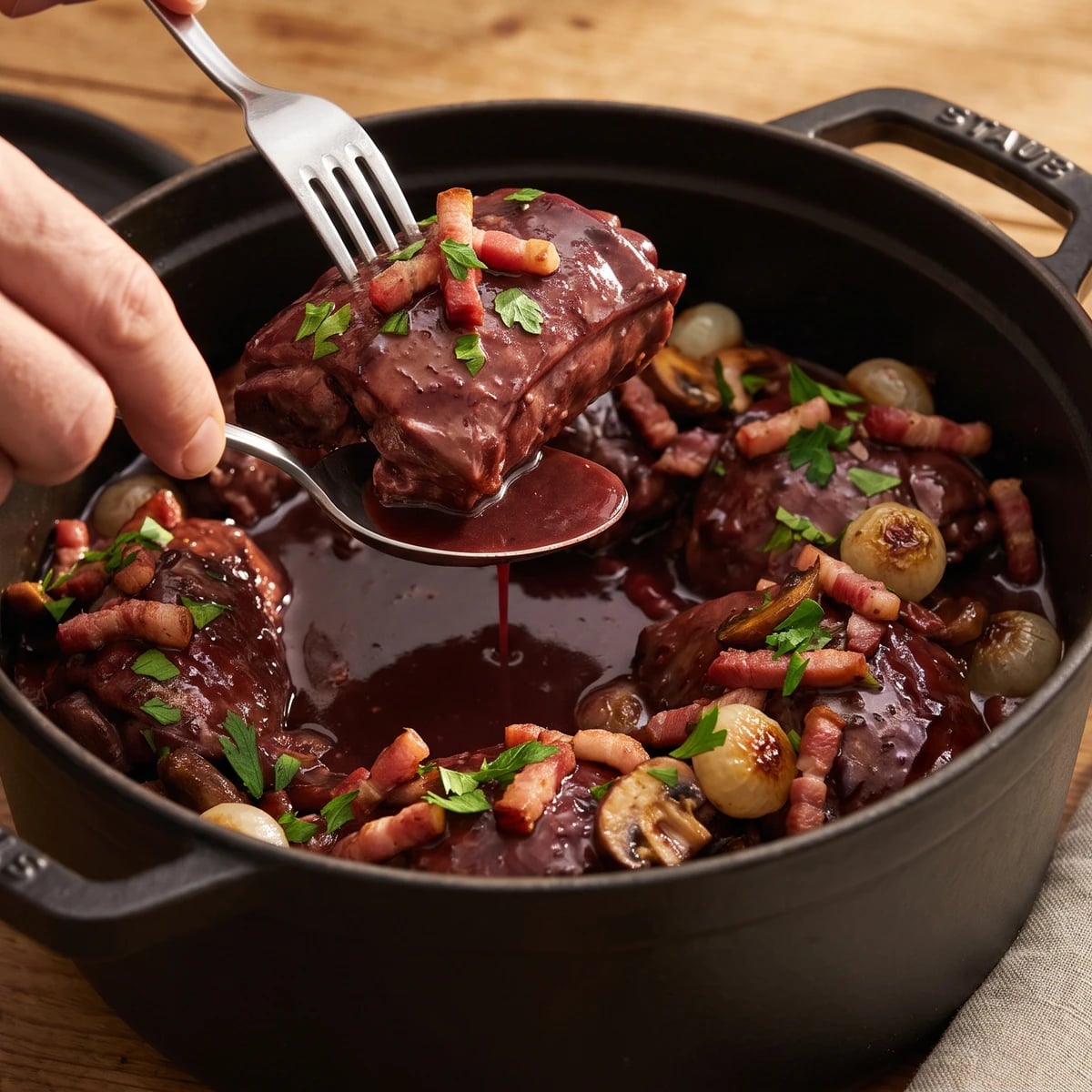
The finished hare should be dark and tender beneath a wine-deep sauce, with pearl onions, mushrooms, and lardons carrying the sweetness, earth, and salt that lean game needs. The bare simmer is the step that matters most: boil the pot and the saddle tightens before the legs surrender.
Ingredients
young dressed hare
Quantity
1 hare, 5 to 6 lb (2.3 to 2.7 kg)
jointed into forelegs, hind legs, and 4 saddle portions, with bones and heart reserved
hare liver
Quantity
1 liver, about 2 oz (55 g)
reserved from the animal; use 1 chicken liver if none is supplied
fine sea salt
Quantity
2 teaspoons (10 ml / 12 g), plus more to taste
| Ingredient | Quantity |
|---|---|
| young dressed harejointed into forelegs, hind legs, and 4 saddle portions, with bones and heart reserved | 1 hare, 5 to 6 lb (2.3 to 2.7 kg) |
| hare liverreserved from the animal; use 1 chicken liver if none is supplied | 1 liver, about 2 oz (55 g) |
| fine sea salt | 2 teaspoons (10 ml / 12 g), plus more to taste |
Where cooking meets culture.
Culinary guides, cultural storytelling, and the editorial depth that makes cooking meaningful.
Discover Culinary Explorer