
Chef Juliette
Ordinary or White Consommé
Beef shin, lean beef, and fowl begin in cold water and rise slowly toward a tremble. Skim before the boil, and you learn the quiet discipline that gives every clear French broth its backbone.
A cooking platform built around craft, culture, and the stories behind what we eat.
Created by Chef Juliette
Based on No. 175, Clarified Butter, from Le Guide Culinaire (1907) by Auguste Escoffier
Beurre clarifié is butter taught to withstand heat: melt it gently, skim the foam, and decant the clear gold from the milk solids for searing, sautéing, and sauce work.
Beurre clarifié (clarified butter) teaches the first principle of butter work: butter contains fat, water, and milk solids, and each behaves differently over heat. Separate them gently and the clear fat can meet the hard heat that whole butter cannot. The one truth before you touch a pan is this: clarification is separation, not browning.
The brigade entry assumes a saucier, a saucepan resting at the side of the fire, and enough service to justify keeping a pound ready at all times. Your home equivalent is a 2-quart saucepan on the smallest burner, a dry spoon, and a sieve lined with muslin or cheesecloth. We keep the book's full pound because it fits an ordinary saucepan and makes a useful jar. Constant readiness is brigade scaffolding and can go; slow separation, careful skimming, and a clean decant are the dish and must stay. One cook, one stove, one evening.
Don't stir once the butter begins melting. Let the layers find their own places, foam above, clear gold in the middle, milky sediment below, then pour with a steady hand. If a little sediment follows, let the butter settle and pour it again. Ça se rattrape.
Beurre clarifié belongs to the working pantry of the French classical kitchen, especially the saucier and sauté stations, where butter flavor was wanted over heat that would burn whole butter. From there it passed naturally into cuisine bourgeoise for frying, basting, and holding ahead, because removing the water and milk solids makes butter steadier and longer-keeping. It is not beurre noisette: clarified butter remains clear and gently flavored, while beurre noisette deliberately browns the milk solids.
Quantity
2 cups (475 ml / 454 g)
cut into 8 pieces
| Ingredient | Quantity |
|---|---|
| unsalted buttercut into 8 pieces | 2 cups (475 ml / 454 g) |
Set a clean, completely dry heatproof jug beside the stove. Line a fine-mesh sieve with clean dry muslin or three layers of cheesecloth and place it over the jug. Water makes hot fat spit, so the pan, spoon, sieve, cloth, and storage jar must all be dry.
Put the butter in a heavy 2-quart saucepan, which gives it twice the room it occupies, and place it over the lowest heat. Let it melt undisturbed for 10 to 15 minutes. White foam will gather on top, clear golden fat will form beneath it, and pale milk solids will sink. The surface should foam quietly, not spit. Do not stir, because stirring sends the solids back through the fat just when they are trying to separate.
As the foam becomes thick enough to lift, skim it gently with a shallow spoon without disturbing the sediment below. Work around the surface rather than digging into the butter. You needn't chase every small white fleck, because the muslin will catch what remains. If you skim away some clear fat with the foam, let the skimmed portion settle in a small cup and return only its clear upper layer to the saucepan.
When the butter looks transparent and the bubbling has nearly stopped, remove the pan from the heat and leave it untouched for 5 to 10 minutes. The clear fat should sit distinctly above a milky layer and pale sediment. If the butter remains cloudy because the pan was jostled, rewarm it just until fully fluid and let it settle again. Ça se rattrape.
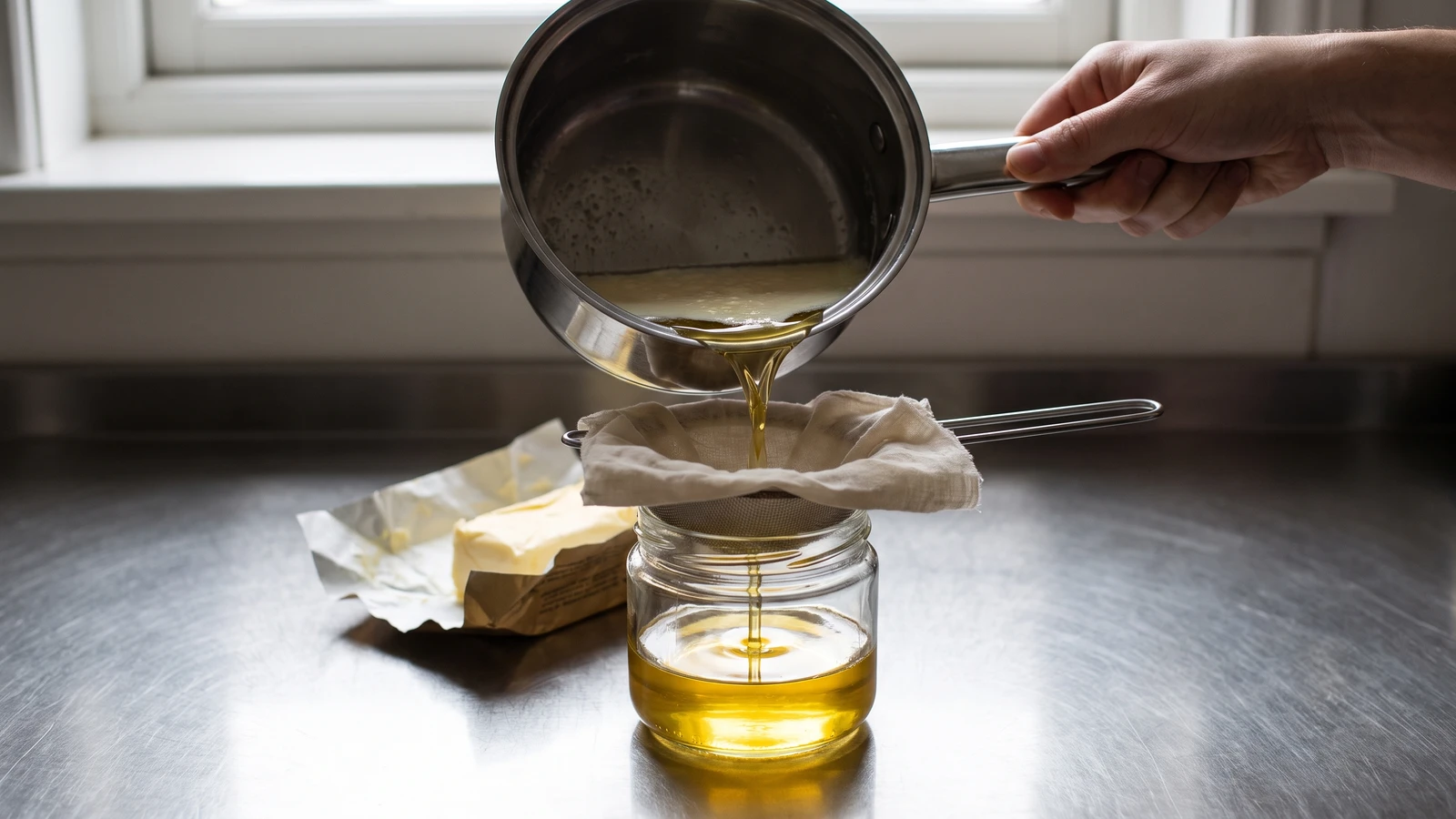
Pour the clear golden butter slowly through the muslin-lined sieve into the heatproof jug. Keep the saucepan tilted gently and stop as soon as the milky liquid approaches the lip; leave that final spoonful behind rather than muddying the whole batch. Do not press the cloth. If sediment slips through, let the strained butter settle for another 10 minutes and decant it through fresh dry muslin into a clean vessel.
Transfer the beurre clarifié to a clean, dry, room-temperature heatproof jar. Let it cool uncovered until it is only faintly warm, then seal and refrigerate. It will set opaque and pale gold in the cold, then turn clear again when melted. Use a clean dry spoon each time and keep it refrigerated for up to one month, or freeze it for up to six months.
1 serving (about 14g)
Culinary guides, cultural storytelling, and the editorial depth that makes cooking meaningful.
Discover Culinary ExplorerChef Juliette
Beef shin, lean beef, and fowl begin in cold water and rise slowly toward a tremble. Skim before the boil, and you learn the quiet discipline that gives every clear French broth its backbone.

Chef Juliette
Break the veal bones small, then give them eight hours at a bare tremble. This pale, gelatinous fond becomes the quiet foundation beneath velouté, blanquette, and every sauce that must stay light.

Chef Juliette
Sauce Orientale concentrates lobster-rich American Sauce with curry, then folds in cream away from the fire: a glossy, gently spiced derivative made for lobster, crayfish, and firm fish.

Chef Juliette
An old lesson in sauce families: Sauce Allemande takes mushroom liquor, then butter, lemon, and parsley, becoming a glossy Poulette for sheep's trotters, leeks, cauliflower, and anything needing gentle richness with a bright edge.