
Chef Juliette
Smelt (Éperlans)
Tiny éperlans, lightly floured and fried until their tails stand crisp, arrive in a generous heap on a napkin with fried parsley and grooved lemon, a weeknight lesson in heat and restraint.
A cooking platform built around craft, culture, and the stories behind what we eat.

Created by Chef Juliette
Based on No. 1739, Mousse de Foie Gras, from Le Guide Culinaire (1907) by Auguste Escoffier
Mousse de Foie Gras is the cold savoury mousse in its purest form: foie gras, a thickened base, gelatine, and half-whipped cream set to a cool, unctuous slice.
Mousse de Foie Gras (chilled foie gras mousse) teaches the grammar of every cold savoury mousse: a smooth thickened base, gelatine, and cream folded in before the mixture sets. The one true thing to know before touching a pan is this: whip the cream only halfway. Stiffly whipped cream makes the finished mousse dry and woolly; barely whipped cream leaves it cool, supple, and unctuous.
The original kitchen assumed a saucier with velouté always ready, a garde-manger, the cold-kitchen station, to clothe and decorate the mould, and a silver timbale held in broken ice through service. Here, one home-scale batch fills a 2-cup mould, a fine-mesh sieve replaces the tammy, and the refrigerator replaces the ice-encrusted timbale. The silver display and brigade quantity are scaffolding and can go. The thickened base, half-whipped cream, gelatine, and thin jelly clothing are the dish, so they stay.
When it is right, the mousse turns out with a clear, delicate gloss over a pale, perfectly smooth interior that yields softly to the knife. One cook, one stove, one evening, followed by a patient chill. Watch the cream before anything else: it must fall from the whisk in a soft fold, not stand at attention.
Although foie gras has deep and distinct homes in Alsace and Périgord, the moulded Mousse de Foie Gras belongs to the Parisian classical cold table, where large savoury mousses were prepared for several guests and presented beneath a fine coating of aspic. It is not simply whipped liver pâté, but a savoury bavarois whose lightness comes from a thickened base, gelatine, and barely whipped cream. From the grand cold buffet it passed naturally to the bourgeois dinner table, where a smaller mould preserved the technique without the ceremony of a brigade service.
Quantity
1 home-scale batch, about 2 cups (480 ml / 430 g), Préparation de la Mousse de Tomates (No. 814)
Prepare with 1 cup (240 ml / 225 g) smooth cooked foie gras replacing the tomato pulp; retain the linked preparation's method and proportions
Quantity
1 prepared 2-cup (480 ml) mould using Another Method of Preparing Aspics de Filets de Soles (No. 916)
Quantity
12 thin slices, about 8 ounces (225 g)
toasted for serving
| Ingredient | Quantity |
|---|---|
| Préparation de la Mousse de Tomates adapted with cooked foie grasPrepare with 1 cup (240 ml / 225 g) smooth cooked foie gras replacing the tomato pulp; retain the linked preparation's method and proportions | 1 home-scale batch, about 2 cups (480 ml / 430 g), Préparation de la Mousse de Tomates (No. 814) |
| chilled, jelly-clothed and decorated mould | 1 prepared 2-cup (480 ml) mould using Another Method of Preparing Aspics de Filets de Soles (No. 916) |
| brioche or pain de mietoasted for serving | 12 thin slices, about 8 ounces (225 g) |
Use Another Method of Preparing Aspics de Filets de Soles (No. 916) to clothe the chilled 2-cup mould with its thin, even film of savoury jelly and complete the restrained decoration. A bowl of ice water will hold the mould steady while you work, and the refrigerator takes over afterward. If the jelly runs down and gathers thickly at the bottom, it is too warm. Pour it back, chill the jelly and mould separately, then coat again. Ça se rattrape.
Prepare the foie gras variation of Préparation de la Mousse de Tomates (No. 814) exactly as its linked method directs, changing only the principal ingredient. When that preparation calls for cream, stop whipping while it still falls from the whisk in a soft, heavy ribbon and has no firm peaks. Fold it into the almost-cold base without beating out its air. If the cream has become too firm, fold in a spoonful reserved from the measured unwhipped cream to relax it. If it looks grainy or buttery, start the cream again; separated cream cannot give a silky mousse.
Spoon the finished Préparation de la Mousse de Tomates (No. 814), made with foie gras, into the mould clothed through Another Method of Preparing Aspics de Filets de Soles (No. 916). Add it in three portions, pressing each gently into the fluting and drawing a thin skewer around the sides to release trapped air without disturbing the jelly. Smooth the surface level. If the mousse begins to set before the mould is filled, stand its bowl briefly over barely warm water and fold only until it flows again; do not heat it.
Cover the mould without letting the wrapping touch the mousse and refrigerate it for at least 6 hours, preferably overnight. Leave it undisturbed and do not freeze it. The gelatine needs a slow, even chill to form a tender structure around the cream; freezing makes the mousse weep and turns its texture coarse when thawed.
Chill the serving platter, then loosen only the top rim with the point of a thin knife. Wrap the mould for 5 seconds in a towel dipped in warm water and wrung nearly dry, place the platter over it, and invert them together. Lift the mould straight upward. If it refuses to release, return the warm towel for another 2 seconds. Patience, not force; too much warmth melts the jelly coat before the centre lets go.
Let the unmoulded mousse stand outside the refrigerator for 10 minutes so the foie gras softens enough to show its full flavour while the mousse remains neatly set. Cut with a thin knife dipped in hot water and wiped dry between slices, or let guests spread it directly onto toasted brioche or pain de mie. Cooking well is not cooking fancy. À table!
1 serving (about 90g)
Culinary guides, cultural storytelling, and the editorial depth that makes cooking meaningful.
Discover Culinary ExplorerChef Juliette
Tiny éperlans, lightly floured and fried until their tails stand crisp, arrive in a generous heap on a napkin with fried parsley and grooved lemon, a weeknight lesson in heat and restraint.

Chef Juliette
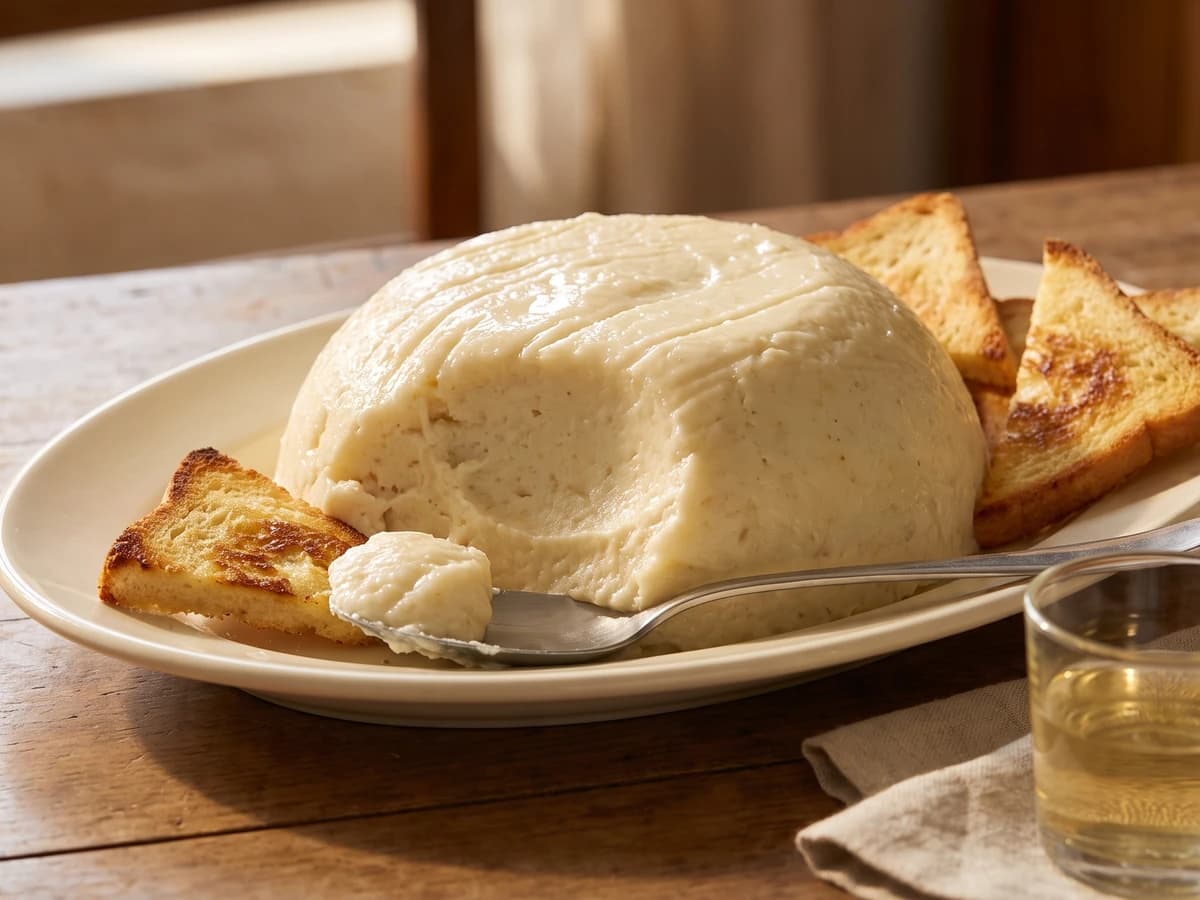
Brandade de Morue turns salt cod, warm olive oil, and milk into a pale, silky emulsion: keep everything warm and add the oil slowly, then crown the generous dome with butter-fried bread.
Chef Juliette
Salt cod worked warm with cream, one patient spoonful at a time, until the rough flakes become a glossy Nîmes paste, domed generously and ringed with butter-fried croutons for the table.

Chef Juliette
Wine-poached char packed in its earthenware crock beneath butter gold: a make-ahead first course that turns careful cooling, thorough boning, and one unbroken seal into quiet abundance.