Culinary Explorer
A cooking platform built around craft, culture, and the stories behind what we eat.
Game Glaze
Created by Chef Juliette
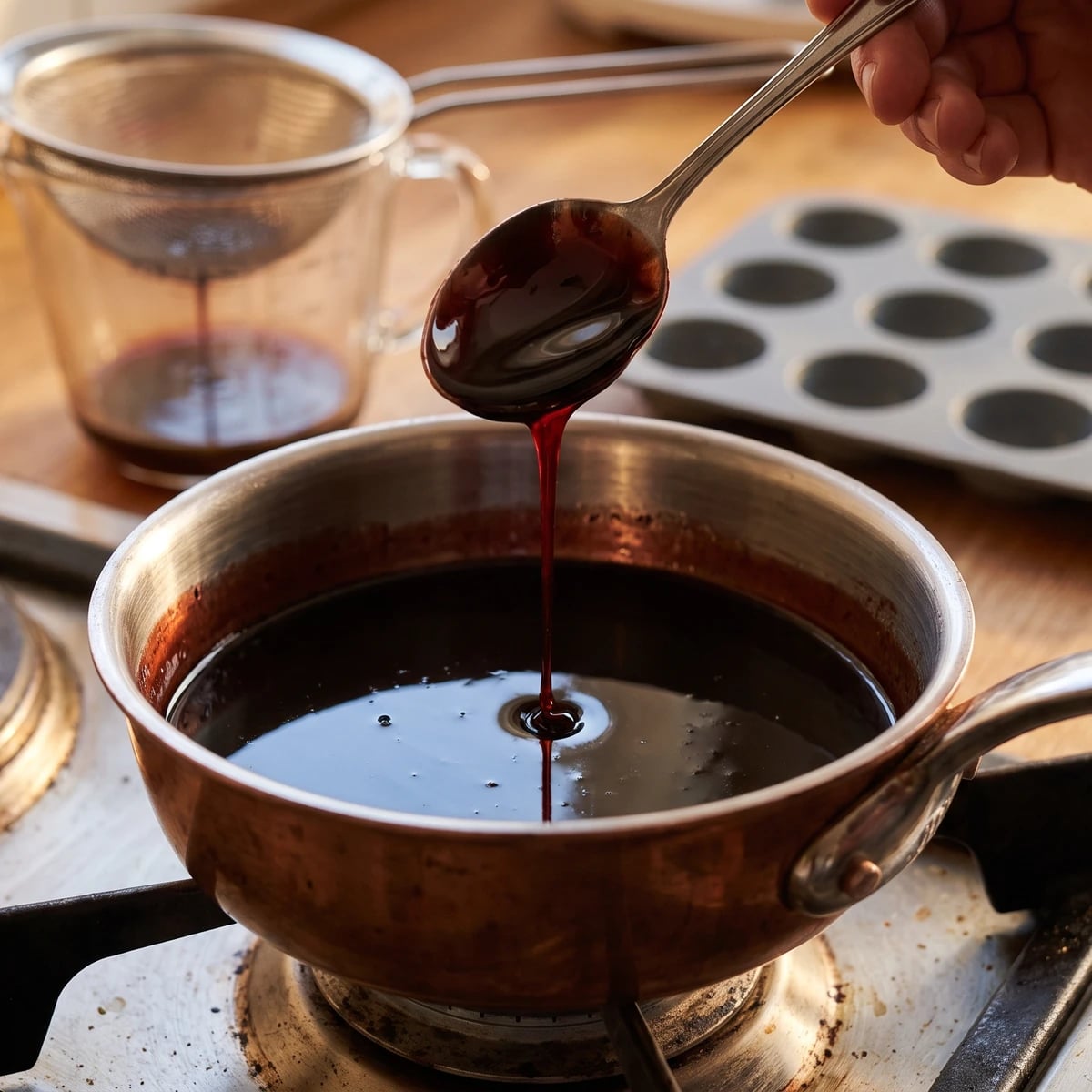
Glace de gibier takes one honest stock to its most concentrated expression: a dark, glossy spoonful that restores venison depth to a pan sauce, jus, or braise without changing its character.
Glace de gibier (game glaze) teaches the purest law of reduction: as water leaves, flavor, gelatin, and salt remain. The last of these matters before you touch a pan. Begin with unsalted Brown Game Stock (No. 8), because a pleasant stock can become punishingly salty long before it becomes a proper glaze.
The original method assumed a saucier watching an open fire, game stock never far from the stove, and a succession of smaller stewpans waiting as the volume fell. At home, two heavy saucepans and a fine sieve lined with damp muslin do the work. The brigade's battery of pans was volume-management scaffolding, so one transfer is enough for this small batch; the gradual lowering of the heat, the filtration at each transfer, and the final spoon test belong to the dish and must stay. This is the method of Meat Glaze (No. 15), applied faithfully to game stock for one cook, one stove, one evening.
The finished glace de gibier is dark mahogany, almost garnet at a thin edge, and glossy enough to veneer a spoon. Lower the heat as the liquid concentrates. That is the step that decides everything: a lively simmer builds the glaze at first, but the same flame will scorch it once only a cup remains.
Ingredients
Brown Game Stock, using the reduction method of Meat Glaze
Quantity
2 quarts (1.9 L / 1.9 kg) Brown Game Stock (No. 8), reduced by the method of Meat Glaze (No. 15)
cold and unsalted
hot water (optional)
Quantity
Up to ¼ cup (60 ml / 60 g)
only if needed to correct over-reduction
| Ingredient | Quantity |
|---|---|
| Brown Game Stock, using the reduction method of Meat Glazecold and unsalted | 2 quarts (1.9 L / 1.9 kg) Brown Game Stock (No. 8), reduced by the method of Meat Glaze (No. 15) |
| hot water (optional)only if needed to correct over-reduction | Up to ¼ cup (60 ml / 60 g) |
Where cooking meets culture.
Culinary guides, cultural storytelling, and the editorial depth that makes cooking meaningful.
Discover Culinary Explorer