Culinary Explorer

A cooking platform built around craft, culture, and the stories behind what we eat.
Discover Culinary Explorer
Poularde à la Lambertye

Poularde à la Lambertye

Created by Chef Juliette

Based on No. 1696, Poularde à la Lambertye, from Le Guide Culinaire (1907) by Auguste Escoffier

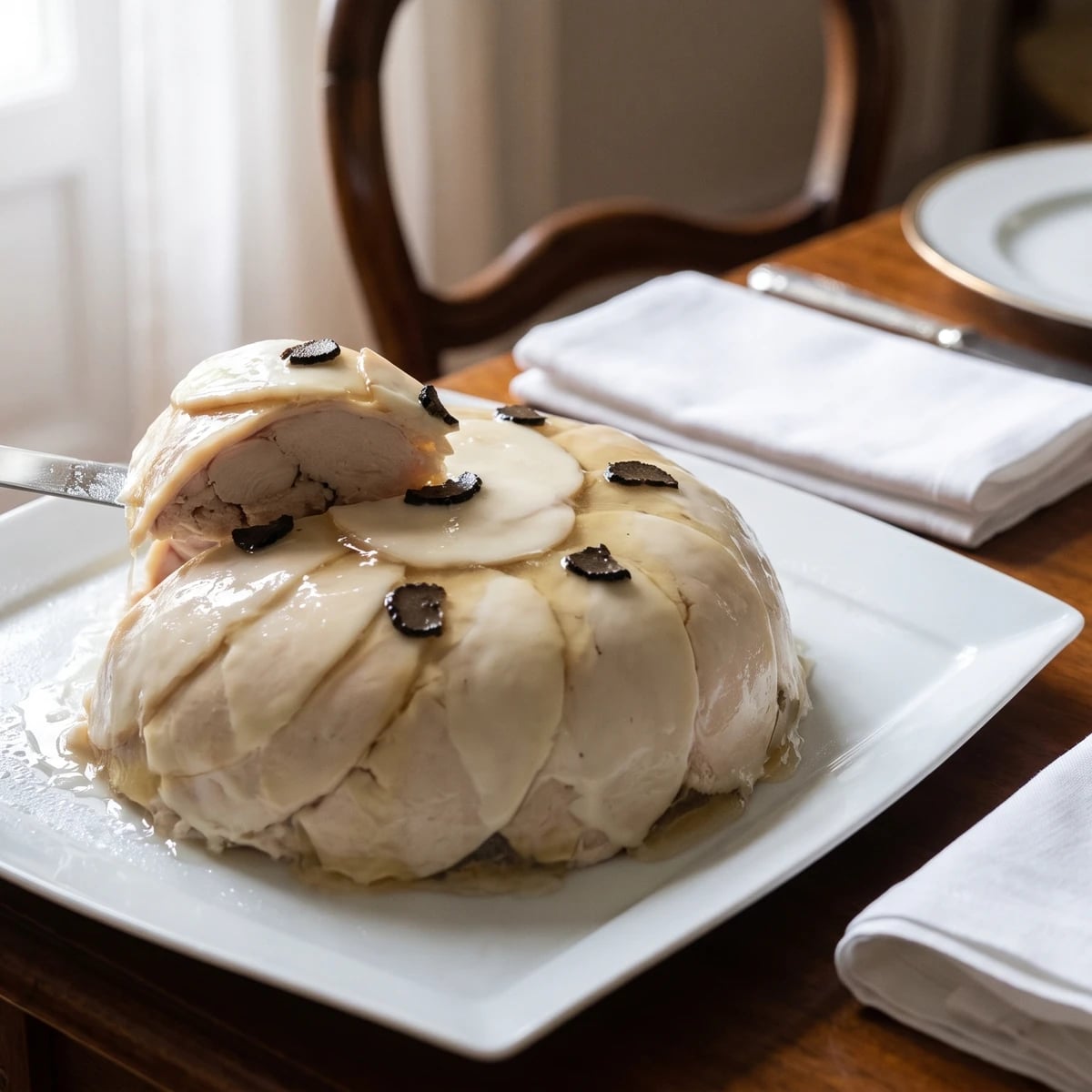
Poularde à la Lambertye turns cold poached chicken into an architectural lesson: foie gras mousse rebuilds the breast, glazed suprêmes restore its form, and truffle and clear jelly provide the final polish.

Main Dishes
French
Dinner Party
Special Occasion
2 hr 30 min
Active Time
1 hr 30 min cook14 hr total
Yield4 servings

Poularde à la Lambertye (poached pullet reconstructed with foie gras mousse and aspic) teaches the cold kitchen's central discipline: every element must be thoroughly chilled before assembly, while the chaud-froid and jelly remain just fluid enough to coat. Warm chicken loosens the mousse, hot glaze melts it, and over-set sauce tears the slices. Temperature, not ornament, decides whether the bird holds its beautiful form.

The original assumed a saucier tending white chaud-froid, a stock never off the fire, a cold-larder cook making chicken mousse and clear jelly, and enough hands to set the finished entrée into a block of ice. Your home equivalent is a small chicken for four, good low-sodium stock strengthened by the poach, measured gelatin for a dependable set, and a refrigerator with a chilled square platter. The block of ice and brigade handoffs are scaffolding, so they go. Removing the breast bones, rebuilding the bird with chicken mousse and foie gras purée at one-quarter its volume, overlapping the coated suprêmes, and finishing with truffle and clear jelly are the dish, so they stay.

This is orderly work rather than quick work: one cook, one stove, one evening of preparation, then a night in the cold. Before you touch a pan, clear a refrigerator shelf and plan to chill the bird completely. That single act makes every cut cleaner and every layer hold.

Poularde à la Lambertye belongs to the Parisian grand-kitchen repertoire of entrées froides, formal cold presentations assembled by the garde-manger from poached poultry, Mousses, chaud-froid, truffle, and aspic. Its title follows the canon's practice of dedicating elaborate dishes to patrons rather than identifying a regional larder, so this is not a farmhouse specialty from a place called Lambertye. The ice block was service equipment as much as spectacle, keeping the mousse and jelly firm while the cold centerpiece waited at table.

The technique, the tradition, and the story behind every dish.

Discover Culinary Explorer

Ingredients

small whole poularde or plump roasting chicken

Quantity

1 whole (3½ to 4 lb / 1.6 to 1.8 kg)

boneless, skinless chicken breast

Quantity

1 breast (10 oz / 285 g)

for the chicken mousse

clear low-sodium chicken stock

Quantity

8 cups (1.9 L / 1.9 kg)

divided and reserved after poaching

fine sea salt

Quantity

2 teaspoons (10 ml / 12 g)

divided

ground white pepper

Quantity

½ teaspoon (2.5 ml / 1 g)

divided

unflavored powdered gelatin for the chicken jelly

Quantity

2 packets (1½ tablespoons / 22 ml / 14 g)

cold water for the chicken jelly

Quantity

½ cup (120 ml / 120 g)

unsalted butter

Quantity

2 tablespoons (30 ml / 28 g)

all-purpose flour

Quantity

3 tablespoons (45 ml / 24 g)

heavy cream for the white chaud-froid sauce

Quantity

½ cup (120 ml / 120 g)

unflavored powdered gelatin for the white chaud-froid sauce

Quantity

1 packet (2¼ teaspoons / 11 ml / 7 g)

cold water for the white chaud-froid sauce

Quantity

¼ cup (60 ml / 60 g)

heavy cream for the chicken mousse

Quantity

½ cup (120 ml / 120 g)

very cold

cooked foie gras terrine

Quantity

½ cup (120 ml / 115 g), or exactly one-quarter the measured volume of the finished chicken mousse base

passed through a fine sieve

whole black truffle

Quantity

1 small truffle (1 oz / 25 g)

fresh or preserved and drained, thinly sliced

Equipment Needed

  • Snug 6- to 7-quart stockpot
  • Instant-read thermometer
  • Fine-mesh sieve and cheesecloth
  • Food processor
  • Poultry shears and narrow boning knife
  • Small offset spatula
  • Pastry brush
  • Wire rack and rimmed tray
  • Chilled square entrée dish, about 12 inches

Instructions

  1. 1

    Poach the poularde

    Set the poularde breast-side up in a snug 6- to 7-quart pot and pour in the chicken stock. Add 1 teaspoon of the salt and bring the liquid slowly to 180°F to 185°F (82°C to 85°C), with only an occasional bubble breaking at the edge. Cover with a parchment cartouche or partly fitted lid and poach gently. After 25 minutes, add the separate chicken breast for the mousse. Remove that breast when its centre reaches 165°F (74°C), then continue cooking the poularde until the thickest part of its thigh also reaches at least 165°F (74°C), about 50 to 65 minutes in total. Never boil it. Boiling clouds the stock, tightens the breast, and damages the skin needed for the finished form.

    If the stock does not quite cover the bird, use a snug pot and turn the poularde carefully halfway through with two wooden spoons. Tongs can tear the softened skin.
  2. 2

    Chill and strain

    Lift the poularde onto a rack set over a tray and let it drain for 15 minutes. Pat away surface moisture without rubbing the skin, then refrigerate it uncovered until thoroughly cold, at least 2 hours. Chill the extra chicken breast separately. Strain the poaching stock through a damp cheesecloth-lined sieve without pressing, which would force cloudy particles through, and reserve at least 4½ cups. Cool any unused stock promptly in a shallow container.

  3. 3

    Make chicken jelly

    Sprinkle the 14 g gelatin over the ½ cup cold water and leave it to swell for 10 minutes. Heat 3 cups of the strained poaching stock until hot but not boiling, then remove it from the heat and stir in the bloomed gelatin until completely dissolved. Season with a little of the remaining salt and white pepper, remembering that cold dulls seasoning. Pass the liquid through damp cheesecloth into a shallow container and chill until firmly set. A cloudy layer may settle at the bottom; ça se rattrape. When remelting the jelly later, ladle the clearest upper portion away first for glazing and reserve the less clear portion for the bed around the bird.

  4. 4

    Build the chaud-froid

    Bloom the remaining 7 g gelatin in the ¼ cup cold water. Melt the butter over low heat, stir in the flour, and cook this white roux for 2 minutes without letting it colour. Gradually whisk in 1½ cups of reserved poaching stock, then simmer gently for 10 minutes, stirring often, until the velouté coats the back of a spoon. Add the ½ cup cream and simmer for 3 minutes more. Remove the pan from the heat, dissolve in the bloomed gelatin, and season lightly with salt and white pepper. Strain the white chaud-froid, press parchment directly onto its surface, and cool it over an ice bath. Reserve ½ cup for the mousse.

  5. 5

    Finish chicken mousse

    Cut the cold poached chicken breast into pieces and process it with the reserved ½ cup white chaud-froid until very smooth. Press the purée through a fine sieve into a chilled bowl. Whip the cold cream only until it forms soft folds, then fold it into the chicken purée to complete the mousse base. Measure the mousse, then fold in foie gras purée equal to exactly one-quarter of that measured volume, about ½ cup for the quantities here. Keep the mixture cold. If it looks too loose to mound, set the bowl over ice and fold gently until it thickens. Ça se rattrape, and no extra gelatin is needed.

  6. 6

    Raise the suprêmes

    Set the completely cold poularde breast-side up. With a narrow sharp knife, cut along each side of the keel bone and follow the ribs to lift both suprêmes, the breast fillets, in long whole pieces. Slip off their skin so the chaud-froid can coat evenly. Use poultry shears to remove the exposed breastbone, wishbone, and loose rib bones while leaving the back, legs, wings, and outer form intact. Work slowly and keep the bird cold; a warm bird tears where a cold one cuts.

  7. 7

    Reconstruct the bird

    Set the boned poularde on a chilled parchment-lined tray. Pack the foie gras chicken mousse into the breast cavity, filling the hollow left by the bones and suprêmes. With a small offset spatula, shape the mousse into the smooth, rounded breast of the original bird. Refrigerate for 45 to 60 minutes, until the reconstruction feels firm under a light fingertip. If the mound slumps, stop shaping and chill it for 15 minutes before trying again.

  8. 8

    Coat the suprêmes

    Cut the cold suprêmes on a long bias into slices about ⅛ inch (3 mm) thick. Warm the remaining white chaud-froid gently over barely warm water until fluid, then cool it until it falls from a spoon in a thick, opaque ribbon. Lay the slices on a rack and spoon chaud-froid over each one to coat it completely. If the sauce runs clear, it is too warm, so cool it over ice; if it sets in the bowl, warm it by a few degrees. Arrange the coated slices over the mousse from the tail end toward the neck, overlapping each by about one-third and pressing them lightly against one another.

  9. 9

    Truffle and glaze

    Arrange the truffle pieces over the overlapped suprêmes while the chaud-froid remains tacky. Melt the chicken jelly over very low heat without boiling, then cool the clearest portion until syrupy but still fluid. Brush one thin coat over the reconstructed bird and chill for 10 minutes; repeat with two more thin coats for a clear, even gloss. If the first coat drags or melts the white surface, the jelly is too warm. Stop, chill both bird and jelly, then continue. Ça se rattrape.

  10. 10

    Surround with jelly

    Transfer the glazed poularde to a chilled square entrée dish with two broad spatulas. Pour the remaining melted jelly, cool but still fluid, around the bird to form a shallow clear bed without washing it over the finished surface. Refrigerate for at least 4 hours, preferably overnight, until the mousse, chaud-froid, and surrounding jelly are completely set.

  11. 11

    Serve well chilled

    Keep the poularde refrigerated until the table is ready. A carved block of ice belongs to banquet service; a thoroughly chilled platter does the work at home. If the dish must remain out for more than 30 minutes, nest it over a larger tray of crushed ice or concealed freezer packs. Cut with a thin knife dipped into hot water and wiped dry between slices, taking each portion through the suprêmes, foie gras mousse, and lower chicken. À table!

Chef Tips

  • Choose a compact chicken no heavier than 4 pounds. A very large roasting bird gives broad, coarse suprêmes and a cavity that demands far more mousse than four guests need.
  • Use cooked foie gras terrine with a clean liver flavour, not a heavily seasoned country pâté. Pressing it through a sieve is not decorative fuss; any lump will tear the mousse's smooth cut surface.
  • A preserved whole black truffle is an honest classical-pantry answer when fresh truffles are unavailable. Drain and dry it well so its liquid does not mark the white chaud-froid.
  • The chaud-froid and jelly should be cold enough to cling but not cold enough to set in the bowl. A warm-water bath and an ice bath beside one another give you precise control without rushing.
  • Serve with Champagne or a structured white Burgundy. The wine needs enough freshness for the foie gras and enough body for the cold poultry, but the finished dish needs no additional garnish.

Advance Preparation

  • Poach the poularde and make both the chicken jelly and white chaud-froid the evening before assembly. Keep everything covered and cold once it has cooled completely.
  • The entire dish can be assembled and glazed a day before serving. Cover it only after the jelly has set, keeping the wrapping clear of the glazed surface.
  • Do not freeze the finished poularde. Freezing makes the chaud-froid weep, turns the jelly cloudy, and spoils the mousse's fine texture.

Frequently Asked Questions

Nutrition Information

1 serving (about 620g)

Calories
1000 calories
Total Fat
69 g
Saturated Fat
30 g
Trans Fat
1 g
Unsaturated Fat
35 g
Cholesterol
360 mg
Sodium
1550 mg
Total Carbohydrates
9 g
Dietary Fiber
1 g
Sugars
2 g
Protein
84 g

Note: Chef personas and recipes are created with AI assistance. Cook with care: follow safe food-handling practices, check doneness with a thermometer when needed, and adapt for allergies and your kitchen.

Where cooking meets culture.

Culinary guides, cultural storytelling, and the editorial depth that makes cooking meaningful.

Discover Culinary Explorer

More from Poultry (Volaille) - Cold Preparations of Fowl

Browse the full collection