Culinary Explorer

A cooking platform built around craft, culture, and the stories behind what we eat.
Discover Culinary Explorer
Soufflé de Volaille à la Périgord

Soufflé de Volaille à la Périgord

Created by Chef Juliette

Based on No. 1686, Soufflé de Volaille à la Périgord, from Le Guide Culinaire (1907) by Auguste Escoffier

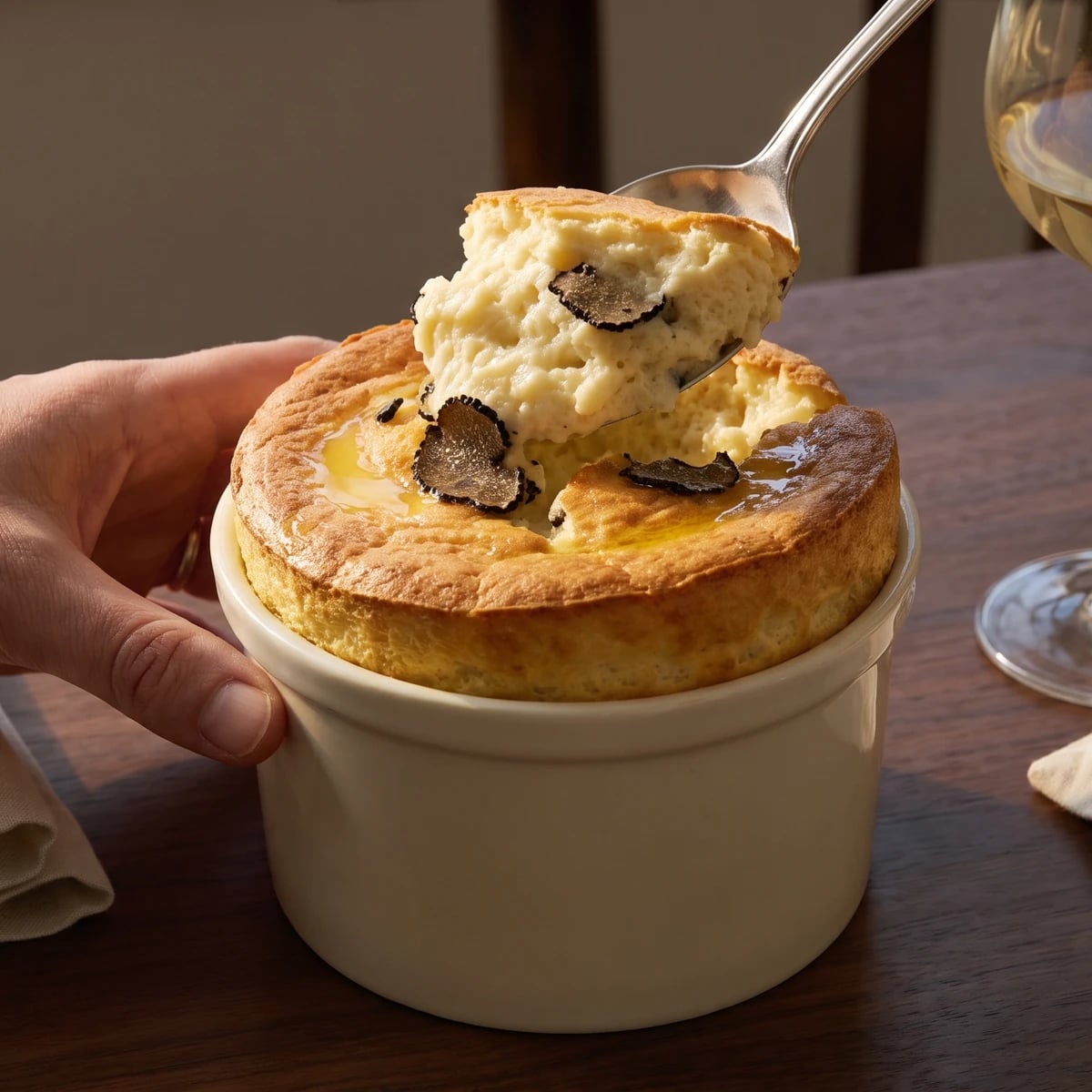
A savory chicken soufflé built on velouté, lifted with egg whites, and layered twice with black truffle, so every spoonful carries tender poultry and the dark perfume of Périgord.

Main Dishes
French
Dinner Party
Special Occasion
Christmas
45 min
Active Time
1 hr cook1 hr 45 min total
Yield4 servings

Soufflé de Volaille à la Périgord (chicken soufflé layered with black truffle) teaches that structure and delicacy aren't opposites. The one true thing to know before touching a pan is this: the chicken base must be thick enough to carry two layers of truffle, yet supple enough to accept the air from the whites. Too loose and the truffle sinks. Too stiff and the soufflé rises grudgingly.

The original entry allowed either of two preceding poultry-soufflé preparations and assumed a saucier with white stock and velouté already waiting. This home version follows the cooked-chicken, velouté-bound path, using the chicken's reduced poaching stock and a food processor in place of pounding and sieving. A 2-liter porcelain dish replaces a row of service molds, and no salamander is needed; the home oven gives the gentler, even heat a soufflé requires. That brigade labor was scaffolding. The equal measures of chopped truffle in the mixture and sliced truffle between its layers are the dish itself, so they stay.

The larger formula calls for equal weights of chopped and sliced truffle. For four servings, both come down together to 1.4 ounces, or 40 grams, preserving that defining proportion. When you fold in the whites, stop the moment the last white streak disappears. That restraint decides whether the soufflé climbs or merely swells.

Soufflé de Volaille à la Périgord belongs to the classical dining table, while its defining black truffle comes from Périgord, the old province centered on the Dordogne in southwestern France. The designation à la Périgord does not mean every dish bearing it began in a farmhouse there; in the classical canon it signals the region's black truffle carried into grand kitchens as a garnish of unusual generosity. This preparation uses the truffle twice, chopped for perfume throughout the chicken and sliced into dark seams, rather than scattering it over the finished dish.

The technique, the tradition, and the story behind every dish.

Discover Culinary Explorer

Ingredients

unsalted chicken stock

Quantity

2 cups (500 ml / 500 g)

boneless, skinless chicken breasts

Quantity

12 oz (340 g)

unsalted butter

Quantity

4 tablespoons (60 ml / 56 g)

divided

fine dry breadcrumbs

Quantity

2 tablespoons (30 ml / 14 g)

plain flour

Quantity

1/4 cup (60 ml / 30 g)

heavy cream

Quantity

1/4 cup (60 ml / 60 g)

fresh black Périgord truffle

Quantity

1/3 cup (80 ml / 40 g)

finely chopped

fresh black Périgord truffle

Quantity

1/2 cup loosely packed (120 ml / 40 g)

thinly sliced

large eggs

Quantity

5

separated

large egg white

Quantity

1

additional large egg white (optional)

Quantity

1

reserved for rescuing overwhipped whites

fine salt

Quantity

3/4 teaspoon (3.75 ml / 4.5 g)

divided

freshly ground white pepper

Quantity

1/8 teaspoon (0.6 ml / 0.25 g)

Equipment Needed

  • 2-liter (about 2-quart) straight-sided porcelain soufflé dish
  • Small saucepan for poaching
  • 2-quart heavy saucepan for the velouté
  • Food processor
  • Electric mixer or large balloon whisk
  • Fine-mesh sieve
  • Broad flexible spatula
  • Instant-read thermometer

Instructions

  1. 1

    Prepare dish and oven

    Set a rack in the lower third of the oven and heat it to 400°F (200°C). Butter a 2-liter straight-sided soufflé dish with 1 tablespoon (15 ml / 14 g) of the butter, brushing upward from base to rim so the coating encourages the mixture in the same direction. Add the breadcrumbs, turn the dish until the base and sides are lightly coated, then tap out the excess. Keep the prepared dish cold while you make the base.

    Choose a straight-sided dish that the mixture will fill about three-quarters full. A broad, shallow dish gives less height and cooks the center before the crown has properly risen.
  2. 2

    Poach the chicken

    Put the stock in a small saucepan and bring it to a bare tremble. Season the chicken with 1/4 teaspoon of the salt, lower it into the stock, and poach gently for 12 to 16 minutes, turning once, until the thickest part reaches 160°F (71°C); it will reach a safe 165°F (74°C) as it rests. Never let the stock boil, because hard heat tightens the meat and gives the finished soufflé a fibrous texture. Lift out the chicken, cover it loosely, and strain the stock. Reduce the stock until exactly 1 cup (250 ml / 250 g) remains. If it falls below that amount, restore the measure with a little water.

  3. 3

    Build the velouté

    Melt the remaining 3 tablespoons (45 ml / 42 g) butter in a saucepan over medium-low heat. Stir in the flour and cook this roux for 2 minutes without allowing it to color. Gradually whisk in the hot reduced stock, then simmer for 4 to 5 minutes, stirring firmly around the corners, until the velouté, the white stock sauce thickened with roux, is smooth and very thick. Stir in the cream and cook until the sauce pulls cleanly from the pan for a moment behind the spoon. If lumps appear, don't begin again. Ça se rattrape: press the hot velouté through a fine sieve, then return it to the pan.

  4. 4

    Make the chicken base

    Cut the rested chicken into small pieces and put it in a food processor with the warm velouté. Process until completely smooth, stopping to scrape the bowl several times; any coarse fibers left now will remain in the soufflé. Transfer the mixture to a large bowl and let it cool until just warm to the touch. Beat in the 5 yolks one at a time, followed by the chopped truffle, the remaining salt, and the white pepper. The base should fall heavily from the spatula and hold a soft mound. If it stands like paste, loosen it with one spoonful of the measured egg whites before whipping the rest.

  5. 5

    Whip glossy whites

    Put the 6 egg whites in a perfectly clean, dry bowl and whisk until they hold glossy medium-firm peaks: the tip should bend slightly rather than stand dry and rigid. Stop there. Overwhipped whites break into little cottony clumps and cannot expand evenly in the oven. If they have gone dry, add the optional unbeaten white and whisk slowly just until the mass becomes supple and glossy again. Ça se rattrape.

  6. 6

    Fold with restraint

    Stir one-quarter of the whipped whites firmly into the chicken base to loosen it. Add half the remaining whites and fold with a broad spatula, cutting down through the center, sweeping along the bottom, and turning the mixture over itself. Repeat with the final whites. Stop as soon as no large white pockets remain; a few fine streaks are safer than another dozen turns. The air you preserve here is the lift you will see at the table.

  7. 7

    Layer the truffles

    Spoon one-third of the soufflé mixture into the prepared dish and level it gently. Arrange half the sliced truffle over it, keeping the slices about 1/2 inch (1 cm) from the sides so they do not interrupt the rise at the rim. Cover with another third of the mixture, add the remaining sliced truffle, and finish with the final third. Smooth the top lightly, then run the tip of a knife around the mixture just inside the rim to form a shallow channel. Wipe the rim clean and bake at once.

  8. 8

    Bake and serve

    Bake for 10 minutes at 400°F (200°C), then lower the heat to 375°F (190°C) without opening the door. Continue for 18 to 22 minutes, until the soufflé has risen well above the rim, the crown is deep butter-gold, and the center trembles gently rather than sloshing. Do not open the oven during the first 20 minutes. If the top colors too quickly after that point, lay a loose sheet of foil over it and finish at 350°F (175°C). Bring the whole dish directly to the table and serve with a broad spoon, reaching through both truffle layers in every portion. À table!

Chef Tips

  • The source's proportion is not negotiable: chopped and sliced truffle in equal weight. Its larger preparation uses 3 1/2 ounces of each; this four-serving version brings both down together to 1.4 ounces (40 g), preserving the defining one-to-one relationship.
  • This dish truly needs black truffle. Fresh Périgord truffle gives the clearest perfume, but outside its season, whole black truffles preserved in their own juice are the classical pantry's honest answer. Drain them well and use the same weights. Truffle-flavored oil cannot build the dark, earthy layers this dish requires.
  • Use unsalted or very lightly salted chicken stock because it is reduced by half. A gelatin-rich homemade stock gives the velouté more body, but a careful cook can make a good low-sodium purchased stock serve splendidly.
  • A soufflé begins settling as soon as it leaves the oven. That isn't failure, it is its nature. Have the table set and the guests seated before it bakes, then serve it without ceremony or delay. Never apologize at your own table.
  • Pour a dry white Bergerac with enough freshness to clear the cream and enough body to meet the truffle. Avoid a heavily perfumed wine, because the truffle has already claimed that part of the conversation.

Advance Preparation

  • The chicken may be poached and the stock reduced up to 24 hours ahead. Chill them separately in covered containers, then warm the stock before making the velouté.
  • The chicken and velouté may be processed together up to 8 hours ahead. Press reusable wrap directly against the surface and keep it cold. Let the base lose its refrigerator chill before adding the yolks and truffles.
  • The truffles may be chopped and sliced up to 4 hours ahead and kept separately in tightly covered containers. Whip the whites, fold, layer, and bake only when the table is ready.

Frequently Asked Questions

Nutrition Information

1 serving (about 240g)

Calories
410 calories
Total Fat
26 g
Saturated Fat
13 g
Trans Fat
1 g
Unsaturated Fat
10 g
Cholesterol
340 mg
Sodium
650 mg
Total Carbohydrates
11 g
Dietary Fiber
1 g
Sugars
1 g
Protein
32 g

Note: Chef personas and recipes are created with AI assistance. Cook with care: follow safe food-handling practices, check doneness with a thermometer when needed, and adapt for allergies and your kitchen.

Where cooking meets culture.

Culinary guides, cultural storytelling, and the editorial depth that makes cooking meaningful.

Discover Culinary Explorer

More from Poultry (Volaille) - Various Preparations of Fowl

Browse the full collection