Culinary Explorer

A cooking platform built around craft, culture, and the stories behind what we eat.
Discover Culinary Explorer
Fricassée de Poulet aux Écrevisses

Fricassée de Poulet aux Écrevisses

Created by Chef Juliette

Based on No. 1668, Fricassée de Poulet aux Écrevisses, from Le Guide Culinaire (1907) by Auguste Escoffier

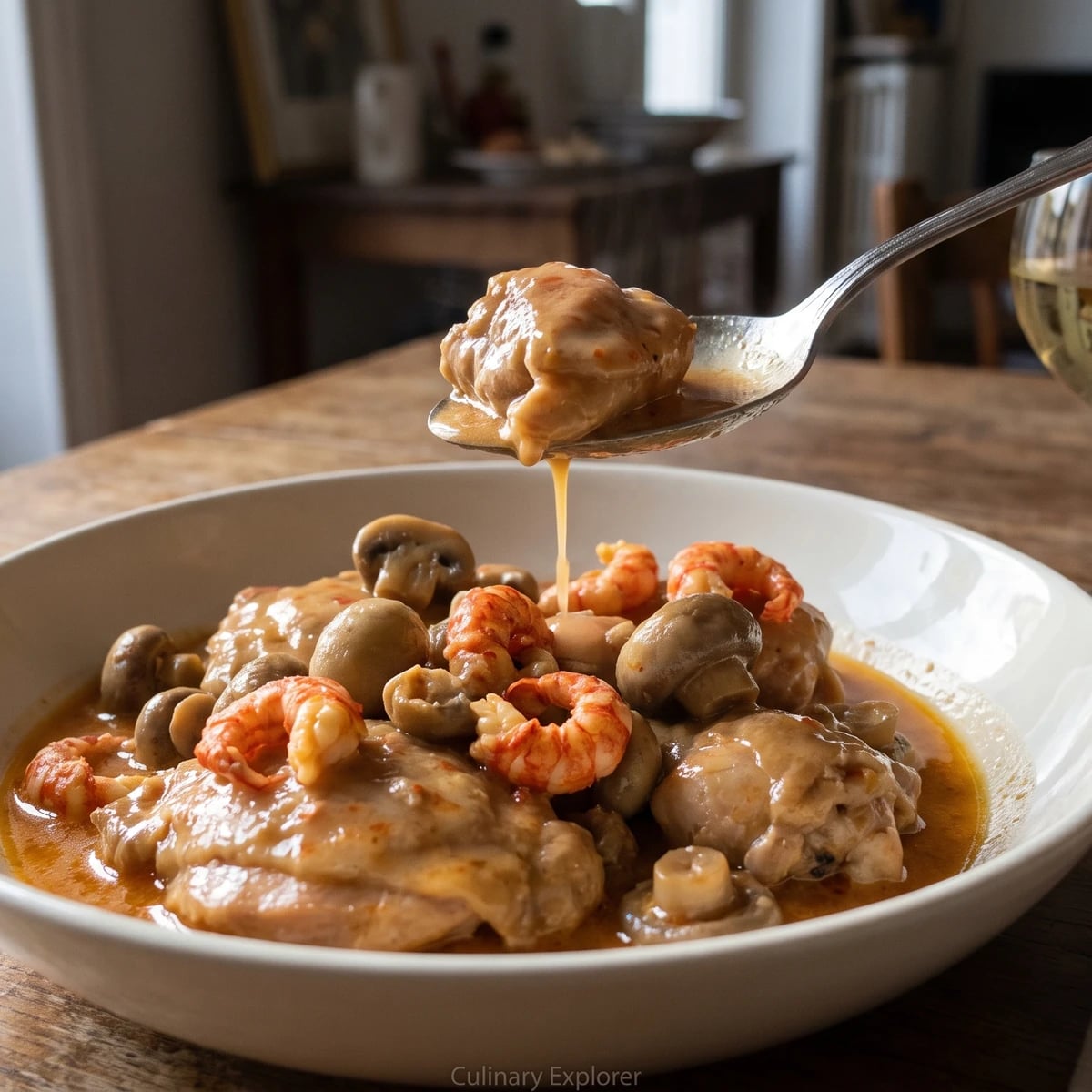
A white chicken fricassée dressed for celebration with tender mushrooms, crayfish tails, and shell-pounded crayfish butter, mounted off the boil so the ivory sauce takes on a coral gloss without losing its silk.

Main Dishes
French
Dinner Party
Special Occasion
Celebration
45 min
Active Time
1 hr 30 min cook2 hr 15 min total
Yield4 servings

Fricassée de Poulet aux Écrevisses (white chicken fricassée with crayfish) teaches the discipline of building flavor without browning. The chicken is raidi, firmed gently in butter without taking color, then poached in a pale sauce founded on flour, stock, cream, and egg yolks. Its depth comes at the finish, when butter pounded with the cooked crayfish shells carries their full savor back into the sauce.

The entry assumes a saucier on staff, chicken stock never off the fire, a mortar for the carcasses, linen for straining, and separate hands tending chicken and crayfish. A heavy casserole, good unsalted stock, a rolling pin, a food processor, and damp cheesecloth do the same work at home. This version sets the base fricassée at one chicken for four and keeps the entry's exact garnish: ten mushrooms, twelve crayfish tails, and 2½ ounces of finished crayfish butter. Only the brigade scaffolding has gone. One cook, one stove, one evening.

The sauce reaches the table ivory blushed with coral, glossy around the chicken, with the mushrooms still pale and the crayfish tails just warmed through. The step that decides it is monter au beurre, whisking the crayfish butter into the sauce after the pan leaves the heat. Boil afterward and the sauce sheds its butter. Keep it off the fire and it turns to silk.

The pairing of fine poultry and freshwater crayfish belongs especially to Bresse and the Dombes, northeast of Lyon, where chickens, pond fish, and crayfish traveled through the same markets. Lyon's grand tables carried that regional marriage into the classical white fricassée, adding mushrooms and returning the flavor of the shells through beurre d'écrevisses rather than discarding them. Despite the bisque method used to cook the crayfish, this is not a tomato-red shellfish sauce; the final butter should tint the ivory fricassée only softly.

The technique, the tradition, and the story behind every dish.

Discover Culinary Explorer

Ingredients

whole chicken

Quantity

1 (3½ to 4 pounds / 1.6 to 1.8 kg)

cut into 8 pieces

small whole raw crayfish

Quantity

12 (about 1½ pounds / 680 g)

rinsed

unsalted butter for the crayfish butter

Quantity

8 tablespoons (½ cup / 120 ml / 113 g)

softened

unsalted butter for cooking the crayfish

Quantity

2 tablespoons (30 ml / 28 g)

unsalted butter for the fricassée

Quantity

3 tablespoons (45 ml / 42 g)

unsalted butter for the mushrooms

Quantity

1 tablespoon (15 ml / 14 g)

small carrot

Quantity

1 (about ⅓ cup / 80 ml / 45 g)

finely diced

small yellow onions

Quantity

2 (about 8 ounces / 225 g total)

one finely diced and one peeled

small shallot

Quantity

1 (about 2 tablespoons / 30 ml / 25 g)

finely diced

bouquet garni

Quantity

2

each containing parsley stems, thyme, and bay leaf

whole cloves

Quantity

2

Cognac

Quantity

2 tablespoons (30 ml / 28 g)

dry white wine

Quantity

½ cup (120 ml / 120 g)

unsalted chicken stock

Quantity

3 cups (720 ml / 720 g)

divided and kept hot

small button mushrooms

Quantity

10 (about 6 ounces / 170 g)

trimmed

water

Quantity

½ cup (120 ml / 120 g)

fresh lemon juice

Quantity

1 tablespoon (15 ml / 15 g)

divided

all-purpose flour

Quantity

¼ cup (60 ml / 30 g)

heavy cream

Quantity

½ cup (120 ml / 120 g)

kept cold

large egg yolks

Quantity

2

fine sea salt

Quantity

2 teaspoons (10 ml / 12 g)

divided

ground white pepper

Quantity

½ teaspoon (2.5 ml / 1 g)

divided

Equipment Needed

  • 12-inch (30 cm) wide heavy casserole with lid
  • 3-quart (3-liter) saucepan
  • Fine-mesh sieve and damp cheesecloth
  • Heavy mortar, or a rolling pin and sturdy bag, plus a food processor
  • Instant-read thermometer
  • Deep 2½-quart (2.4-liter) serving timbale or bowl

Instructions

  1. 1

    Prepare the mise

    Prepare the mise en place, everything measured and within reach, before heating a pan. Pat the chicken dry and season it with half the salt and half the white pepper. Stud the peeled onion with the two cloves, keep the stock hot, and set a metal bowl over ice for collecting the crayfish butter. White pepper keeps the pale sauce visually clean, but its flavor should remain quiet.

  2. 2

    Cook the crayfish

    Melt the 2 tablespoons of butter in a 3-quart saucepan over medium-low heat. Add the diced onion, carrot, and shallot, then cook for 4 minutes without coloring them. Add the crayfish, raise the heat to medium, and turn them until every shell is vivid red. Pour in the Cognac and let it boil for 30 seconds; there is no need to set it alight. Add the wine, 1 cup of the hot stock, and one bouquet garni. Cover and simmer gently for 6 to 8 minutes, until the tail meat is opaque and reaches 145°F (63°C). Lift out the crayfish and strain the cooking liquor, pressing the vegetables lightly. Reserve every drop.

    If using live crayfish, discard any that do not move when handled before cooking. Frozen raw crayfish should be thawed under refrigeration, never on the counter.
  3. 3

    Make crayfish butter

    When the crayfish are cool enough to handle, twist off the tails, remove their shells and intestinal veins, and refrigerate the meat. Discard the small gritty stomach sac from each head, but keep the heads, claws, and every clean piece of shell. Crush the carcasses coarsely in a heavy mortar or a sturdy bag with a rolling pin, then pulse them with the softened butter until the shells are finely broken and the butter turns orange. Scrape this into a small saucepan, add ¼ cup of the reserved cooking liquor, and hold it just below a simmer for 12 minutes. Do not let the shells fry or brown. Rub the warm mixture through a fine sieve lined with two damp layers of cheesecloth into the chilled bowl, pressing firmly with the back of a ladle. Let the orange butter set over the concentrated liquor, then lift it off and blot its underside. Measure 5 tablespoons (75 ml / 70 g), the source entry's full 2½-ounce finish, and keep it cool. Combine the liquid beneath it with the remaining crayfish cooking liquor.

  4. 4

    Poach the mushrooms

    Put the ten mushrooms in a small saucepan with the water, 1 tablespoon of butter, 1 teaspoon of the lemon juice, and a pinch of the remaining salt. Cover and simmer for 5 to 6 minutes, just until a knife enters without resistance. Lift out the mushrooms and add their cooking liquid to the reserved crayfish liquor. This cuisson à blanc, cooking pale in a buttered, acidulated liquid, preserves the mushrooms' ivory color; browning them would pull the whole fricassée in the wrong direction.

  5. 5

    Raidir the chicken

    Melt the 3 tablespoons of butter in a wide heavy casserole over medium-low heat. Add the chicken in one layer and turn the pieces for 6 to 8 minutes, until their surfaces are opaque and slightly firm but entirely unbrowned. This is raidir, firming the flesh in butter without coloring it. If the butter begins to brown, lift the casserole from the heat, lower the flame, and continue only when the foaming settles. Sprinkle the flour evenly over the chicken and turn every piece through the butter for 2 minutes, cooking out the raw flour without letting the roux color. Gradually pour in the remaining 2 cups of hot stock, stirring around the pieces so the sauce stays smooth, then add the combined mushroom and crayfish liquors. Set in the clove-studded onion and the remaining bouquet garni.

  6. 6

    Poach at a tremble

    Bring the sauce slowly to the barest simmer, cover the casserole slightly ajar, and cook gently. Begin checking the breast pieces after 18 minutes and remove them when they reach 165°F (74°C). Let the legs continue until they reach about 175°F (79°C) and yield easily at the joint, usually 30 to 35 minutes in all. A hard boil toughens the meat and can make the flour catch on the pot floor. If the sauce tightens before the legs are tender, loosen it with a spoonful of hot water and lower the heat.

  7. 7

    Strain and reduce

    Transfer the cooked chicken to a warm dish and cover it loosely. Strain the sauce into a clean saucepan without pressing the onion or bouquet garni, then skim away any surface fat. Simmer gently until reduced to about 2 cups (480 ml) and thick enough to nappe, coat the back of a spoon in a smooth, even film. Taste now for salt and white pepper, remembering that the crayfish butter will add depth but no useful seasoning.

  8. 8

    Set the liaison

    Whisk the egg yolks with 6 tablespoons (90 ml) of the cold cream, keeping the remaining 2 tablespoons cold. Whisk in a ladleful of hot sauce, then another, before pouring the tempered liaison back into the saucepan. Stir constantly over low heat until the sauce thickens slightly and reaches about 170°F (77°C), but never let it boil. Stir in the remaining lemon juice. If tiny yellow grains appear, lift the pan off the heat immediately, blend in the reserved cold cream, and pass the sauce through the fine sieve. The liaison has caught, but it can still be smoothed.

  9. 9

    Mount and serve

    Return the chicken and mushrooms to the sauce and warm them at the faintest tremble. Add the crayfish tails for the final minute, only long enough to heat them through. Transfer the chicken, mushrooms, and tails to a warmed deep timbale or serving bowl, arranging several tails where they remain visible. Take the sauce completely off the heat and wait until all bubbling stops. Whisk in the measured 5 tablespoons (75 ml / 70 g) of crayfish butter in four additions, letting each disappear before adding the next. Do not return the pan to the fire. If orange beads of butter rise instead of emulsifying, place 1 teaspoon of cold water in a clean bowl and whisk in the sauce little by little. Ça se rattrape. Pour the coral-ivory sauce over the fricassée and serve at once. À table!

Chef Tips

  • Whole crayfish matter because the shells make the finish. If fresh ones are out of season, good frozen whole cooked crayfish are the honest preserved choice: thaw them under refrigeration, remove the tails without reheating them, and simmer the shells with the aromatics and liquor before making the butter.
  • Use a gelatin-rich, unsalted chicken stock. The sauce reduces substantially, and a salty carton becomes harsher as it concentrates. If your stock is thin, reduce it before measuring rather than adding more flour.
  • Pale does not mean timid. The chicken, roux, mushrooms, and aromatics must avoid browning, but each still cooks fully. The restraint keeps the crayfish butter clear and recognizable instead of burying it beneath roasted flavors.
  • A dry white from the Mâconnais suits the cream, chicken, and sweet shellfish without flattening them. At the table, all this dish needs beside it is something plain that will carry the sauce.
  • Refrigerate leftovers within two hours and eat them within two days. Reheat over very low heat without boiling, loosening the sauce with a spoonful of cream or stock if it has tightened.

Advance Preparation

  • The crayfish may be cooked, shelled, and turned into butter one day ahead. Refrigerate the tails, finished butter, and strained cooking liquor in separate covered containers; keep the butter cool but pliable when the final mounting begins.
  • The chicken may be poached and the sauce strained up to 4 hours ahead. Cool the chicken and sauce quickly in separate shallow containers, refrigerate them, then reheat gently and complete the liaison, garnish, and crayfish-butter finish just before serving.
  • Do not finish the sauce with the egg liaison or crayfish butter in advance. Those are service steps, and repeated heating risks curdling the yolks and breaking the final emulsion.

Frequently Asked Questions

Nutrition Information

1 serving (about 470g)

Calories
1060 calories
Total Fat
86 g
Saturated Fat
40 g
Trans Fat
2 g
Unsaturated Fat
42 g
Cholesterol
440 mg
Sodium
1450 mg
Total Carbohydrates
17 g
Dietary Fiber
2 g
Sugars
6 g
Protein
54 g

Note: Chef personas and recipes are created with AI assistance. Cook with care: follow safe food-handling practices, check doneness with a thermometer when needed, and adapt for allergies and your kitchen.

Where cooking meets culture.

Culinary guides, cultural storytelling, and the editorial depth that makes cooking meaningful.

Discover Culinary Explorer

More from Poultry (Volaille) - Various Preparations of Fowl

Browse the full collection