
Chef Juliette
Ordinary or White Consommé
Beef shin, lean beef, and fowl begin in cold water and rise slowly toward a tremble. Skim before the boil, and you learn the quiet discipline that gives every clear French broth its backbone.
A cooking platform built around craft, culture, and the stories behind what we eat.
Created by Chef Juliette
Based on No. 165, Court-bouillon with Red Wine, from Le Guide Culinaire (1907) by Auguste Escoffier
Court-bouillon au vin rouge is the brief, wine-dark poaching liquor for river fish: two parts excellent red wine, one part water, carrots and aromatics, simmered gently so the wine stays supple.
Court-bouillon au vin rouge (red-wine poaching liquor) teaches that a poaching bath is built by proportion, not weight or richness. Two parts excellent red wine to one part water is the one true thing to know before touching the pan. Keep that ratio exact and the liquor gives river fish fragrance, color, and gentle acidity without burying its flavor.
The classical formula assumed a saucier minding a brigade-sized fish kettle, with fish fumet never far from the fire whenever aspic was required. At home, a five-quart nonreactive pot, a fine sieve, and good homemade or purchased fumet are the honest equivalents. I have scaled the bath to about two quarts while preserving its full four ounces of carrots and exact wine-to-water ratio. The brigade's holding and repeated skimming can go; the proportion, restrained salt, and thirty-minute extraction are the dish and must stay. One cook, one stove, one evening.
Finished properly, the court-bouillon is translucent garnet, aromatic without bitterness, and unmistakably wine-led. Bring it up slowly and keep it at a bare tremble rather than a galloping boil. That controlled simmer is the step that decides the whole preparation.
The red-wine court-bouillon belongs most naturally to the inland river tables of Burgundy, where local wine gave pike, carp, and eel a darker, more forceful poaching bath than pale coastal preparations required. Grand kitchens carried that practice into the classical stock system, defining court-bouillon as a deliberately brief aromatic liquor rather than a long-cooked stock. Its aspic use corrects a common misconception: the bath was not merely discarded poaching liquid, because fish fumet and gelatine could turn the same wine-scented foundation into a savory garnet jelly.
Quantity
6 cups (1.42 L / 1,410 g)
Quantity
3 cups (710 ml / 710 g)
Quantity
1 cup (240 ml / 4 oz / 113 g)
finely minced
Quantity
1 cup (240 ml / 4 oz / 113 g)
finely minced
Quantity
1
Quantity
2 teaspoons (10 ml / 12 g)
Quantity
1 teaspoon (5 ml / 3 g)
lightly bruised
Quantity
3 cups (710 ml / 720 g), replacing the water
Quantity
5 packets (¼ cup / 60 ml / 35 g), plus 1 packet (2¼ teaspoons / 11 ml / 7 g) if needed
| Ingredient | Quantity |
|---|---|
| excellent dry red wine | 6 cups (1.42 L / 1,410 g) |
| cold water | 3 cups (710 ml / 710 g) |
| carrotsfinely minced | 1 cup (240 ml / 4 oz / 113 g) |
| yellow onionsfinely minced | 1 cup (240 ml / 4 oz / 113 g) |
| bouquet garni (6 parsley stems, 2 thyme sprigs, and 1 bay leaf) | 1 |
| fine sea salt | 2 teaspoons (10 ml / 12 g) |
| black peppercornslightly bruised | 1 teaspoon (5 ml / 3 g) |
| fish fumet, concentrated fish essence, for the aspic variation (optional) | 3 cups (710 ml / 720 g), replacing the water |
| powdered gelatine for the aspic variation (optional) | 5 packets (¼ cup / 60 ml / 35 g), plus 1 packet (2¼ teaspoons / 11 ml / 7 g) if needed |
Mince the carrots and onions evenly so they surrender their flavor within the short cooking time. Tie the parsley stems, thyme, and bay leaf into a bouquet garni, then bruise the peppercorns lightly and reserve them. Crushed pepper muddies the liquor; whole pepper gives too little in thirty minutes.
Combine the six cups of red wine and three cups of water in a five-quart nonreactive pot. Add the carrots, onions, bouquet garni, and salt. The two-to-one proportion of wine to water is the structure of this court-bouillon, so measure it rather than judging by eye. If the liquor will later be reduced, use only one teaspoon of salt now and correct the seasoning after reduction.
Bring the court-bouillon slowly to a bare simmer over medium heat, skimming away any coarse froth that collects at the surface. Simmer uncovered for twenty minutes, with only an occasional bubble breaking the surface. Add the bruised peppercorns and continue for ten minutes. If the pan boils hard and the liquor falls well below eight cups, take it off the heat and restore the volume with unsalted liquid mixed in the same two-to-one proportion of wine to water, then simmer gently for five minutes. For the aspic variation, use fumet as the water portion.
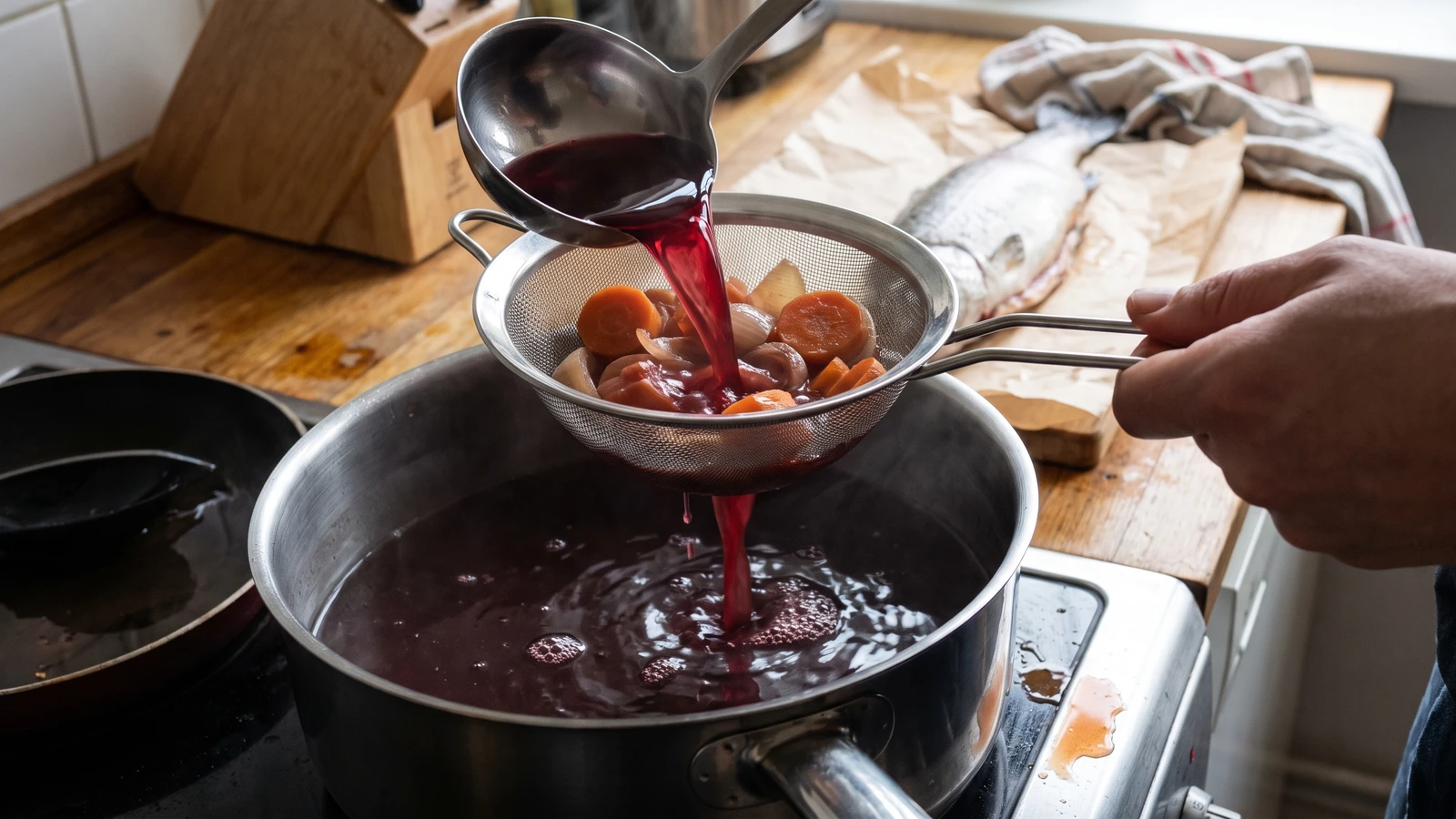
Pass the court-bouillon through a fine-mesh sieve lined with damp cheesecloth into a clean nonreactive vessel. Let it drain under its own weight. Pressing the vegetables forces bitter particles into the liquor and clouds what should be translucent. Taste only after it cools for a minute, because very hot liquid hides salt; if it is too salty, dilute it gradually with more unsalted wine and water in the same two-to-one ratio.
For aspic stock, sprinkle five packets of powdered gelatine over the reserved cup of cold fish fumet and leave it for ten minutes to bloom. Whisk the swollen gelatine into the strained court-bouillon while the liquid is hot but no longer boiling, stirring until completely dissolved. Spoon a little onto a chilled saucer and refrigerate it for ten minutes; it should form a tender jelly that cuts cleanly. If it remains too soft, ça se rattrape: bloom the extra packet in four tablespoons of cold fumet or water, melt it into the gently rewarmed stock, and test again. Never boil the court-bouillon after adding gelatine.
Use the court-bouillon according to the fish recipe's poaching time. A whole river fish may be settled into the cold liquor and brought up gently with it, while steaks or fillets enter liquor already held at a bare tremble; neither should face a hard boil. For storage, set the vessel in an ice bath, stir until cool, and refrigerate promptly in covered containers. Pour the aspic stock into its mold and chill undisturbed for at least six hours. À table!
1 serving (about 235g)
Culinary guides, cultural storytelling, and the editorial depth that makes cooking meaningful.
Discover Culinary ExplorerChef Juliette
Beef shin, lean beef, and fowl begin in cold water and rise slowly toward a tremble. Skim before the boil, and you learn the quiet discipline that gives every clear French broth its backbone.

Chef Juliette
Break the veal bones small, then give them eight hours at a bare tremble. This pale, gelatinous fond becomes the quiet foundation beneath velouté, blanquette, and every sauce that must stay light.

Chef Juliette
Sauce Orientale concentrates lobster-rich American Sauce with curry, then folds in cream away from the fire: a glossy, gently spiced derivative made for lobster, crayfish, and firm fish.

Chef Juliette
An old lesson in sauce families: Sauce Allemande takes mushroom liquor, then butter, lemon, and parsley, becoming a glossy Poulette for sheep's trotters, leeks, cauliflower, and anything needing gentle richness with a bright edge.