
Chef Juliette
Ordinary or White Consommé
Beef shin, lean beef, and fowl begin in cold water and rise slowly toward a tremble. Skim before the boil, and you learn the quiet discipline that gives every clear French broth its backbone.
A cooking platform built around craft, culture, and the stories behind what we eat.
Created by Chef Juliette
Based on No. 164, Court-bouillon with White Wine, from Le Guide Culinaire (1907) by Auguste Escoffier
A clear, wine-bright court-bouillon for freshwater fish, built on equal measures of white wine and water, thirty minutes of aromatic extraction, and one essential discipline: salt for the reduction you intend.
Court-bouillon au vin blanc (short white-wine poaching liquor) teaches extraction without heaviness. The wine must remain bright, the onion and herbs must speak clearly, and the salt must anticipate what happens after the fish leaves the kettle. This is not a stock simmered toward depth. It is a quick, clean cooking medium whose restraint protects the flavor of freshwater fish.
The original formula assumed a saucier with a tammy cloth waiting beside the stove. At home, a nonreactive saucepan and a fine-mesh sieve lined with damp cheesecloth do the same work. The book's large faggot is simply a large bouquet garni, a firmly tied bundle of parsley stems, thyme, and bay. Its two-quart quantity is already a sensible home batch, enough for a whole fish or several portions, so the equal measures of wine and water remain untouched. One cook, one stove, one evening.
The tammy is brigade scaffolding and may become a lined sieve. The equal measure of wine and water, the controlled half-hour boil, and the light hand with salt must stay, because those are the dish. The finished court-bouillon should be pale gold, clear, and fragrant without tasting like wine left raw in a glass. Before you touch the pan, decide whether you will reduce it later. That one decision controls how much salt goes in.
Court-bouillon belongs to the French fish kettle rather than a single province, but the white-wine form is particularly at home on inland river tables in Burgundy and the Rhône-Saône basin, where pike, carp, trout, and perch were commonly poached. Household kitchens made the aromatic liquor quickly, and the classical repertoire carried it into grand kitchens as a standardized preparation strained before the fish entered. Court means short: this is a quickly made cooking liquor, not a long-simmered stock or a soup intended for the bowl.
Quantity
4 cups (1 U.S. quart / 950 ml / about 945 g)
Quantity
4 cups (1 U.S. quart / 950 ml / 950 g)
Quantity
3 ounces (about ½ cup / 120 ml / 85 g)
finely minced
Quantity
1
tied firmly
Quantity
½ ounce (about 1 tablespoon / 15 ml / 14 g), or half this amount if reducing later
Quantity
6 to 8 (about ¼ teaspoon / 1.25 ml / 0.5 g)
| Ingredient | Quantity |
|---|---|
| dry white wine | 4 cups (1 U.S. quart / 950 ml / about 945 g) |
| water | 4 cups (1 U.S. quart / 950 ml / 950 g) |
| yellow onionfinely minced | 3 ounces (about ½ cup / 120 ml / 85 g) |
| large bouquet garni composed of parsley stems, thyme, and bay leaftied firmly | 1 |
| sel gris (coarse gray sea salt) | ½ ounce (about 1 tablespoon / 15 ml / 14 g), or half this amount if reducing later |
| black peppercorns | 6 to 8 (about ¼ teaspoon / 1.25 ml / 0.5 g) |
Lay the thyme and bay leaf against the parsley stems and bind them firmly with kitchen twine. This bouquet garni is the honest modern reading of the book's large faggot: the old word changes, but the bundle and its work do not. Mince the onion finely so it releases its flavor during the short cooking time.
Pour the white wine and water into a 3 to 4-quart nonreactive saucepan. Add the minced onion, bouquet garni, and peppercorns. Add the full ½ ounce of sel gris when the court-bouillon will remain a poaching liquor; if you intend to reduce it afterward for a sauce, begin with half. If the full salt has already gone in and a later reduction tastes too strong, don't discard it. Ça se rattrape: dilute the reduced liquid with unsalted water, ¼ cup (60 ml) at a time, tasting after each addition.
Bring the mixture to a full boil over medium-high heat. Lower the heat only enough to maintain a steady, controlled boil, then set the lid slightly ajar and cook for 30 minutes. The liquid should remain lively without thrashing against the pan; a violent boil drives off too much wine and concentrates the salt before the aromatics have done their work. If the level falls sharply, add a little boiling water to restore the normal evaporation loss.
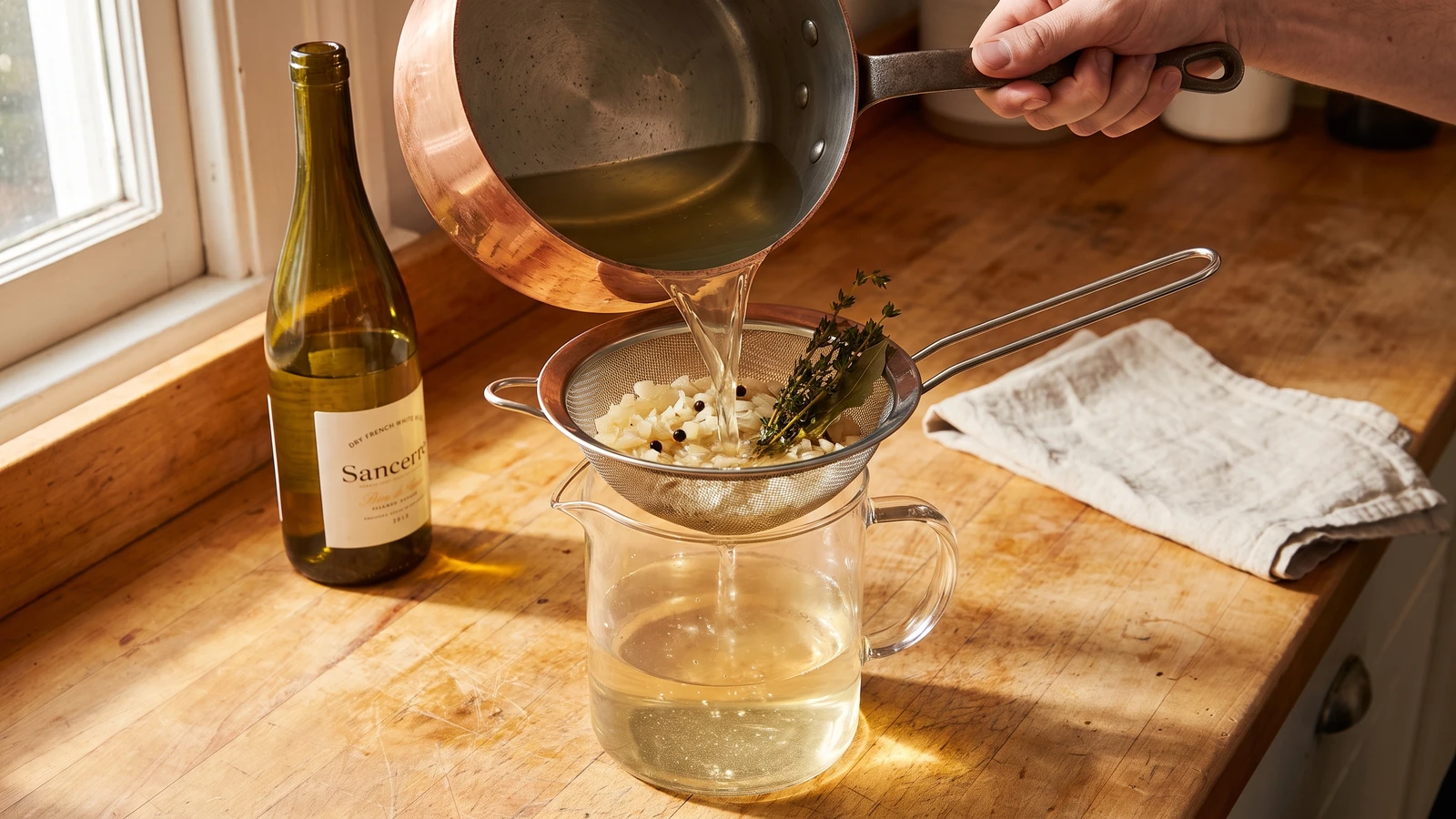
Set a fine-mesh sieve over a heatproof jug and line it with damp cheesecloth or a clean thin kitchen cloth, the home equivalent of a tammy. Pour the court-bouillon through immediately. Let it drain under its own weight and do not press the onion or bouquet garni, which would force dull particles into the clear liquor. If it looks cloudy, strain it once more through a freshly rinsed damp cloth. The flavor is not lost, and the clarity comes back.
For a whole freshwater fish, cool the court-bouillon completely, pour it over the fish while cold, and bring both gradually toward a gentle poach so the flesh cooks evenly from edge to bone. For steaks or fillets, use the court-bouillon hot but never let it boil aggressively around the fish. If making it ahead, cool it promptly in shallow containers, cover, and refrigerate once cold.
1 serving (about 240g)
Culinary guides, cultural storytelling, and the editorial depth that makes cooking meaningful.
Discover Culinary ExplorerChef Juliette
Beef shin, lean beef, and fowl begin in cold water and rise slowly toward a tremble. Skim before the boil, and you learn the quiet discipline that gives every clear French broth its backbone.

Chef Juliette
Break the veal bones small, then give them eight hours at a bare tremble. This pale, gelatinous fond becomes the quiet foundation beneath velouté, blanquette, and every sauce that must stay light.

Chef Juliette
Sauce Orientale concentrates lobster-rich American Sauce with curry, then folds in cream away from the fire: a glossy, gently spiced derivative made for lobster, crayfish, and firm fish.

Chef Juliette
An old lesson in sauce families: Sauce Allemande takes mushroom liquor, then butter, lemon, and parsley, becoming a glossy Poulette for sheep's trotters, leeks, cauliflower, and anything needing gentle richness with a bright edge.