
Chef Juliette
John Dory (St. Pierre)
John Dory has the delicacy of sole and the firmness of turbot. A light flouring, a quick butter sauté, and nut-brown beurre noisette show exactly why looks never mattered.
A cooking platform built around craft, culture, and the stories behind what we eat.
Created by Chef Juliette
Based on No. 1601, Suprêmes de Volaille Henri IV, from Le Guide Culinaire (1907) by Auguste Escoffier
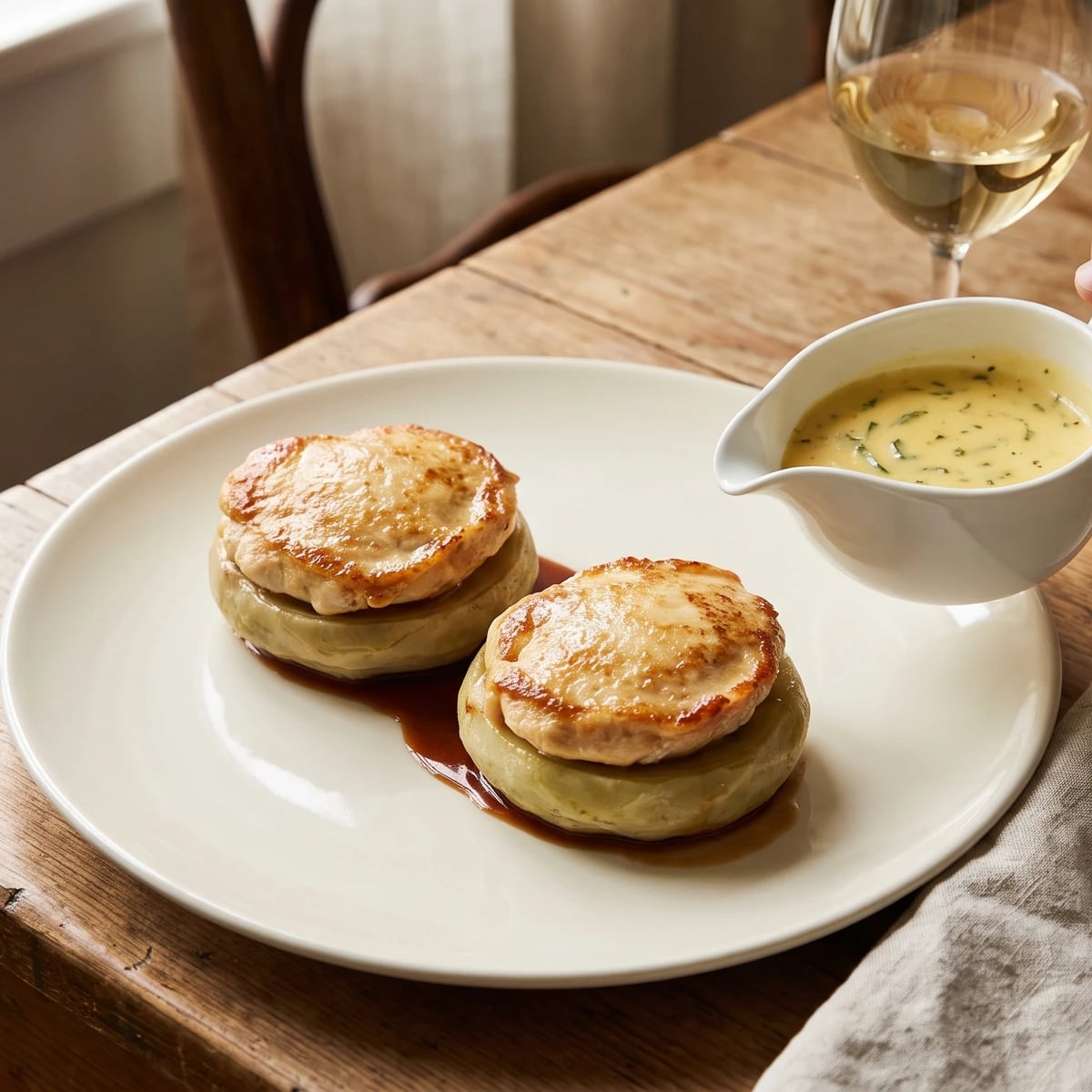
Tender chicken collops browned in clarified butter, each settled on an artichoke bottom with a gloss of meat glaze, while Béarnaise waits alongside, barely warm and alive.
Suprêmes de Volaille Henri IV (chicken breast collops on artichoke bottoms with Béarnaise) teaches temperature before anything else. Its grammar is the sauté, cooking thin pieces quickly in a little hot fat, then getting them to the table while their flour coat is still delicate. The chicken is forgiving. The Béarnaise is not fond of heat.
The original entry assumed a saucier on staff, meat glaze drawn from a stock never off the fire, artichoke bottoms already turned, and plates held through service. At home, a small stock reduction with its body restored, plain preserved artichoke bottoms instead of hand-turned fresh ones, and one bowl over gently heated water keep the same intent. A brigade's salamander is service scaffolding and goes entirely; the round collop, the clarified-butter sauté, the buttered glaze, and the Béarnaise served apart are the dish and stay. Pantry labor shrinks, technique does not. One cook, one stove, one evening.
Done well, the artichoke is tender under a golden collop, the meat glaze gives one small, savory gloss, and the tarragon sauce arrives in its own sauceboat. Before you touch the skillet, settle the Béarnaise plan: make it close to service and keep it barely warm, never hot. That is the one step that decides the evening.
Suprêmes de Volaille Henri IV belongs to the Parisian grand-kitchen repertoire, where named garnitures served as shorthand for a precise arrangement of meat, vegetable base, glaze, and sauce. Its artichoke bottoms and Béarnaise invoke Henri IV, who came from Béarn, but Béarnaise itself entered the canon in the Paris region rather than as a farmhouse sauce from Béarn. The dish moved naturally to the bourgeois dinner table because its formal appearance depends on careful portioning and sauce work, not rare ingredients.
Quantity
1⅓ cups (320 ml / 300 g)
clarified and divided
Quantity
2 cups (480 ml / 480 g)
Quantity
½ teaspoon (2.5 ml / 1.5 g)
use only if the stock lacks natural body
Quantity
2 tablespoons (30 ml / 28 g)
divided
Quantity
¼ cup (60 ml / 60 g)
Quantity
¼ cup (60 ml / 60 g)
Quantity
1 small (about 2 tablespoons / 30 ml / 25 g)
finely chopped
Quantity
1 teaspoon (5 ml / 2 g)
lightly crushed
Quantity
2 tablespoons (30 ml / 6 g)
finely chopped, tender stems reserved
Quantity
1 tablespoon (15 ml / 3 g)
finely chopped
Quantity
3 large
Quantity
3 tablespoons (45 ml / 45 g)
divided
Quantity
4 (about 1½ pounds / 680 g total)
Quantity
½ cup (120 ml / 60 g)
for dredging
Quantity
8 (about 1 pound / 450 g drained)
thawed or rinsed if canned and dried well
Quantity
to taste
| Ingredient | Quantity |
|---|---|
| unsalted butterclarified and divided | 1⅓ cups (320 ml / 300 g) |
| unsalted veal or beef stock | 2 cups (480 ml / 480 g) |
| powdered unflavored gelatin (optional)use only if the stock lacks natural body | ½ teaspoon (2.5 ml / 1.5 g) |
| cold unsalted butterdivided | 2 tablespoons (30 ml / 28 g) |
| dry white wine | ¼ cup (60 ml / 60 g) |
| white wine vinegar | ¼ cup (60 ml / 60 g) |
| shallotfinely chopped | 1 small (about 2 tablespoons / 30 ml / 25 g) |
| black peppercornslightly crushed | 1 teaspoon (5 ml / 2 g) |
| fresh tarragon leavesfinely chopped, tender stems reserved | 2 tablespoons (30 ml / 6 g) |
| fresh chervil leavesfinely chopped | 1 tablespoon (15 ml / 3 g) |
| pasteurized egg yolks | 3 large |
| waterdivided | 3 tablespoons (45 ml / 45 g) |
| boneless, skinless chicken breast suprêmes | 4 (about 1½ pounds / 680 g total) |
| all-purpose flourfor dredging | ½ cup (120 ml / 60 g) |
| plain preserved artichoke bottomsthawed or rinsed if canned and dried well | 8 (about 1 pound / 450 g drained) |
| fine salt and ground white pepper | to taste |
Melt the 1⅓ cups butter slowly without letting it color. Skim away the white foam, then pour the clear golden fat into a measuring jug, leaving the milky sediment behind. Reserve ¾ cup (180 ml / about 165 g) for the Béarnaise and ¼ cup (60 ml / about 55 g) for sautéing the chicken. Keep the Béarnaise portion liquid and barely warm. Clarified butter matters here because its milk solids have been removed, so the collops can take clean color without burnt specks.
If the stock is thin and does not set softly when chilled, sprinkle the gelatin over it and leave it for 5 minutes. Simmer the stock uncovered in a small saucepan until reduced to ¼ cup (60 ml), glossy and lightly tacky, about 25 minutes. Lower the heat as it concentrates so the final spoonfuls do not scorch. In a second saucepan, combine the wine, vinegar, shallot, peppercorns, and reserved tarragon stems. Simmer until 2 tablespoons (30 ml) of liquid remain, then strain, pressing gently on the aromatics. If either reduction goes too far, loosen it with a spoonful of water. The concentration can be corrected before anything burns.
Lay each suprême flat and slice it horizontally through its thickness to make 2 broad collops, giving you 8 altogether. Place them between sheets of parchment and tap them gently to an even ¼-inch (6 mm) thickness. Trim each into a neat round about 3 to 3½ inches (8 to 9 cm) across, preserving as much meat as possible, and save the trimmings for another meal. Even thickness is not plating theater; it lets every collop finish at the same moment. Pat them dry and keep them cold. Do not season or flour them yet.
Set a heatproof bowl over a saucepan containing an inch of water held at the barest tremble, making certain the bowl does not touch the water. Whisk the yolks with the strained wine-vinegar reduction and 1 tablespoon (15 ml) of the measured water until pale, thick, and able to hold the trace of the whisk. Take the bowl off the saucepan. Add the reserved ¾ cup clarified butter first by droplets, then in a thin stream, whisking constantly until the Béarnaise is glossy and softly mounded. Fold in the chopped tarragon and chervil, then season with salt and white pepper. If the sauce turns oily or separates, stop. Ça se rattrape: whisk 1 teaspoon cold water in a clean bowl, then add the broken sauce to it a teaspoon at a time until the emulsion reforms. Hold the finished Béarnaise over water at 110 to 120°F (43 to 49°C) for no more than 20 minutes. Barely warm means barely warm.
Arrange the artichoke bottoms cup-side up in a wide covered pan with the remaining 2 tablespoons (30 ml) water and 1 tablespoon (14 g) of the cold butter. Warm them over low heat for about 5 minutes, turning once and keeping them pale. Transfer them to warmed plates or a platter. Reheat the reduced meat stock just until fluid, remove it from the heat, and whisk in the remaining tablespoon of cold butter to make the buttered meat glaze. It should gleam and coat a spoon lightly. If it looks greasy, whisk in a teaspoon of hot water.
Season the collops with salt and white pepper. Dredge each lightly in flour immediately before cooking, then tap away every loose trace. Heat a 12-inch skillet over medium-high heat and add half the reserved clarified butter. When the fat glistens, lay in 4 collops without crowding. Sauté for 1½ to 2 minutes on the first side and about 1 minute on the second, until evenly golden and the centers reach 165°F (74°C). Transfer them directly to a warm plate and repeat with fresh clarified butter. If flour specks blacken between batches, pour off that fat and wipe the skillet carefully with paper held in tongs before continuing. Burnt flour must not follow the second batch.
Spoon a small gloss of buttered meat glaze into each warm artichoke bottom, then set one collop squarely on top. Give each person 2. Pour the Béarnaise into a warmed sauceboat and serve it separately, exactly as the dish requires; flooding the chicken would soften its delicate flour coat and bury the artichoke. Bring everything to the table at once. À table!
1 serving (about 365g)
Culinary guides, cultural storytelling, and the editorial depth that makes cooking meaningful.
Discover Culinary Explorer
Chef Juliette
John Dory has the delicacy of sole and the firmness of turbot. A light flouring, a quick butter sauté, and nut-brown beurre noisette show exactly why looks never mattered.

Chef Juliette
Fresh haddock proves its delicacy in the meunière pan: a fine flour crust, moist pearly flakes, and beurre noisette sharpened with lemon and parsley, ready from one skillet in half an hour.

Chef Juliette
Éperlans à l’Anglaise turns small fish into a lesson in disciplined coating: boned smelts under a close, crisp crumb, pan-fried in clarified butter and finished with bright, half-melted maître d’hôtel butter.

Chef Juliette
Tiny smelts, shallot, mushrooms, white wine, gratin sauce, and fine bread raspings meet a fierce oven, where the fish must turn tender in the same breath the buttered crust bronzes.