
Chef Juliette
John Dory (St. Pierre)
John Dory has the delicacy of sole and the firmness of turbot. A light flouring, a quick butter sauté, and nut-brown beurre noisette show exactly why looks never mattered.
A cooking platform built around craft, culture, and the stories behind what we eat.
Created by Chef Juliette
Based on No. 1597, Suprêmes de Volaille Favorite, from Le Guide Culinaire (1907) by Auguste Escoffier
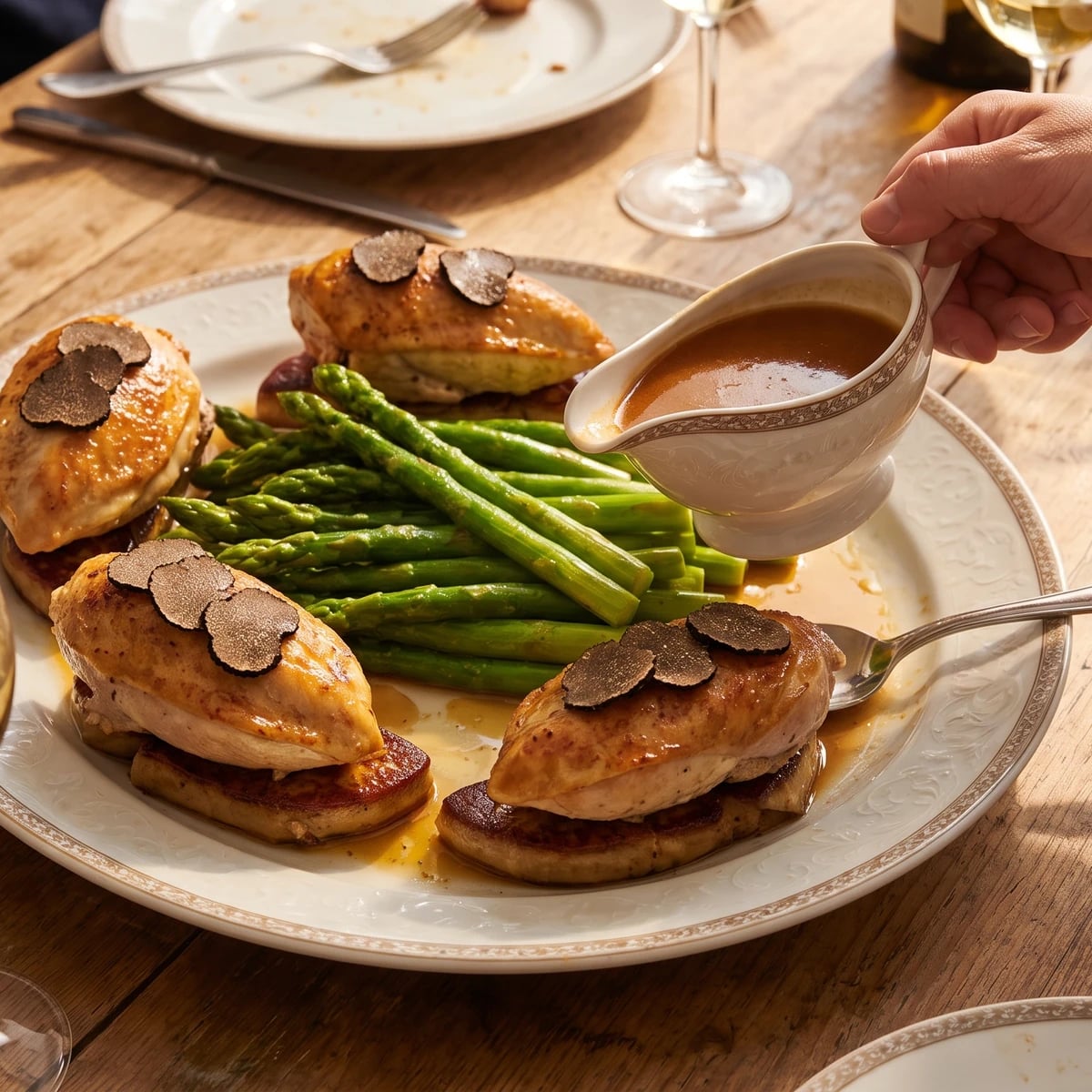
Clarified-butter suprêmes rest on seared foie gras beneath exact truffle slices, with butter-bound asparagus at the center and a separately passed light meat glaze gleaming beside them.
Suprêmes de Volaille Favorite (chicken breast fillets sautéed in clarified butter with foie gras, truffle, asparagus, and light meat glaze) teaches service, the classical art of bringing several delicate things to the table together without making any of them wait. The one true thing to know before you touch a pan is this: a suprême has no patience. Reduce the glaze, blanch the asparagus, slice the truffle, chill the foie gras, and warm the platter first. Only then does the chicken meet the clarified butter.
The original recipe assumed a saucier minding stock that never left the fire, extra hands landing the garnish, and a salamander standing ready if an assembled plate lost its heat. At home, an unsalted, gelatin-rich stock reduced in a small saucepan, a gently warmed platter, and a strict sequence do that work. The brigade portions and separate stations are scaffolding, so they go. This version makes a four-point crown for four people, preserving one slice of foie gras and exactly three truffle slices per suprême while reducing only the quantity. The clarified-butter sauté, butter-bound asparagus, and separately passed glaze mounted with real butter are the dish, and all stay. One cook, one stove, one evening.
When it lands properly, the chicken is evenly golden and juicy, the foie gras bronzed and yielding, the asparagus vivid, and the glaze light enough to pour while still coating the spoon. Have every garnish ready before the sauté begins. That timing, more than the truffle, decides the dish.
Suprêmes de Volaille Favorite belongs to the grand Parisian dining-room branch of the classical canon, where a precisely cooked poultry fillet was joined to a named garnish and a separately served sauce. Suprême here means the breast fillet of the fowl, not a cream sauce, while Favorite identifies the composed garnish of foie gras, truffle, asparagus heads, and light meat glaze rather than any region of France. Its passage to the home table changes the number of hands, not the arrangement or its generous intent.
Quantity
4, about 6 ounces each (1½ pounds / 680 g total)
trimmed to an even ¾-inch / 2 cm thickness
Quantity
¼ cup (60 ml / 55 g)
Quantity
4 slices, about 2 ounces each (8 ounces / 225 g total)
thoroughly chilled
Quantity
3 cups (710 ml / 300 g)
trimmed to 2-inch / 5 cm lengths
Quantity
12 thin slices (about ½ ounce / 14 g)
fresh, or whole preserved and drained
Quantity
3 cups (710 ml / 710 g)
Quantity
¼ cup (60 ml / 57 g)
cut into 8 pieces and divided
Quantity
2 teaspoons (10 ml / 12 g)
divided
Quantity
¼ teaspoon (1 ml / 0.5 g)
divided
| Ingredient | Quantity |
|---|---|
| skinless, boneless chicken breast suprêmestrimmed to an even ¾-inch / 2 cm thickness | 4, about 6 ounces each (1½ pounds / 680 g total) |
| clarified butter | ¼ cup (60 ml / 55 g) |
| fresh raw duck foie grasthoroughly chilled | 4 slices, about 2 ounces each (8 ounces / 225 g total) |
| asparagus headstrimmed to 2-inch / 5 cm lengths | 3 cups (710 ml / 300 g) |
| black trufflefresh, or whole preserved and drained | 12 thin slices (about ½ ounce / 14 g) |
| unsalted, gelatin-rich chicken or veal stock | 3 cups (710 ml / 710 g) |
| cold unsalted buttercut into 8 pieces and divided | ¼ cup (60 ml / 57 g) |
| fine sea saltdivided | 2 teaspoons (10 ml / 12 g) |
| finely ground white pepperdivided | ¼ teaspoon (1 ml / 0.5 g) |
Reserve ¼ cup (60 ml) of the cold stock for corrections. Pour the rest into a wide 2-quart saucepan and boil steadily until reduced to about ¾ cup (180 ml), skimming away any foam, 25 to 30 minutes. The light meat glaze should coat a spoon in a translucent, flowing film rather than cling like caramel. If it becomes sticky or strongly concentrated, loosen it a spoonful at a time with the reserved stock. Hold it over the gentlest heat without adding the butter yet.
Bring a broad pan of water to a boil and season it with about three-quarters of the salt. Add the asparagus heads and blanch until vivid green and tender at the tip while retaining a slight bite at the cut end, 2 to 3 minutes. Drain, cool briefly under cold running water, and dry them thoroughly. Moisture left on the asparagus will dilute the butter that must bind it later.
Count out 12 truffle slices, three for each suprême. If using preserved truffle, blot the slices dry; preserved truffle is quieter than fresh, but it keeps the form and intention of the garnish honestly. Keep the foie gras in the cold until its pan is ready. Warm a large oval platter gently, then remove it from the heat, and warm the sauceboat with hot water before drying it. Set half the cold butter beside the asparagus and half beside the glaze. Nothing should require searching once the chicken begins.
Dry the suprêmes meticulously and season both sides with most of the remaining salt and white pepper. Heat the clarified butter in a heavy 12-inch skillet over medium-high heat until it shimmers. Lay in the suprêmes smooth-side down without crowding and sauté without shifting them until evenly golden, 4 to 5 minutes. Turn once and cook the second side for 3 to 5 minutes, until the thickest part reaches 160°F / 71°C and will rise to 165°F / 74°C while resting. If the surface browns before the center is ready, lower the heat and cover the pan for one minute, then uncover and finish gently. Transfer the suprêmes to the warm platter and rest them uncovered for no more than 5 minutes.
Pour the chicken butter from the skillet and wipe away any browned specks. Return the dry pan to high heat until properly hot. Season the chilled foie gras lightly, lay in the slices, and sauté for 45 to 60 seconds per side, until deeply golden outside, hot, and still supple within. If the foie gras releases a pool of fat before taking color, the pan was too cool or the liver too warm. Lift the slices immediately to a cool plate, drain the pan, reheat it, and return them for only a few seconds to finish the surface. Place the four slices at equal points around the warm platter.
Return the dry asparagus pan to low heat with 2 tablespoons (30 ml / 28 g) of the cold butter. Add the asparagus heads and toss gently until heated through and coated in a close, gleaming film. The butter should cohere around the asparagus rather than collect beneath it. If it turns oily, lift the pan from the heat, add 1 teaspoon of hot water, and toss again until the butter gathers around the vegetables.
Bring the light meat glaze back to the barest simmer, then remove it from the heat. Monter au beurre (finish by whisking in cold butter): whisk in the remaining 2 tablespoons (30 ml / 28 g) butter one piece at a time, adding the next only when the last has disappeared. Never boil the glaze after this point or the emulsion can split. If an oily ring appears, set the pan on a folded towel and whisk in 1 teaspoon of the reserved cold stock. Ça se rattrape. Taste for salt and white pepper, then pour the glaze into the warmed sauceboat.
Set one suprême directly upon each slice of foie gras, arranging the four portions in a crown with their tapered ends pointing outward. Lay exactly three truffle slices across every suprême. Heap the butter-bound asparagus heads in the center, keeping their tips visible. Do not pour glaze over the assembled dish; the source sends it separately so each guest adds it at the table. Carry the platter and sauceboat out at once. À table!
1 serving (about 310g)
Culinary guides, cultural storytelling, and the editorial depth that makes cooking meaningful.
Discover Culinary Explorer
Chef Juliette
John Dory has the delicacy of sole and the firmness of turbot. A light flouring, a quick butter sauté, and nut-brown beurre noisette show exactly why looks never mattered.

Chef Juliette
Fresh haddock proves its delicacy in the meunière pan: a fine flour crust, moist pearly flakes, and beurre noisette sharpened with lemon and parsley, ready from one skillet in half an hour.

Chef Juliette
Éperlans à l’Anglaise turns small fish into a lesson in disciplined coating: boned smelts under a close, crisp crumb, pan-fried in clarified butter and finished with bright, half-melted maître d’hôtel butter.

Chef Juliette
Tiny smelts, shallot, mushrooms, white wine, gratin sauce, and fine bread raspings meet a fierce oven, where the fish must turn tender in the same breath the buttered crust bronzes.