
Chef Juliette
John Dory (St. Pierre)
John Dory has the delicacy of sole and the firmness of turbot. A light flouring, a quick butter sauté, and nut-brown beurre noisette show exactly why looks never mattered.
A cooking platform built around craft, culture, and the stories behind what we eat.
Created by Chef Juliette
Based on No. 1589, Suprêmes de Volaille aux Champignons, à Blanc, from Le Guide Culinaire (1907) by Auguste Escoffier
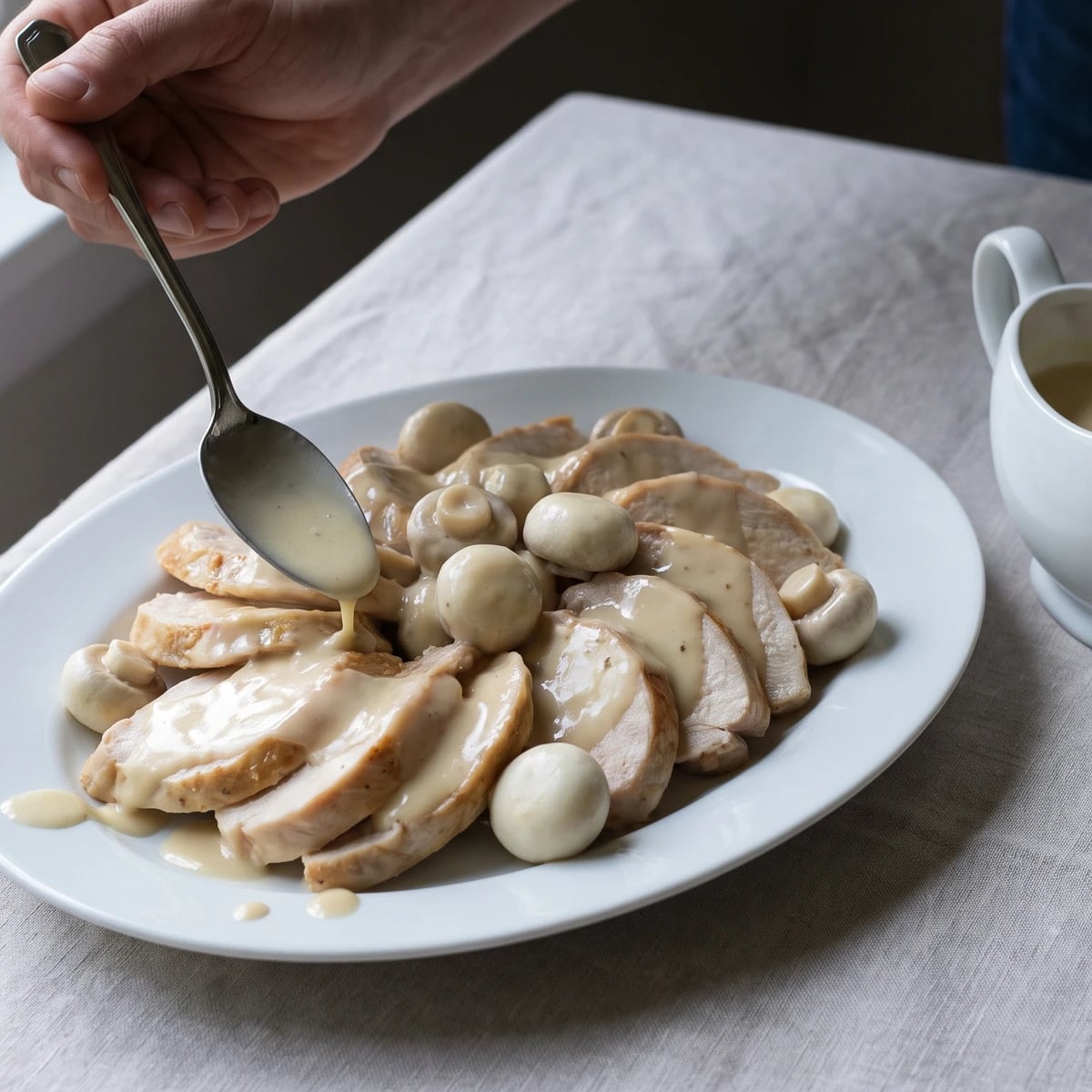
Four tender chicken suprêmes in a crown of very white mushrooms, lightly coated with glossy Allemande sauce: a lesson in poaching gently, building flavor without browning, and stopping the sauce before it boils.
Suprêmes de Volaille aux Champignons, à Blanc (chicken breast fillets with white mushrooms and Allemande sauce) teaches control without color. The one true thing to know before touching the pan is that cooking à blanc must never mean cooking without flavor. Mushroom liquor, pale roux, chicken juices, yolks, cream, and butter build the depth, while gentle heat preserves the dish's quiet ivory character.
The brigade entry assumes mushroom cooking liquor beside a finished Sauce Allemande, a saucier ready to unite them, and stock never off the fire. At home, one small batch does the work: cook the mushroom heads in stock, poach the suprêmes in that same liquor, then turn it into a velouté, a pale roux-thickened stock, and finish it with a liaison, the binding of yolks and cream. Holding separate pots of finished sauce is brigade scaffolding and can go. Cooking the mushrooms à blanc, poaching the chicken in their liquor, and binding that liquor into Allemande are the dish and must stay. A salamander has no work here; a low oven and a parchment cartouche give you the gentler heat this preparation wants. One cook, one stove, one evening.
When it is right, the suprêmes remain plump and juicy, the mushroom heads are pearl white, and the sauce falls from the spoon in a smooth ivory ribbon with butter gleaming at its surface. The step that decides the dish is the liaison: temper it slowly, keep it below a boil, and stop as soon as the sauce coats the spoon.
Suprêmes de Volaille aux Champignons, à Blanc belongs to the cuisine classique of Paris, where the breast fillet was treated as the bird's most delicate portion and presented apart from the joints destined for roasting or braising. Its compact architecture carried naturally into bourgeois dining rooms: tender chicken, mushrooms, stock, and a sauce drawn from their shared cooking liquor. À blanc does not mean flavorless or merely creamy; it names the discipline of keeping the mushrooms, roux, chicken, and finished sauce pale while building depth without browning.
Quantity
4 (about 24 oz / 680 g total)
Quantity
16 (about 10 oz / 285 g)
caps kept whole and stems thinly sliced
Quantity
2 cups (480 ml / 480 g)
Quantity
1/2 cup (120 ml / 120 g), plus more if needed
Quantity
7 tablespoons (105 ml / 100 g)
divided
Quantity
1 1/2 tablespoons (22 ml / 22 g)
divided
Quantity
3 tablespoons (45 ml / 24 g)
Quantity
1/3 cup (80 ml / 80 g)
Quantity
2
Quantity
1 1/2 teaspoons (7.5 ml / 9 g), plus more as needed
divided
Quantity
1/4 teaspoon (1.25 ml / 0.5 g), plus more as needed
| Ingredient | Quantity |
|---|---|
| chicken suprêmes, boneless and skinless | 4 (about 24 oz / 680 g total) |
| small closed white button mushroomscaps kept whole and stems thinly sliced | 16 (about 10 oz / 285 g) |
| unsalted or low-sodium chicken stock | 2 cups (480 ml / 480 g) |
| cold water | 1/2 cup (120 ml / 120 g), plus more if needed |
| unsalted butterdivided | 7 tablespoons (105 ml / 100 g) |
| fresh lemon juicedivided | 1 1/2 tablespoons (22 ml / 22 g) |
| all-purpose flour | 3 tablespoons (45 ml / 24 g) |
| heavy cream | 1/3 cup (80 ml / 80 g) |
| large egg yolks | 2 |
| fine sea saltdivided | 1 1/2 teaspoons (7.5 ml / 9 g), plus more as needed |
| ground white pepper | 1/4 teaspoon (1.25 ml / 0.5 g), plus more as needed |
Heat the oven to 325°F (165°C). Pat the suprêmes dry, remove any loose sinew, and fold each thin tip underneath so the fillets have an even, plump shape. If one thick end rises sharply, press it gently to even the thickness without flattening the breast. Season both sides with 1/2 teaspoon (2.5 ml / 3 g) of the salt and half the white pepper, then leave them at cool room temperature while you prepare the mushrooms.
Put the mushroom caps and sliced stems in a small saucepan with the chicken stock, water, 1 tablespoon (15 ml / 14 g) of the butter, 1 tablespoon (15 ml / 15 g) of the lemon juice, and 1/4 teaspoon (1.25 ml / 1.5 g) of the salt. Lay a cartouche, a round of parchment paper, directly over the mushrooms and bring the liquid only to a bare simmer. Cook for 5 to 7 minutes, until the caps are just tender and still very white. Lift out the caps and cover them. Simmer the stems for another 5 minutes, then strain the mushroom cooking liquor through a fine sieve, pressing gently on the stems without forcing debris through.
Arrange the suprêmes snugly in a single layer in a shallow ovenproof pan. Add enough warm mushroom cooking liquor to reach halfway up their sides, about 1 1/2 cups (360 ml / 360 g), and dot them with 1 tablespoon (15 ml / 14 g) of the butter. Cover directly with a fresh cartouche, bring the liquor just to a tremble on the stove, then transfer the pan to the oven. Poach for 12 to 16 minutes, turning the pan once, until the thickest part reaches 160°F (71°C). Transfer the suprêmes to a warmed platter and cover loosely; their temperature will rise to 165°F (74°C) as they rest. If the liquor begins boiling before the chicken is ready, pull the pan from the heat immediately and let the temperature settle. A hard boil tightens the meat, but if it goes slightly too far, ça se rattrape: slice the suprêmes on a shallow diagonal and serve them generously coated with sauce.
Strain the chicken poaching liquor and combine it with the reserved mushroom liquor. Measure 2 cups (480 ml / 480 g); if there is more, reduce it briskly to that amount and keep any excess separately, while if it is short by a spoonful, add water. Melt 3 tablespoons (45 ml / 43 g) of the butter in a clean saucepan over low heat. Stir in the flour and cook for 2 minutes, stirring constantly, until the raw flour smell disappears but the roux takes no color. Whisk in the hot measured liquor a little at a time, smoothing each addition before adding the next. Bring the velouté to a full simmer for 1 minute, then cook gently for 7 to 8 minutes, whisking often, until it lightly coats the back of a spoon. If lumps appear, take the pan off the heat, whisk firmly, and pass the sauce through the fine sieve. Ça se rattrape.
Whisk the egg yolks and cream together in a heatproof bowl. While whisking continuously, add about 1 cup (240 ml / 240 g) of the hot velouté in a thin stream. Pour this tempered liaison back into the saucepan and cook over low heat, stirring constantly, until the Sauce Allemande reaches 160°F to 165°F (71°C to 74°C) and holds a clean trail across the back of the spoon. Do not let it boil. Remove it from the heat and whisk in the remaining 2 tablespoons (30 ml / 29 g) of butter, one small piece at a time, followed by the remaining 1 1/2 teaspoons (7 ml / 7 g) of lemon juice. Season with the remaining salt and white pepper. If the sauce starts looking grainy, pull it from the heat, whisk in 1 teaspoon (5 ml / 5 g) of cold water, and strain it immediately into a clean warm bowl. If it is too thick, loosen it with a spoonful of reserved liquor; if too thin, return it to the gentlest heat and stir until it coats the spoon.
Warm the mushroom caps in 2 or 3 spoonfuls of Sauce Allemande over the lowest heat. Arrange the suprêmes on a warmed oval platter in a crown, with their narrow ends angled toward the center and slightly overlapping. Nestle the very white mushroom heads in the center and between the fillets. Coat the chicken moderately with Sauce Allemande, enough to glaze each suprême while leaving its shape visible, and pour the remaining sauce into a warmed sauceboat for the table. Serve at once. À table!
1 serving (about 345g)
Culinary guides, cultural storytelling, and the editorial depth that makes cooking meaningful.
Discover Culinary Explorer
Chef Juliette
John Dory has the delicacy of sole and the firmness of turbot. A light flouring, a quick butter sauté, and nut-brown beurre noisette show exactly why looks never mattered.

Chef Juliette
Fresh haddock proves its delicacy in the meunière pan: a fine flour crust, moist pearly flakes, and beurre noisette sharpened with lemon and parsley, ready from one skillet in half an hour.

Chef Juliette
Éperlans à l’Anglaise turns small fish into a lesson in disciplined coating: boned smelts under a close, crisp crumb, pan-fried in clarified butter and finished with bright, half-melted maître d’hôtel butter.

Chef Juliette
Tiny smelts, shallot, mushrooms, white wine, gratin sauce, and fine bread raspings meet a fierce oven, where the fish must turn tender in the same breath the buttered crust bronzes.