
Chef Juliette
John Dory (St. Pierre)
John Dory has the delicacy of sole and the firmness of turbot. A light flouring, a quick butter sauté, and nut-brown beurre noisette show exactly why looks never mattered.
A cooking platform built around craft, culture, and the stories behind what we eat.
Created by Chef Juliette
Based on No. 1520, Poularde Souvaroff, from Le Guide Culinaire (1907) by Auguste Escoffier
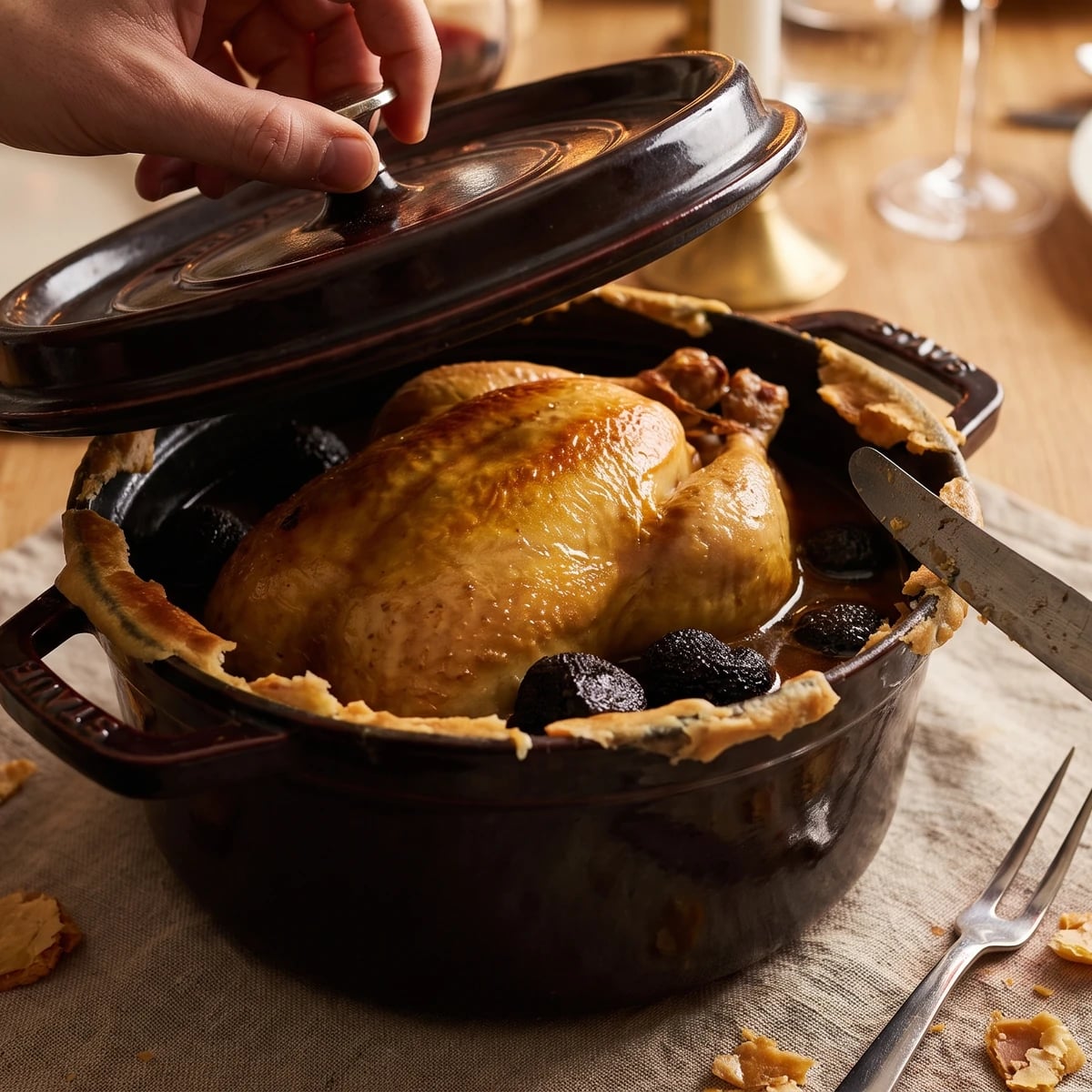
A foie-gras-and-truffle-stuffed poularde, poêled in butter, enclosed with Madeira-scented whole truffles, and sealed in its cocotte so the first broken edge of paste releases the dish's full perfume.
Poularde Souvaroff (foie-gras-and-truffle-stuffed pullet sealed in a pot) teaches containment. The bird is poêlé, gently butter-roasted in a covered pot, then enclosed with Madeira, veal stock, foie gras, and truffles. The one true thing to know is this: the paste seal isn't theater. It holds the fragrance around the bird until the lid is broken at the table, and that first rush of truffle perfume is half the dish.
The grand kitchen assumed a saucier, veal stock never off the fire, and separate vessels for cooking and presentation. Your home equivalent is one snug heavy cocotte, a small measure of rich veal stock, and Poëlings (No. 250) scaled for a single bird. The extra vessel was brigade scaffolding and can go. The dry butter cooking, full foie gras and truffle proportions, Madeira reduction, and unbroken paste seal are the dish, so they stay. One cook, one stove, one evening.
Guard the seal. Roll the paste evenly, press it continuously around the lid, and patch any crack as soon as it appears. A pale bird can be corrected during the poëling and an over-reduced Madeira can be loosened, but fragrance escaping through a neglected gap cannot be called back.
Poularde Souvaroff belongs to the ceremonial Parisian table of classical grand cuisine, whose cooks often attached Russian names to elaborate service pieces while keeping French products and methods at their core. Souvaroff is the French rendering of Suvorov, but this is not a Russian country dish: poularde, foie gras, Périgord truffle, Madeira, poëling, and a luted cocotte all speak the language of the French grand kitchen. Its paste seal reached celebratory home tables because it is practical as well as dramatic, holding the truffle perfume captive until the lid is opened before the guests.
Quantity
1 bird, 4½ to 5 pounds (2 to 2.3 kg)
giblets removed
Quantity
2 teaspoons (10 ml / 12 g)
Quantity
1 teaspoon (5 ml / 2 g)
Quantity
1 cup, loosely packed (240 ml / 227 g / 8 oz)
very cold and cut into large dice
Quantity
about ¾ cup (180 ml / 142 g / 5 oz)
cut into large dice
Quantity
1 preparation Poëlings (No. 250), scaled for one pullet
Quantity
10 medium (about 10½ oz / 300 g)
Quantity
½ cup (120 ml / 120 g)
Quantity
scant ½ cup, equivalent to one-sixth imperial pint (95 ml / 95 g)
Quantity
1½ cups (360 ml / 180 g)
for the sealing paste
Quantity
⅓ cup plus up to 1 tablespoon (95 ml / 95 g)
for the sealing paste
| Ingredient | Quantity |
|---|---|
| oven-ready poularde or plump pulletgiblets removed | 1 bird, 4½ to 5 pounds (2 to 2.3 kg) |
| fine sea salt | 2 teaspoons (10 ml / 12 g) |
| freshly ground black pepper | 1 teaspoon (5 ml / 2 g) |
| raw foie grasvery cold and cut into large dice | 1 cup, loosely packed (240 ml / 227 g / 8 oz) |
| black truffle for the stuffingcut into large dice | about ¾ cup (180 ml / 142 g / 5 oz) |
| referenced poëling preparation | 1 preparation Poëlings (No. 250), scaled for one pullet |
| whole black truffles | 10 medium (about 10½ oz / 300 g) |
| dry Madeira | ½ cup (120 ml / 120 g) |
| rich veal stock | scant ½ cup, equivalent to one-sixth imperial pint (95 ml / 95 g) |
| all-purpose flourfor the sealing paste | 1½ cups (360 ml / 180 g) |
| cold waterfor the sealing paste | ⅓ cup plus up to 1 tablespoon (95 ml / 95 g) |
Heat the oven to 350°F (180°C). Mix the flour with the initial ⅓ cup of cold water, adding the remaining water a teaspoon at a time, until you have a stiff, smooth paste that bends without crumbling. Knead it briefly, cover it, and let it rest while you prepare the bird. Keep back a walnut-sized piece for repairs.
Dry the poularde thoroughly, then season it inside and out with the salt and pepper. Gently combine the cold foie gras and diced truffle, keeping the pieces distinct, and spoon them loosely into the cavity. Don't ram the stuffing tight or heat cannot reach its center evenly. Truss the legs across the opening and fold the wing tips beneath the bird.
Apply Poëlings (No. 250) in the same snug cocotte you will eventually carry to the table, taking the poularde only to three-quarters cooked, about 65 to 75 minutes for this size of bird. The skin should be evenly hazelnut-gold, the thickest part of the thigh about 145°F (63°C), and the stuffing near 140°F (60°C). Add no stock during this stage. Moistening now would turn the poularde into a braise and erase the concentrated butter-roasted savor that poëling is meant to build. Don't move on with pale skin, because the sealed finish will not brown it.
Lift the poularde onto a rimmed plate without cleaning or degreasing the cocotte. The butter and fond left by Poëlings (No. 250) carry the bird's flavor. Add the 10 whole truffles and the Madeira, then simmer gently for 3 to 5 minutes, rolling the truffles through the butter until the Madeira loses its raw alcoholic edge and reduces to a thin syrup. If the liquid disappears before that point and the fond threatens to catch, lower the heat and add a spoonful of the measured veal stock. Ça se rattrape.
Return the poularde and any collected juices to the cocotte, settling the whole truffles around it. Pour the veal stock around the bird rather than over its browned skin. Insert an oven-safe probe into the center of the stuffing, fit the lid, and roll the sealing paste into a rope about ¾ inch (2 cm) thick. Press it continuously around the join between lid and pot, sealing carefully around the probe cable. If the paste splits, press on a piece of the reserved dough with a damp finger immediately. The crack looks alarming, but it is entirely repairable.
Return the sealed cocotte to the moderate oven for 30 minutes. The stuffing must reach 165°F (74°C), with the thigh at least as hot, before the bird is served. If the probe reads low after the prescribed half hour, continue for 5 to 10 minutes; temperature, not optimism, decides poultry. Remove the cocotte and let it stand sealed for 10 minutes.
Remove the probe and press the small cable opening closed. Carry the cocotte to the table exactly as it stands. Cut through the paste ring with a sturdy table knife and lift the lid away from your guests, releasing the trapped perfume all at once. Carve the poularde, keeping the foie-gras-and-truffle stuffing in generous spoonfuls, and give each serving whole truffles and some of the glossy Madeira jus from the bottom of the cocotte. À table!
1 serving (about 485g)
Culinary guides, cultural storytelling, and the editorial depth that makes cooking meaningful.
Discover Culinary Explorer
Chef Juliette
John Dory has the delicacy of sole and the firmness of turbot. A light flouring, a quick butter sauté, and nut-brown beurre noisette show exactly why looks never mattered.

Chef Juliette
Fresh haddock proves its delicacy in the meunière pan: a fine flour crust, moist pearly flakes, and beurre noisette sharpened with lemon and parsley, ready from one skillet in half an hour.

Chef Juliette
Éperlans à l’Anglaise turns small fish into a lesson in disciplined coating: boned smelts under a close, crisp crumb, pan-fried in clarified butter and finished with bright, half-melted maître d’hôtel butter.

Chef Juliette
Tiny smelts, shallot, mushrooms, white wine, gratin sauce, and fine bread raspings meet a fierce oven, where the fish must turn tender in the same breath the buttered crust bronzes.