
Chef Juliette
Ordinary or White Consommé
Beef shin, lean beef, and fowl begin in cold water and rise slowly toward a tremble. Skim before the boil, and you learn the quiet discipline that gives every clear French broth its backbone.
A cooking platform built around craft, culture, and the stories behind what we eat.
Created by Chef Juliette
Based on No. 151a, Melted Butter, from Le Guide Culinaire (1907) by Auguste Escoffier
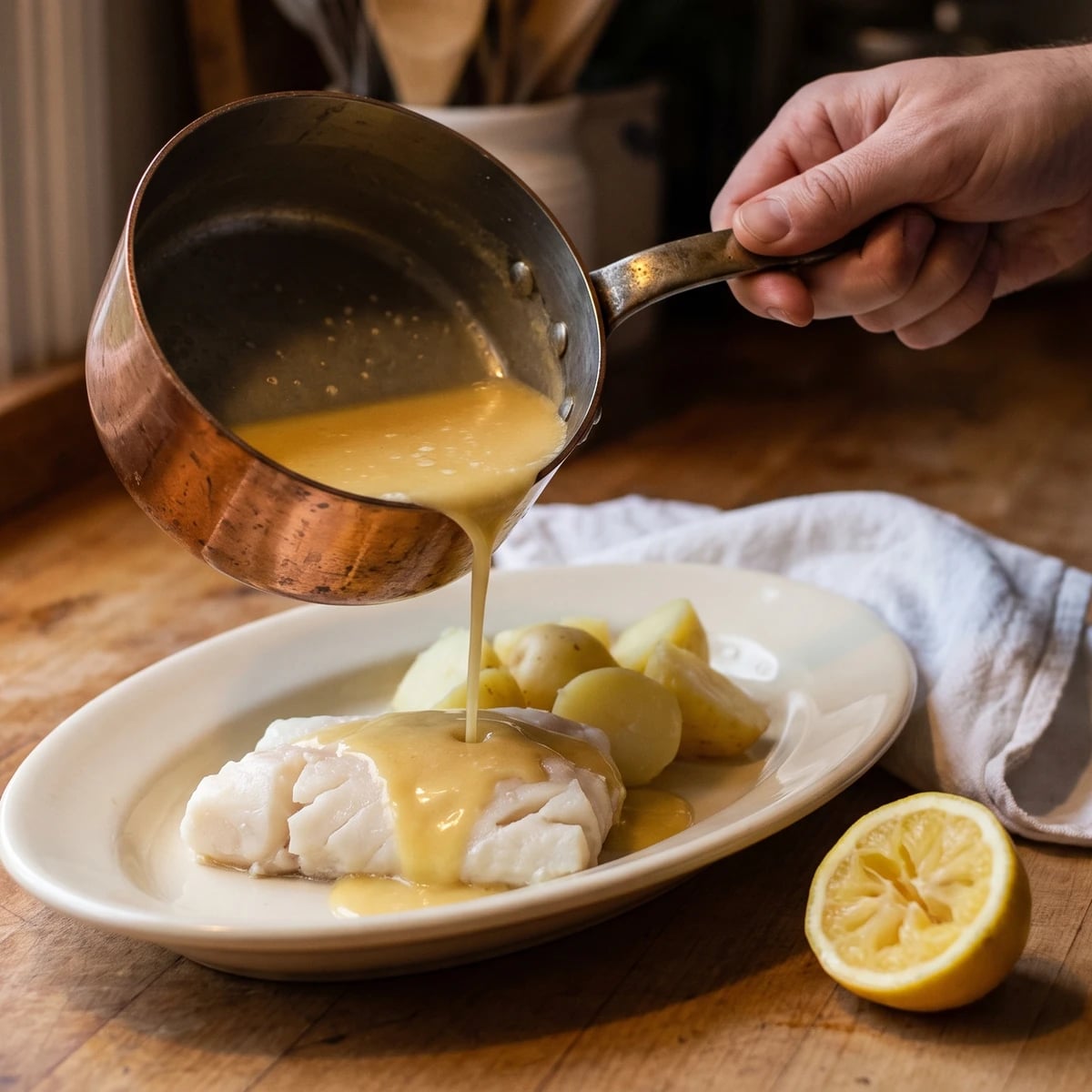
Beurre fondu asks for three minutes and complete attention: real butter, barely melted, sharpened with salt and lemon, then sent straight to boiled fish before its milky emulsion separates.
Beurre fondu, melted butter, teaches restraint. Its one true thing is this: melting is the finish, not the beginning. You want butter just warm enough to become fluid while its water and milk solids remain held in the golden fat. Let it sit over heat until it clears, and you have beurre clarifié, useful elsewhere but stripped of the fresh flavor and soft grace this sauce owes boiled fish.
The original entry assumed a saucier could make an unmeasured service portion at the last instant while another hand drained the fish. At home, the honest equivalent is a small saucepan, 1/2 cup of butter for four people, and every plate ready before the flame is lit. The entry's little salt and few drops of lemon are measured here for consistency; no stockpot, reduction, roux, or salamander belongs to this preparation. Those are scaffolding for other sauces. Here the last-minute melting is the dish. One cook, one stove, one evening.
Keep the heat low and pull the pan away while the final pieces are still visible. Residual heat finishes them. If a clear ring forms, cold butter and the lemon drops can bring the emulsion back. Ça se rattrape. The step that matters most is serving the beurre fondu before it has time to separate.
Beurre fondu belongs to the national French classical table rather than to one regional larder, and it was used chiefly with fish boiled gently in salted water or court-bouillon. Grand kitchens classified it among the simplest butter sauces, but sauciers did not hold it beside reductions: its cloudy, just-melted state was the desired finish, while beurre clarifié was a different preparation for different work. At the bourgeois table the scale shrank to a small pan, yet the service rule remained unchanged, make it last and send it at once.
Quantity
1/2 cup (120 ml / 113 g)
cold and cut into 8 equal cubes
Quantity
1/8 teaspoon (0.6 ml / 0.7 g)
Quantity
4 to 6 drops (about 1/16 teaspoon / 0.3 ml / 0.3 g)
| Ingredient | Quantity |
|---|---|
| unsalted buttercold and cut into 8 equal cubes | 1/2 cup (120 ml / 113 g) |
| fine table salt | 1/8 teaspoon (0.6 ml / 0.7 g) |
| fresh lemon juice | 4 to 6 drops (about 1/16 teaspoon / 0.3 ml / 0.3 g) |
Have the boiled fish cooked, drained thoroughly, and waiting on warm plates before you begin. Fill a small sauceboat with hot tap water to warm it, then empty and dry it completely. Beurre fondu cannot wait while you search for plates; water left on the fish or in the sauceboat will thin its flavor.
Keep one butter cube cold and put the other seven in the smallest saucepan you own. Set it over the lowest heat and rotate the pan slowly, turning the softening pieces through the liquid without letting the butter sizzle or foam hard. When most of it is fluid but two soft pieces remain, take the pan completely off the heat. Add the reserved cold cube and swirl until every piece has only just disappeared. The beurre fondu should look uniformly butter-gold and softly cloudy, with no clear oil floating above white sediment.
Stir in the table salt and 4 drops of lemon juice. Taste; the lemon should sharpen the butter without announcing itself, so add the final 2 drops only if needed. If a clear oily ring appears, clarification has begun. Remove the pan from all heat and whisk firmly while adding the reserved cold cube and the lemon drops; the cooler butter and tiny aqueous phase should restore the milky body. Ça se rattrape. If the butter remains completely clear and divided, keep it for cooking and begin the sauce again, because it is no longer beurre fondu.
Pour the beurre fondu into the warm, dry sauceboat or spoon it directly over the drained fish. Serve immediately, while the sauce is fluid, fragrant, and still unified. Do not hold it over a warming flame and do not let it stand while the fish cools. À table!
1 serving (about 29g)
Culinary guides, cultural storytelling, and the editorial depth that makes cooking meaningful.
Discover Culinary Explorer
Chef Juliette
Beef shin, lean beef, and fowl begin in cold water and rise slowly toward a tremble. Skim before the boil, and you learn the quiet discipline that gives every clear French broth its backbone.

Chef Juliette
Break the veal bones small, then give them eight hours at a bare tremble. This pale, gelatinous fond becomes the quiet foundation beneath velouté, blanquette, and every sauce that must stay light.

Chef Juliette
Sauce Orientale concentrates lobster-rich American Sauce with curry, then folds in cream away from the fire: a glossy, gently spiced derivative made for lobster, crayfish, and firm fish.

Chef Juliette
An old lesson in sauce families: Sauce Allemande takes mushroom liquor, then butter, lemon, and parsley, becoming a glossy Poulette for sheep's trotters, leeks, cauliflower, and anything needing gentle richness with a bright edge.