
Chef Juliette
Ordinary or White Consommé
Beef shin, lean beef, and fowl begin in cold water and rise slowly toward a tremble. Skim before the boil, and you learn the quiet discipline that gives every clear French broth its backbone.
A cooking platform built around craft, culture, and the stories behind what we eat.
Created by Chef Juliette
Based on No. 140a, Châteaubriand Butter, from Le Guide Culinaire (1907) by Auguste Escoffier
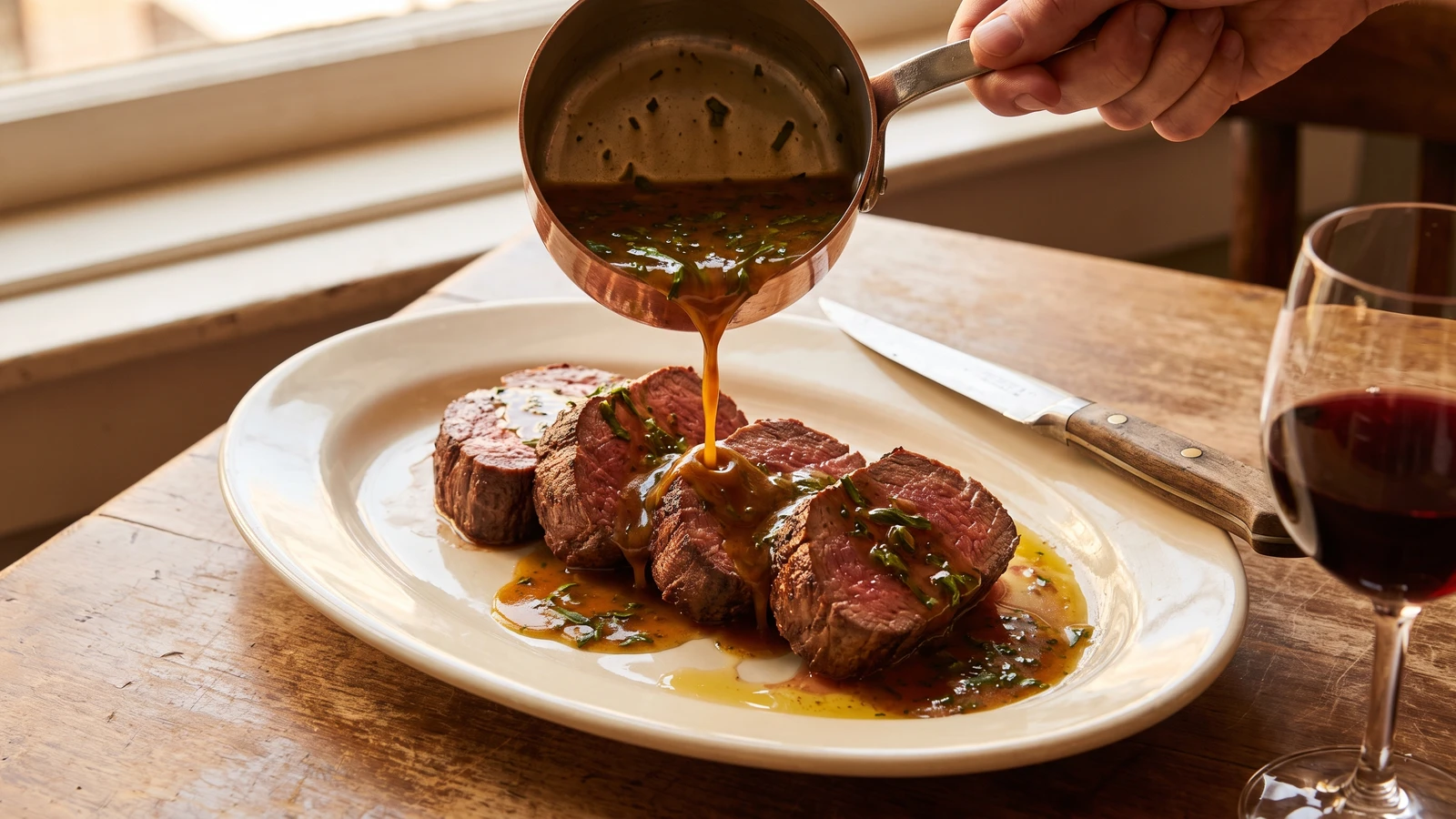
Beurre Châteaubriand turns a firm white-wine reduction and veal gravy into a glossy sauce with herb butter and tarragon, succeeding only when the pan leaves the fire.
Beurre Châteaubriand (white-wine, veal and herb-butter sauce) teaches the clean handoff from reduction to emulsion. The one true thing to know before touching the pan is this: finish reducing the liquid before the butter enters, then never let the finished sauce boil. Reduction builds its backbone. Butter gives it body and shine.
The source assumed a saucier at the stove, veal gravy always ready, brigade quantities, and a tammy for passing the sauce. At home, a small heavy saucepan replaces the station, good unsalted prepared veal gravy replaces the permanent stockpot, and a fine-mesh sieve replaces the tammy. The formula is quarter-scaled in practical measures, enough for four portions because a mounted butter sauce should be made close to serving. Staffing and bulk are scaffolding. The two reductions and the off-fire butter finish are the dish, and they stay.
When it lands correctly, the sauce is mahogany-gold, savory with mushroom and shallot, brightened by tarragon, and glossy enough to fall from the spoon in a soft ribbon. Remove the pan from the heat before adding the butter. That single movement decides the sauce.
Beurre Châteaubriand belongs to the Parisian classical grill repertoire, made for the thick center-cut fillet served under the same name and carried from grand dining rooms into bistro practice. It is often mistaken for a simple compound butter, but this source makes a true reduction sauce: white wine, shallot, mushroom parings and veal gravy are concentrated, then enriched with Butter à la Maître d’Hôtel (No. 150) and fresh tarragon.
Quantity
½ cup (120 ml / 118 g)
Quantity
1 small
finely chopped
Quantity
1 small sprig
Quantity
¼ leaf
torn once
Quantity
½ cup loosely packed (120 ml / 28 g)
Quantity
½ cup (120 ml / 120 g)
Quantity
¼ cup (60 ml / 57 g)
cool but pliable and divided into 8 pieces
Quantity
⅜ teaspoon (1.9 ml / 0.4 g)
finely chopped
Quantity
1 teaspoon (5 ml / 5 g)
only if needed to rescue the emulsion
| Ingredient | Quantity |
|---|---|
| dry white wine | ½ cup (120 ml / 118 g) |
| shallotfinely chopped | 1 small |
| thyme | 1 small sprig |
| dried bay leaftorn once | ¼ leaf |
| clean mushroom parings | ½ cup loosely packed (120 ml / 28 g) |
| unsalted veal gravy | ½ cup (120 ml / 120 g) |
| Butter à la Maître d’Hôtel (No. 150)cool but pliable and divided into 8 pieces | ¼ cup (60 ml / 57 g) |
| fresh tarragonfinely chopped | ⅜ teaspoon (1.9 ml / 0.4 g) |
| cold water (optional)only if needed to rescue the emulsion | 1 teaspoon (5 ml / 5 g) |
Combine the white wine, shallot, thyme, bay leaf, and mushroom parings in a small heavy saucepan. Bring them to a brisk, controlled simmer over medium-high heat and reduce the wine by two-thirds, until about 2 tablespoons plus 2 teaspoons (40 ml) remain. The shallot and mushrooms should sit in a wet, intensely scented glaze, never a dry pan. If the wine slips too far and the shallot begins to catch, add 1 tablespoon of wine or water and reduce again. Ça se rattrape.
Pour in the veal gravy and stir across the pan floor to gather every trace of the wine reduction. Return the mixture to a lively simmer and reduce the whole by half, to about ⅓ cup (80 ml). It is ready when the bubbles look close and glossy and the liquid lightly naps the back of a spoon, meaning it coats rather than runs off like broth. Complete this reduction now. Once the butter enters, boiling is forbidden.
Set a fine-mesh sieve over a clean heatproof jug and pour in the reduction. Press the shallot and mushroom parings firmly with the back of a spoon to recover their liquid, then discard the solids. This sieve is the honest home equivalent of the tammy: the equipment changes, but the purpose remains a smooth, concentrated base without stray fibers. Rinse and dry the saucepan, then return the strained sauce to it.
Bring the strained base just to the first simmer, then remove the pan completely from the heat and wait about 20 seconds. Monter au beurre means mounting the sauce with butter: whisk in the Butter à la Maître d’Hôtel (No. 150) one piece at a time, adding each new piece when the last is nearly absorbed. Beat steadily until the sauce is thick, glossy, and unified, then fold in the chopped tarragon. If it turns oily or separates, do not return it to the flame. Whisk the cold water in a clean bowl, then add the broken sauce a teaspoon at a time until it gathers; once smooth, whisk in the remainder gradually. Ça se rattrape.
Taste before considering any further seasoning, since the veal gravy and compound butter already carry salt, pepper, lemon, and parsley. Spoon about 2 tablespoons over each grilled fillet of beef, letting the sauce pool naturally beneath it. Serve at once. If dinner pauses, hold the saucepan in barely warm water for no more than 10 minutes and whisk occasionally; direct heat will split what you have just built. À table!
1 serving (about 38g)
Culinary guides, cultural storytelling, and the editorial depth that makes cooking meaningful.
Discover Culinary ExplorerChef Juliette
Beef shin, lean beef, and fowl begin in cold water and rise slowly toward a tremble. Skim before the boil, and you learn the quiet discipline that gives every clear French broth its backbone.

Chef Juliette
Break the veal bones small, then give them eight hours at a bare tremble. This pale, gelatinous fond becomes the quiet foundation beneath velouté, blanquette, and every sauce that must stay light.

Chef Juliette
Sauce Orientale concentrates lobster-rich American Sauce with curry, then folds in cream away from the fire: a glossy, gently spiced derivative made for lobster, crayfish, and firm fish.

Chef Juliette
An old lesson in sauce families: Sauce Allemande takes mushroom liquor, then butter, lemon, and parsley, becoming a glossy Poulette for sheep's trotters, leeks, cauliflower, and anything needing gentle richness with a bright edge.