
Chef Juliette
John Dory (St. Pierre)
John Dory has the delicacy of sole and the firmness of turbot. A light flouring, a quick butter sauté, and nut-brown beurre noisette show exactly why looks never mattered.
A cooking platform built around craft, culture, and the stories behind what we eat.
Created by Chef Juliette
Based on No. 1388, Fresh Neck of Pork with Red Cabbage à la Flamande, from Le Guide Culinaire (1907) by Auguste Escoffier
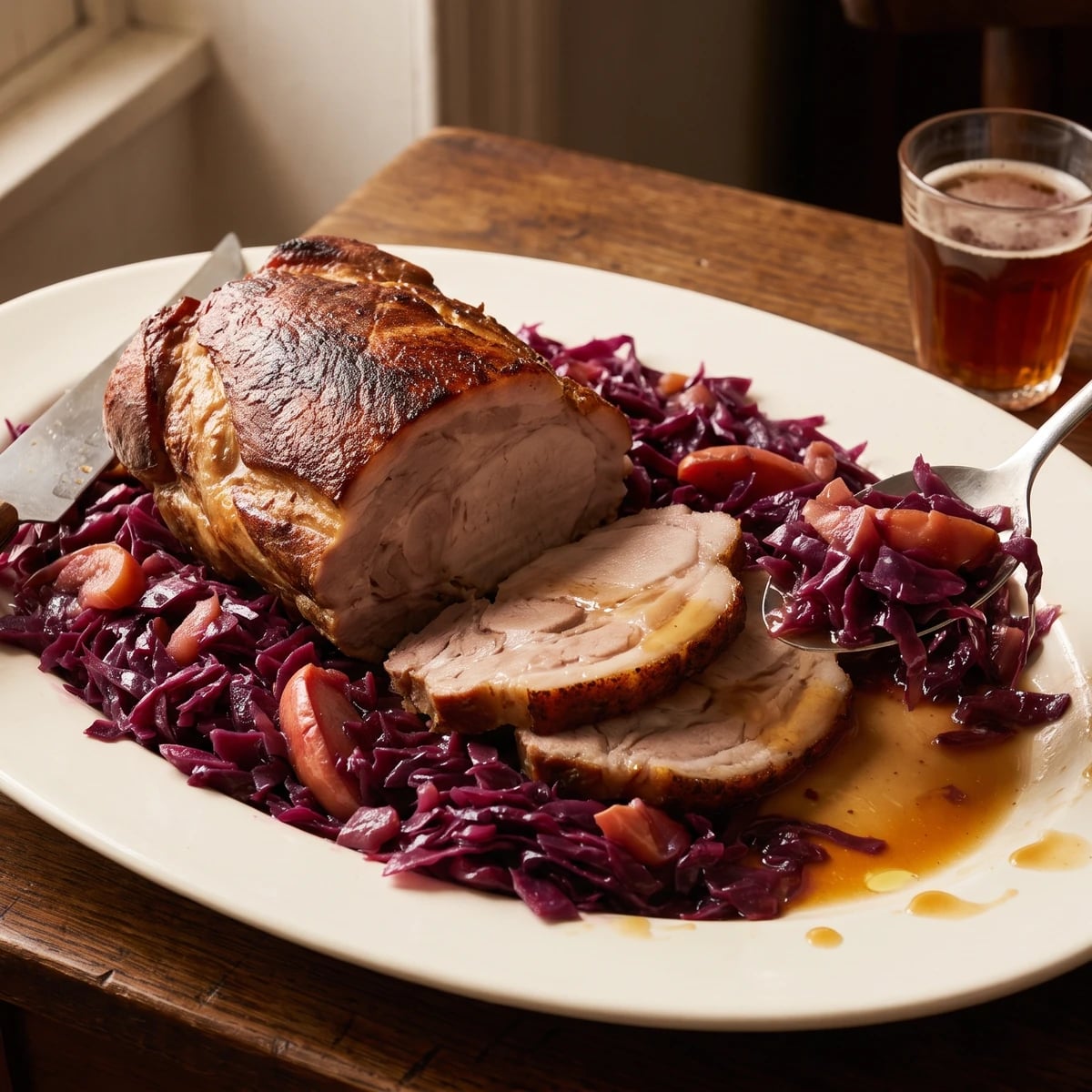
Burnished pork collar, apple-sharpened red cabbage, and clear roasting jus make the northern lesson plain: roast patiently, keep the garnish gentle, and clear the joint gravy without stripping away every savory drop of fat.
Cou de porc frais aux choux rouges à la flamande (fresh neck of pork with Flemish-style red cabbage) teaches the discipline of gentle heat. The pork must bronze without drying, while the vinegar-bright cabbage stays tender rather than jammy and the apple remains distinct. Before you touch a pan, know the one true thing: force the heat and you lose the balance that makes this generous northern dish work.
The book assumes a roast station and a vegetable station working at once, followed by a free hand to clear the joint gravy before service. It asks for neither a saucier's sauce nor stock from the ever-hot pot; the pork's own juices are the foundation. At home, the Choux Rouges à la Flamande (No. 2098) remains a finished preparation in its own right, while one compact pork collar roasts and a clear jug separates its gravy. The separate hands are brigade scaffolding and can go. The gentle vinegar-only braise and the removal of three quarters of the grease are the dish, and they stay. One cook, one stove, one evening.
The finished platter should be broad and abundant: burnished slices of pork in the center, wine-dark cabbage gathered around them, and enough clear gravy across the vegetables to make them gleam. Keep the cabbage covered and gentle whenever it meets the heat, including its final warming. That is the step that matters most tonight.
Cou de porc aux choux rouges à la flamande belongs to French Flanders, particularly the northern tables around Lille, where pork, sweet-sour cabbage, apples, and local beer share the same larder. The garnish traveled from farmhouse and estaminet cooking into the classical repertoire, where it became a separately named preparation arranged formally around a roast joint. This is not Alsatian choucroute: the cabbage is red rather than fermented white, vinegar supplies its moisture, and apple with a little sugar rounds the acidity.
Quantity
1 roast (3 lb / 1.35 kg)
tied into an even shape
Quantity
2¼ teaspoons (11 ml / 14 g)
Quantity
1 teaspoon (5 ml / 2 g)
Quantity
5 cups (1.2 L / 1 kg) prepared Choux Rouges à la Flamande (No. 2098)
Quantity
½ cup (120 ml / 120 g)
for releasing the roasting fond
| Ingredient | Quantity |
|---|---|
| boneless fresh pork neck or collar roasttied into an even shape | 1 roast (3 lb / 1.35 kg) |
| fine sea salt | 2¼ teaspoons (11 ml / 14 g) |
| freshly ground black pepper | 1 teaspoon (5 ml / 2 g) |
| prepared Choux Rouges à la Flamande | 5 cups (1.2 L / 1 kg) prepared Choux Rouges à la Flamande (No. 2098) |
| boiling waterfor releasing the roasting fond | ½ cup (120 ml / 120 g) |
Heat the oven to 450°F (230°C). Pat the pork completely dry, then season every surface with the salt and pepper. If the butcher has not tied it, bind it at 1-inch (2.5 cm) intervals so the roast cooks evenly and carves cleanly. Set it fat-side up on a small rack in a heavy roasting pan and leave it for 20 minutes while the oven finishes heating. A dry, even surface takes color; a damp one merely sweats.
Roast at 450°F (230°C) for 20 minutes, until the top is properly bronzed and the fat has begun to render. Do not baste yet. Opening the oven and washing the surface with liquid before the crust forms only delays the browning the gravy needs.
Reduce the oven to 325°F (160°C) and continue roasting for 1 hour 50 minutes to 2 hours 20 minutes. Turn the pan once for even color, but leave the pork fat-side up. It is ready when the center reaches 180 to 185°F (82 to 85°C), a thin knife meets little resistance, and the meat is tender while still firm enough to slice. If the crust darkens too quickly, cover it loosely with foil. If the fond on the pan floor threatens to turn black, add 2 tablespoons of the boiling water around the rack, never over the pork. Ça se rattrape: lower the heat slightly and preserve the brown fond before it becomes bitter.
Transfer the pork to a warm platter or carving board and tent it loosely with foil for 25 to 30 minutes. While it rests, warm the prepared Choux Rouges à la Flamande (No. 2098) in its covered cocotte over low heat for 15 to 20 minutes, folding it once from the edges toward the center. Add no stock or water. If the bottom catches, do not scrape the scorched layer through the cabbage; lift the clean portion into another pan, cover it, and lower the heat.
Remove the rack from the roasting pan and pour in the remaining boiling water, scraping up every brown speck of fond. Add the juices collected beneath the resting pork and simmer for 2 to 3 minutes, until the gravy tastes concentrated but remains fluid. Pour it into a clear heatproof jug and let the fat rise for 2 minutes, then spoon away roughly three quarters of the visible grease, leaving a fine savory sheen. If the gravy is weak, reduce it briefly; if it tightens or tastes too strong, loosen it with a spoonful of hot water.
Set the roast in the center of a warm oval platter and surround it generously with the cabbage, keeping the vegetables beside the pork rather than beneath its crust. Spoon the three-parts-cleared joint gravy over the cabbage so its surface gleams, then remove the strings and carve the pork across the grain into thick slices. Bring the remaining gravy separately for anyone who wants another spoonful. À table!
1 serving (about 525g)
Culinary guides, cultural storytelling, and the editorial depth that makes cooking meaningful.
Discover Culinary Explorer
Chef Juliette
John Dory has the delicacy of sole and the firmness of turbot. A light flouring, a quick butter sauté, and nut-brown beurre noisette show exactly why looks never mattered.

Chef Juliette
Fresh haddock proves its delicacy in the meunière pan: a fine flour crust, moist pearly flakes, and beurre noisette sharpened with lemon and parsley, ready from one skillet in half an hour.

Chef Juliette
Éperlans à l’Anglaise turns small fish into a lesson in disciplined coating: boned smelts under a close, crisp crumb, pan-fried in clarified butter and finished with bright, half-melted maître d’hôtel butter.

Chef Juliette
Tiny smelts, shallot, mushrooms, white wine, gratin sauce, and fine bread raspings meet a fierce oven, where the fish must turn tender in the same breath the buttered crust bronzes.