
Chef Juliette
John Dory (St. Pierre)
John Dory has the delicacy of sole and the firmness of turbot. A light flouring, a quick butter sauté, and nut-brown beurre noisette show exactly why looks never mattered.
A cooking platform built around craft, culture, and the stories behind what we eat.
Created by Chef Juliette
Based on No. 1277, Fricadelles, from Le Guide Culinaire (1907) by Auguste Escoffier
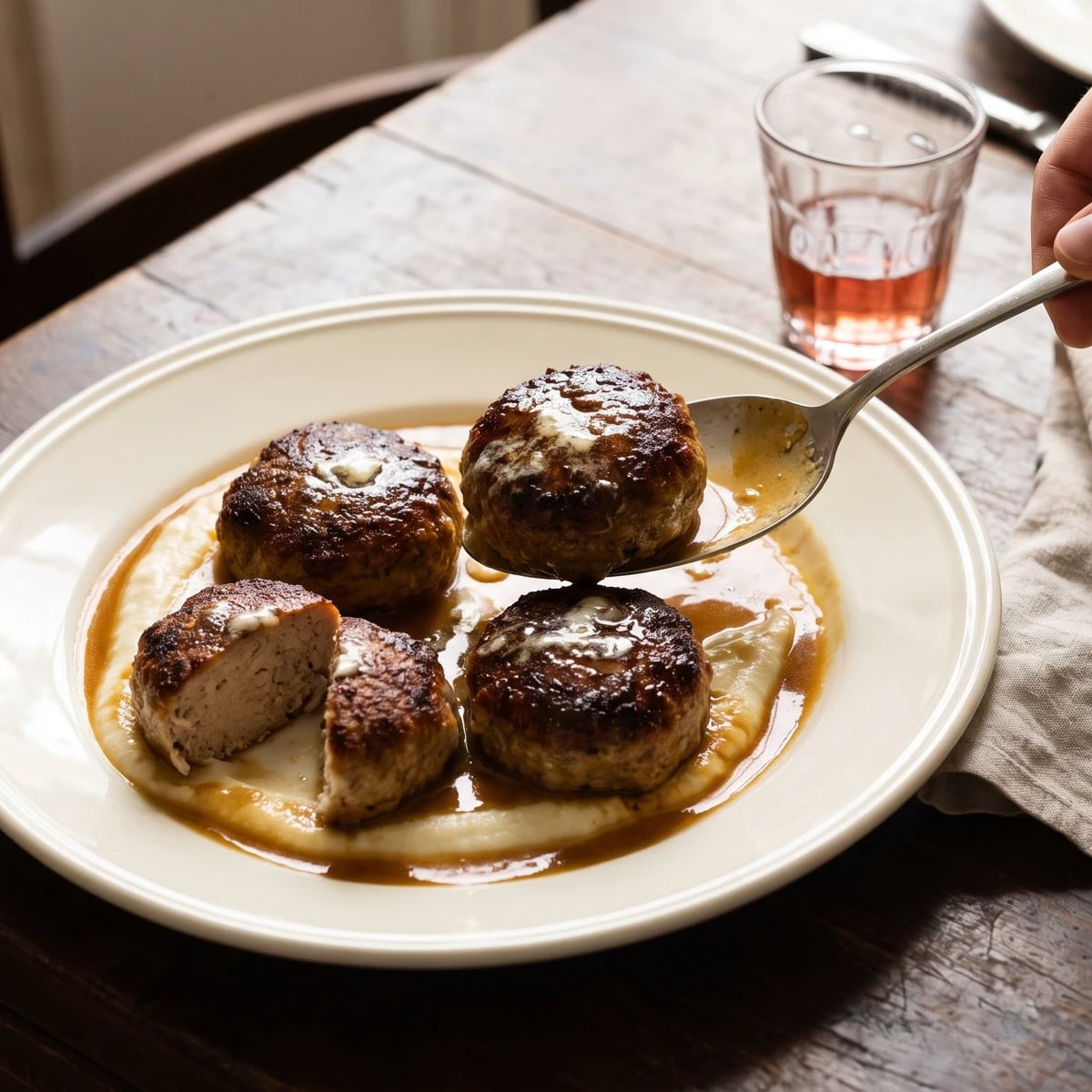
Fricadelles turn lean veal, cold butter, bread, egg, and onion into bronzed, tender patties, browned in a skillet and finished in the oven with vegetable purée and sharp Sauce Piquante.
Fricadelles de veau (butter-rich veal patties) teach one true thing before your hand reaches for the pan: the butter must stay cold enough to bind into the chopped veal. Here butter isn't a finishing luxury. It supplies the tenderness, and if it melts before the crust forms, it runs into the skillet and leaves the fricadelles tight.
The original entry assumed ten portions, a commis chopping veal and butter together, a saucier holding the vegetable purée and Sauce Piquante ready, and a sauté pan that could pass straight into the oven. At home, a small food processor replaces the practiced chopping hand, one oven-safe skillet handles the browning and finishing, and the finished accompaniments warm in two small saucepans. The brigade portions and separate stations are scaffolding, so they can go. The cold veal-butter bind, flour-dusted shaping, deep browning, and oven finish are the dish, so they stay.
Expect a deeply bronzed outside and a fine, tender center, with the acidity of Sauce Piquante cutting through all that generous butter. If the mixture begins to look greasy while you work, stop and chill it. Ça se rattrape. Keep everything cold until the shaped fricadelles meet the hot pan, because that is the step that decides the dish.
Fricadelles belong to the private household table across France, with especially close cousins in northern France and Belgium, rather than to one grand regional school. The classical canon carried them from domestic practice into professional manuals almost unchanged: chopped meat, bread or potato, egg, onion, seasoning, and a browned surface, with either raw meat or cooked leftovers as the base. The raw veal version is the richer branch, bound with an arresting amount of butter and served with a vegetable purée, Sauce Piquante, or Sauce Robert.
Quantity
6.4 ounces (180 g)
cleared of fat and gristle, cut into small chunks and chilled
Quantity
½ cup plus 1½ teaspoons (126 ml / 120 g)
very cold and diced
Quantity
⅓ cup firmly packed (80 ml / 57 g)
measured after soaking and pressing very dry
Quantity
1 cup (240 ml / 240 g)
for soaking the bread
Quantity
2 tablespoons plus 2 teaspoons (40 ml / 40 g)
from about 1 large egg
Quantity
2 tablespoons (30 ml / 23 g)
finely chopped
Quantity
1 tablespoon (15 ml / 14 g)
Quantity
1 teaspoon (5 ml / 5.7 g)
Quantity
1 small pinch (0.3 ml / 0.15 g)
Quantity
1 small pinch (0.3 ml / 0.1 g)
Quantity
2 tablespoons (30 ml / 16 g)
for dusting
Quantity
2 tablespoons (30 ml / 28 g)
Quantity
2 cups (480 ml / 500 g)
warmed
Quantity
1 cup (240 ml / 250 g)
warmed
| Ingredient | Quantity |
|---|---|
| very lean boneless vealcleared of fat and gristle, cut into small chunks and chilled | 6.4 ounces (180 g) |
| unsalted butter for the veal mixturevery cold and diced | ½ cup plus 1½ teaspoons (126 ml / 120 g) |
| soft white bread crumbmeasured after soaking and pressing very dry | ⅓ cup firmly packed (80 ml / 57 g) |
| cold waterfor soaking the bread | 1 cup (240 ml / 240 g) |
| beaten eggfrom about 1 large egg | 2 tablespoons plus 2 teaspoons (40 ml / 40 g) |
| yellow onionfinely chopped | 2 tablespoons (30 ml / 23 g) |
| unsalted butter for the onion | 1 tablespoon (15 ml / 14 g) |
| fine salt | 1 teaspoon (5 ml / 5.7 g) |
| freshly ground black pepper | 1 small pinch (0.3 ml / 0.15 g) |
| freshly grated nutmeg | 1 small pinch (0.3 ml / 0.1 g) |
| plain flourfor dusting | 2 tablespoons (30 ml / 16 g) |
| unsalted butter for browning | 2 tablespoons (30 ml / 28 g) |
| prepared vegetable purée, preferably celeriacwarmed | 2 cups (480 ml / 500 g) |
| prepared Sauce Piquantewarmed | 1 cup (240 ml / 250 g) |
Set an oven rack in the center and heat the oven to 400°F (200°C). Chill the food processor bowl and blade for ten minutes with the veal and diced butter nearby in the cold. If you have no processor, use a sharp chef's knife on a chilled board and chop the veal and butter together in small batches; that is closer to the original method, only slower.
Melt the tablespoon of butter in a small pan over low heat. Add the onion and cook for 6 to 8 minutes, stirring often, until completely tender but still pale, then spread it on a plate to cool. Soak the bread crumb in the cold water until saturated, gather it in a clean towel, and squeeze with conviction until no more water drips. Measure the required 57 g after pressing. Water left in the bread loosens the mixture and encourages the fricadelles to crack.
Pulse the chilled veal briefly until finely chopped but not pasty. Add the cold diced butter and pulse in short bursts until it is evenly dispersed in fine pale flecks. Transfer the mixture to a cold bowl and add the pressed bread, beaten egg, cooled onion, salt, pepper, and nutmeg. Mix firmly by hand or with a wooden spoon until cohesive and slightly tacky. If the butter smears against the bowl or the mixture becomes shiny, stop. Ça se rattrape: spread it shallow in the bowl, chill it for ten minutes, then finish mixing by hand.
Dust a board lightly with the flour. Divide the mixture into four equal portions, roughly 3½ ounces (100 g) each, and roll them gently into balls. Flatten each with the broad side of a knife into a quoit-like disc about 3 inches (7.5 cm) across and ¾ inch (2 cm) thick, with no hole in the center. Dust only enough to prevent sticking. If the edges crack, press them together with cool fingertips rather than kneading flour into the meat. Chill the shaped fricadelles for ten minutes.
Melt the browning butter in a 10-inch (25 cm) oven-safe sauté pan over medium heat. When its foam subsides, add the fricadelles with space between them and brown for 2 to 3 minutes per side, turning with a broad spatula only after a firm bronze crust has formed. If one resists the spatula, give it another thirty seconds; forcing it early tears the surface. Transfer the pan to the oven and cook for 6 to 9 minutes, until the centers reach 160°F (71°C). If your pan cannot go into the oven, move the browned fricadelles to a preheated metal baking tray. Rest them for three minutes.
Warm the vegetable purée and Sauce Piquante separately over gentle heat while the fricadelles finish. Spoon the purée generously onto a warm round platter, arrange the four fricadelles over it, and let the glossy Sauce Piquante pool around them without covering their bronzed tops. The source also permits Sauce Robert in place of the Piquante, but choose one sauce, not both. Bring the platter straight to the table. À table!
1 serving (about 290g)
Culinary guides, cultural storytelling, and the editorial depth that makes cooking meaningful.
Discover Culinary Explorer
Chef Juliette
John Dory has the delicacy of sole and the firmness of turbot. A light flouring, a quick butter sauté, and nut-brown beurre noisette show exactly why looks never mattered.

Chef Juliette
Fresh haddock proves its delicacy in the meunière pan: a fine flour crust, moist pearly flakes, and beurre noisette sharpened with lemon and parsley, ready from one skillet in half an hour.

Chef Juliette
Éperlans à l’Anglaise turns small fish into a lesson in disciplined coating: boned smelts under a close, crisp crumb, pan-fried in clarified butter and finished with bright, half-melted maître d’hôtel butter.

Chef Juliette
Tiny smelts, shallot, mushrooms, white wine, gratin sauce, and fine bread raspings meet a fierce oven, where the fish must turn tender in the same breath the buttered crust bronzes.