
Chef Juliette
Ordinary or White Consommé
Beef shin, lean beef, and fowl begin in cold water and rise slowly toward a tremble. Skim before the boil, and you learn the quiet discipline that gives every clear French broth its backbone.
A cooking platform built around craft, culture, and the stories behind what we eat.
Created by Chef Juliette
Based on No. 123, Bohemian Sauce, from Le Guide Culinaire (1907) by Auguste Escoffier
Sauce bohémienne turns cold Béchamel into the steady heart of a mayonnaise, enriched with yolk and oil, sharpened with tarragon vinegar, then finished with mustard for the cold table.
Sauce bohémienne (Bohemian sauce) teaches one true thing about emulsions: the first spoonfuls of oil decide everything. Cold Béchamel gives the yolk a starchy, water-rich foundation, so the finished sauce is fuller and steadier than mayonnaise alone, but it cannot excuse a careless start. Oil in drops first, then a thread. C'est la même grammaire.
The source formula assumed a saucier on staff, cold Béchamel already waiting, and a service bowl large enough to swallow a quart of oil. It needed neither a stock never off the fire nor a salamander. At home, the brigade quantity is quartered exactly around one yolk, and a damp towel steadies the bowl while one hand whisks and the other pours. The extra hands and great volume were scaffolding; the Béchamel foundation, the patient emulsion, the tarragon vinegar, and mustard added last are the dish. One cook, one stove, one evening.
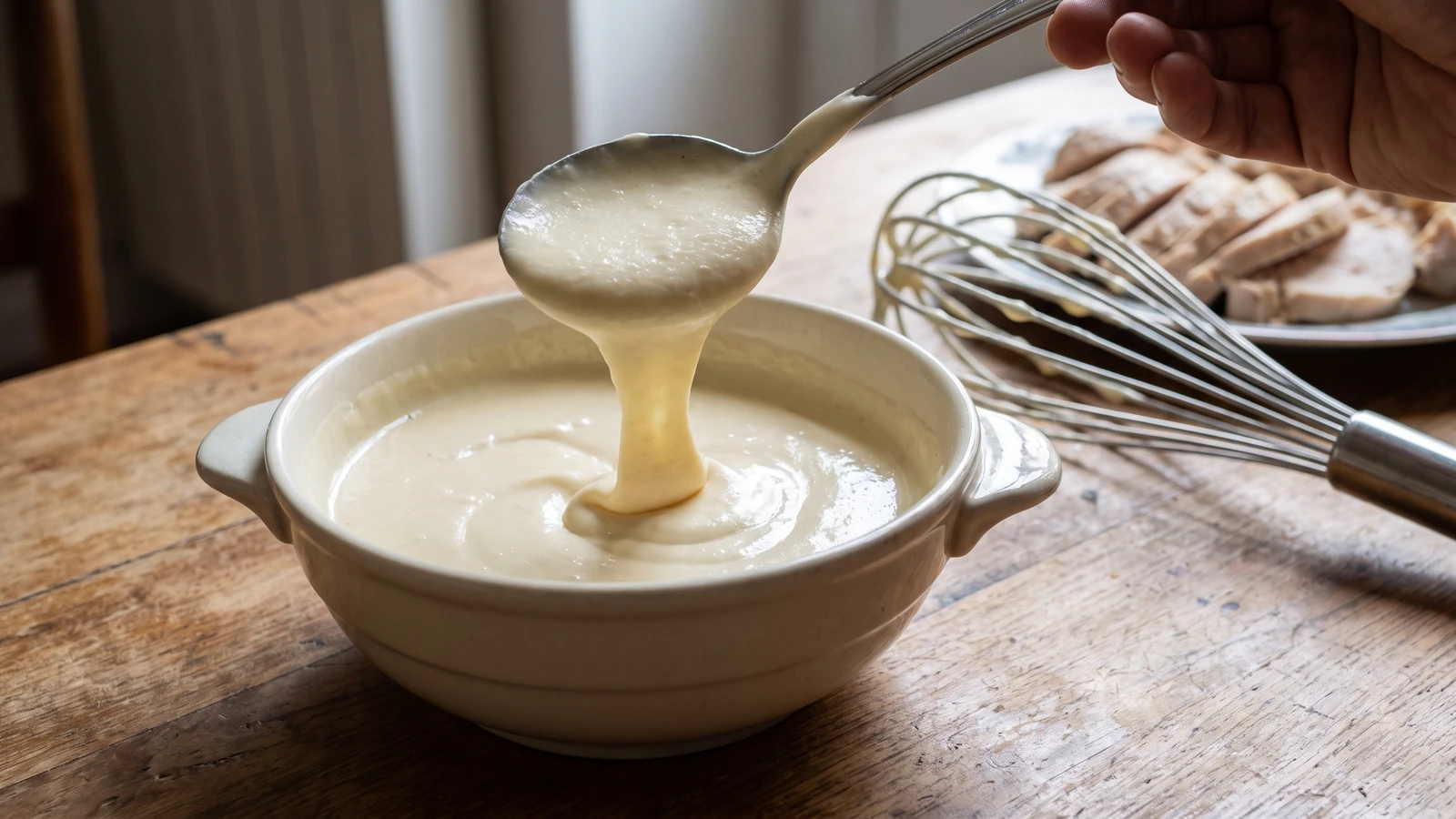
When it is right, the sauce falls from the whisk in a pale ivory ribbon, glossy but not greasy, with tarragon's clean acidity arriving before the mustard. Watch the first two tablespoons of oil: once the emulsion takes, the rest is confidence. If it splits, ça se rattrape, and the method catches it at the exact moment.
Sauce bohémienne belongs to the French grand-kitchen repertoire centered in Paris, where cold sauces were organized as rigorously as the warm mother sauces. Its name points less to Bohemian regional cooking than to the canon's habit of giving derivative sauces evocative geographical names; its defining practice is mayonnaise built on cold Béchamel, then sharpened with tarragon vinegar and mustard. From the professional cold larder it traveled naturally to household buffets and dinner tables, accompanying cold poached fish, poultry, and cooked vegetables.
Quantity
2 tablespoons plus 1 teaspoon (35 ml / 36 g)
fully chilled and whisked smooth
Quantity
1
Quantity
⅛ teaspoon (0.6 ml / 0.8 g)
Quantity
¹⁄₁₆ teaspoon (0.3 ml / 0.1 g)
Quantity
1 cup plus 3 tablespoons (285 ml / 260 g)
Quantity
2¼ teaspoons (11 ml / 11 g)
Quantity
¾ teaspoon (3.75 ml / 4 g)
Quantity
1 teaspoon (5 ml / 5 g)
| Ingredient | Quantity |
|---|---|
| cold Béchamelfully chilled and whisked smooth | 2 tablespoons plus 1 teaspoon (35 ml / 36 g) |
| large egg yolk | 1 |
| fine salt | ⅛ teaspoon (0.6 ml / 0.8 g) |
| ground white pepper | ¹⁄₁₆ teaspoon (0.3 ml / 0.1 g) |
| neutral oil, such as sunflower or grapeseed | 1 cup plus 3 tablespoons (285 ml / 260 g) |
| tarragon vinegar | 2¼ teaspoons (11 ml / 11 g) |
| Dijon mustard | ¾ teaspoon (3.75 ml / 4 g) |
| additional cold Béchamel for rescuing the emulsion (optional) | 1 teaspoon (5 ml / 5 g) |
Set a medium mixing bowl on a damp towel so it cannot wander while you whisk. Add the cold Béchamel, egg yolk, salt, and white pepper, then whisk until perfectly smooth and slightly loosened. The Béchamel must be cold but pliable, with no skin or floury lumps; this smooth, water-rich foundation is what will hold the oil.
Add about 2 tablespoons of the oil one drop at a time, whisking continuously and waiting for each addition to disappear before adding the next. The base will grow thicker, glossier, and slightly paler as the emulsion takes. Do not hurry this beginning. The measured Béchamel and steady bowl replace the brigade's extra hands, but the slow first additions cannot be cut because they are the dish.
Once the base is thick enough to hold the trace of the whisk, add the remaining oil in a fine, unbroken thread while whisking steadily. Divide the tarragon vinegar into three additions and whisk one in whenever the sauce grows so tight that the whisk begins to drag. Each addition will loosen the sauce briefly; continue whisking until it closes again before adding more oil. Finish incorporating both the oil and vinegar, keeping the sauce smooth, dense, and free of visible oil beads.
Whisk in the Dijon mustard only after all the oil and tarragon vinegar have been absorbed. That final placement belongs to the source formula: the mustard should season the completed emulsion, not do the yolk's early work. Taste for salt and white pepper. The finished Sauce bohémienne should fall in a broad ribbon and nap the back of a spoon without feeling oily.
Transfer the sauce to a clean glass or porcelain container, cover its surface closely, and refrigerate for 30 minutes. Whisk it briefly before serving; if it has firmed in the cold, whisking alone should restore the satin texture. Serve with cold poached fish, chicken, cooked ham, asparagus, or other plainly cooked vegetables. Keep it cold once it reaches the table. À table!
1 serving (about 41g)
Culinary guides, cultural storytelling, and the editorial depth that makes cooking meaningful.
Discover Culinary ExplorerChef Juliette
Beef shin, lean beef, and fowl begin in cold water and rise slowly toward a tremble. Skim before the boil, and you learn the quiet discipline that gives every clear French broth its backbone.

Chef Juliette
Break the veal bones small, then give them eight hours at a bare tremble. This pale, gelatinous fond becomes the quiet foundation beneath velouté, blanquette, and every sauce that must stay light.

Chef Juliette
Sauce Orientale concentrates lobster-rich American Sauce with curry, then folds in cream away from the fire: a glossy, gently spiced derivative made for lobster, crayfish, and firm fish.

Chef Juliette
An old lesson in sauce families: Sauce Allemande takes mushroom liquor, then butter, lemon, and parsley, becoming a glossy Poulette for sheep's trotters, leeks, cauliflower, and anything needing gentle richness with a bright edge.