Culinary Explorer
A cooking platform built around craft, culture, and the stories behind what we eat.
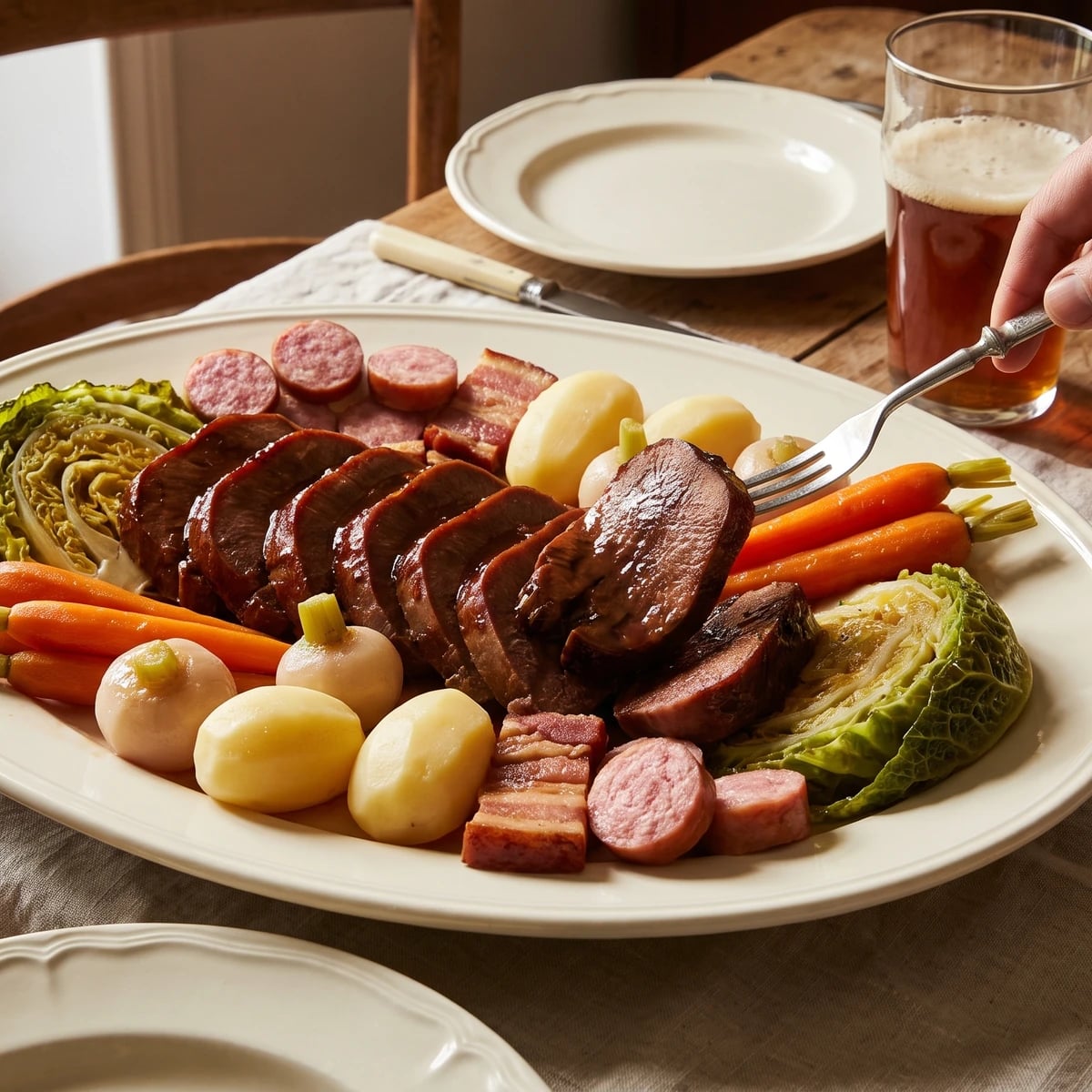
Langue de Bœuf Flamande
Created by Chef Juliette
Langue de Bœuf Flamande teaches the generous logic of garnish: tender glazed tongue at the centre, braised cabbage, roots, potatoes, bacon, and sausage gathered around it.
Langue de Bœuf Flamande (Flemish-style ox tongue) teaches the generous architecture of a classical garnish: the centre must earn the abundance around it. Before you touch a pan, know the one true thing about tongue. Time is only a guide; it is ready when a thin skewer enters the thick end with almost no resistance. An underbraised tongue will slice like rubber, and no glaze can flatter it.
The brigade entry assumed a saucier on staff, a stock never off the fire, a salamander for the final shine, and enough hands to tend each vegetable in its own pan. Here, the tongue’s strained braising liquor becomes the glaze, a home broiler replaces the salamander, one Savoy cabbage becomes four braised wedges, and evenly cut roots replace ornamental knife work. The scale and choreography change because four people need supper, not service for forty; the long braise, the last-moment glaze, and every element of the Flemish garnish remain because those are the dish. One cook, one stove, one evening.
When it is right, the tongue lies in overlapping slices under a mahogany gloss, surrounded by soft green cabbage, butter-bright roots, pale potatoes, bacon, and sausage. It is abundant without being fussy. The step that decides everything comes first: hold the braise at a bare tremble and trust the skewer, not the clock.
Ingredients
fresh ox tongue
Quantity
1 (3 to 3½ pounds / 1.4 to 1.6 kg)
rinsed
cold water
Quantity
About 2 gallons (7.6 L / 7.6 kg)
divided
unsalted or very low-sodium beef stock
Quantity
4 cups (960 ml / about 960 g)
| Ingredient | Quantity |
|---|---|
| fresh ox tonguerinsed | 1 (3 to 3½ pounds / 1.4 to 1.6 kg) |
| cold waterdivided | About 2 gallons (7.6 L / 7.6 kg) |
| unsalted or very low-sodium beef stock | 4 cups (960 ml / about 960 g) |
Where cooking meets culture.
Culinary guides, cultural storytelling, and the editorial depth that makes cooking meaningful.
Discover Culinary Explorer