
Chef Juliette
John Dory (St. Pierre)
John Dory has the delicacy of sole and the firmness of turbot. A light flouring, a quick butter sauté, and nut-brown beurre noisette show exactly why looks never mattered.
A cooking platform built around craft, culture, and the stories behind what we eat.
Created by Chef Juliette
Based on No. 1150, Pièce de Bœuf à la Mode Froide, from Le Guide Culinaire (1907) by Auguste Escoffier
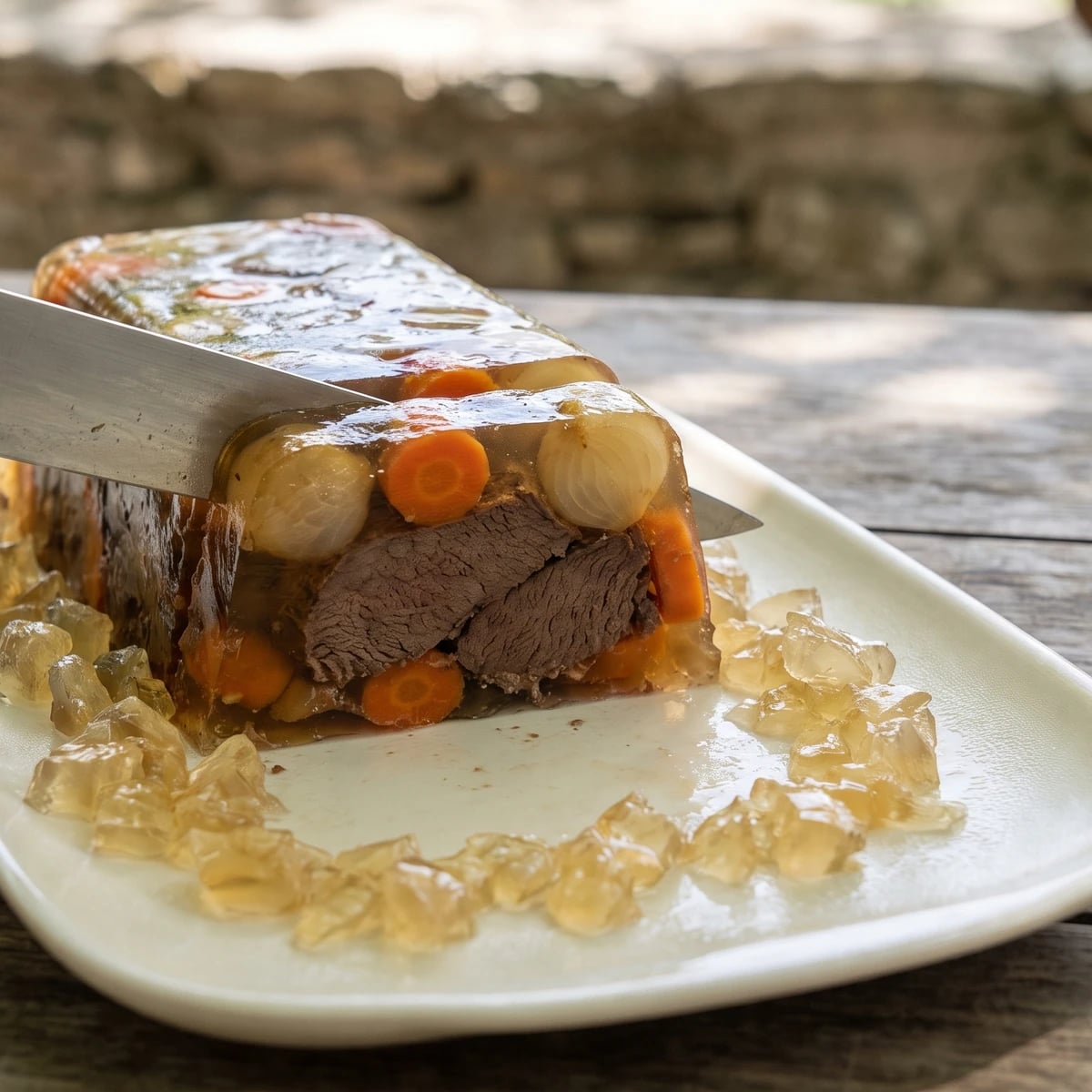
Pièce de Bœuf à la Mode Froide turns yesterday’s braise into a composed cold centerpiece, with tender beef, carrots, onions, and calf’s-foot-rich sauce held in a clear, delicate jelly.
Pièce de Bœuf à la Mode Froide (cold molded bœuf à la mode) teaches that a cold dish is finished by its set, not merely by its chill. Before you touch a pan, know this: the sauce must hold a clean slice while remaining tender beneath the fork. A rubber block and a spreading puddle both miss the point.
The original entry assumed a fine piece left from the hot service, with its carrots, onions, diced calf’s foot, reduced sauce, and clear aspic waiting nearby. Behind those few lines stood a saucier and a stockpot that never went cold, plus a terrine à pâté chosen from a shelf of molds. Your honest equivalents are the best intact piece reserved from your braise, its strained cooking sauce, prepared light aspic, and a 1.5 litre loaf pan. One cook, one stove, one evening for the assembly, then the refrigerator takes the night watch.
Elaborate molded ornament and specialized equipment are brigade scaffolding, so they may go. Trimming the meat, arranging the carrots and onions, surrounding it with calf’s-foot dice, straining the sauce, correcting it with one-third its volume of aspic when needed, and chilling it completely are the dish itself. Test a spoonful of sauce on a cold saucer before filling the mold. If it refuses to hold, ça se rattrape, and that is the moment to repair it.
Pièce de Bœuf à la Mode Froide belongs to Parisian cuisine bourgeoise and the classical cold buffet, where a family braise could return as a composed second service. The cold version was rarely cooked for itself; it made deliberate use of an intact remainder, its carrots and onions, the natural gelatine of calf’s foot, and its strained cooking sauce. The terrine à pâté supplied the shape, while a loose border of lightly chopped aspic turned careful thrift into a dish fit for picnics and formal tables alike.
Quantity
1 intact piece (1½ lb / 680 g)
well chilled
Quantity
1½ cups (360 ml / 375 g)
chilled and defatted
Quantity
¾ cup (180 ml / 120 g)
drained and cut into neat coins or batons
Quantity
½ cup (120 ml / 100 g)
drained and kept whole if small or halved if large
Quantity
½ cup (120 ml / 100 g)
cut into small dice
Quantity
½ cup (120 ml / 125 g)
melted
Quantity
1½ cups (360 ml / 375 g)
chilled firm for chopping
Quantity
1 teaspoon (5 ml / 3 g)
Quantity
1 tablespoon (15 ml / 15 g)
for blooming the optional gelatine
| Ingredient | Quantity |
|---|---|
| cold cooked piece of bœuf à la modewell chilled | 1 intact piece (1½ lb / 680 g) |
| reserved bœuf à la mode cooking saucechilled and defatted | 1½ cups (360 ml / 375 g) |
| reserved braised carrotsdrained and cut into neat coins or batons | ¾ cup (180 ml / 120 g) |
| reserved braised onionsdrained and kept whole if small or halved if large | ½ cup (120 ml / 100 g) |
| cooked calf’s-foot meat from the braisecut into small dice | ½ cup (120 ml / 100 g) |
| clear, lightly set aspic jelly (optional)melted | ½ cup (120 ml / 125 g) |
| very light aspic jellychilled firm for chopping | 1½ cups (360 ml / 375 g) |
| unflavored powdered gelatine (optional) | 1 teaspoon (5 ml / 3 g) |
| cold water (optional)for blooming the optional gelatine | 1 tablespoon (15 ml / 15 g) |
Lift the chilled beef onto a board and trim away loose scraps, gristle, and heavy seams of surface fat without carving into the sound meat. Keep the piece whole and regular enough to sit cleanly in the mold. This trimming is explicit in the original method: ragged edges cloud the jelly, while a thick fat cap is unpleasant when cold. Return the trimmed beef to the refrigerator while you prepare the rest.
Rinse a 1.5 litre terrine à pâté or metal loaf pan with cold water and shake it out without drying. Do not grease it, because fat clouds the clear surface. Arrange about one-third of the carrots and onions attractively across the bottom, remembering that this will become the top when the dish is turned out. Keep the design simple and generous. Cooking well is not cooking fancy.
Scrape every trace of hardened fat from the sauce, warm it gently until completely fluid, and pass it through a fine-mesh strainer. Measure 1½ cups (360 ml), then place a tablespoon on a saucer chilled in the freezer. Refrigerate the sample for five minutes. It should set firmly enough to hold a cut edge but yield at once beneath a spoon. If the sauce is scant or the sample sets too stiff, stir in the melted light aspic, exactly one-third the sauce’s original volume, ½ cup (120 ml) here, as the source directs. Retest before proceeding.
Let the corrected sauce cool until barely warm but still fluid. Set the beef lengthwise in the center of the mold, leaving space around every side. Tuck the remaining carrots, onions, and calf’s-foot dice into that space, distributing them evenly rather than packing them tightly. Pour in the strained sauce slowly, directing it down the sides so the decoration underneath stays in place. Tap the mold gently on a folded towel and run a thin skewer around the edges to release trapped air. The sauce should surround the meat and just cover it.
Set the mold on a shallow metal tray and refrigerate it uncovered until thoroughly cold, about thirty minutes, then cover without touching the surface. Chill for at least six hours, preferably overnight, until the center feels firm when pressed lightly. Do not hurry it in the freezer. The slow, complete chill gives the natural calf’s-foot gelatine time to form a tender, even set.
Shortly before serving, turn the firm light aspic onto a cold board and chop it with a large knife into small, irregular facets. Keep the hand light. You want a loose, delicate border that catches the light, not compressed cubes or aspic paste. Return it to the refrigerator while you unmold the beef.
Lay a warm, wrung-out towel against the sides and bottom of the mold for five to ten seconds. Place a chilled platter over it, invert both together, and lift the mold straight upward. If the bœuf à la mode does not release, replace the mold and warm it for another five seconds. If the surface softens too much, return the unmolded dish to the refrigerator for ten minutes. Surround it generously with the chopped light aspic, then cut thick slices with a sharp knife dipped in hot water and wiped dry. Serve cold. À table!
1 serving (about 475g)
Culinary guides, cultural storytelling, and the editorial depth that makes cooking meaningful.
Discover Culinary Explorer
Chef Juliette
John Dory has the delicacy of sole and the firmness of turbot. A light flouring, a quick butter sauté, and nut-brown beurre noisette show exactly why looks never mattered.

Chef Juliette
Fresh haddock proves its delicacy in the meunière pan: a fine flour crust, moist pearly flakes, and beurre noisette sharpened with lemon and parsley, ready from one skillet in half an hour.

Chef Juliette
Éperlans à l’Anglaise turns small fish into a lesson in disciplined coating: boned smelts under a close, crisp crumb, pan-fried in clarified butter and finished with bright, half-melted maître d’hôtel butter.

Chef Juliette
Tiny smelts, shallot, mushrooms, white wine, gratin sauce, and fine bread raspings meet a fierce oven, where the fish must turn tender in the same breath the buttered crust bronzes.