Culinary Explorer
A cooking platform built around craft, culture, and the stories behind what we eat.
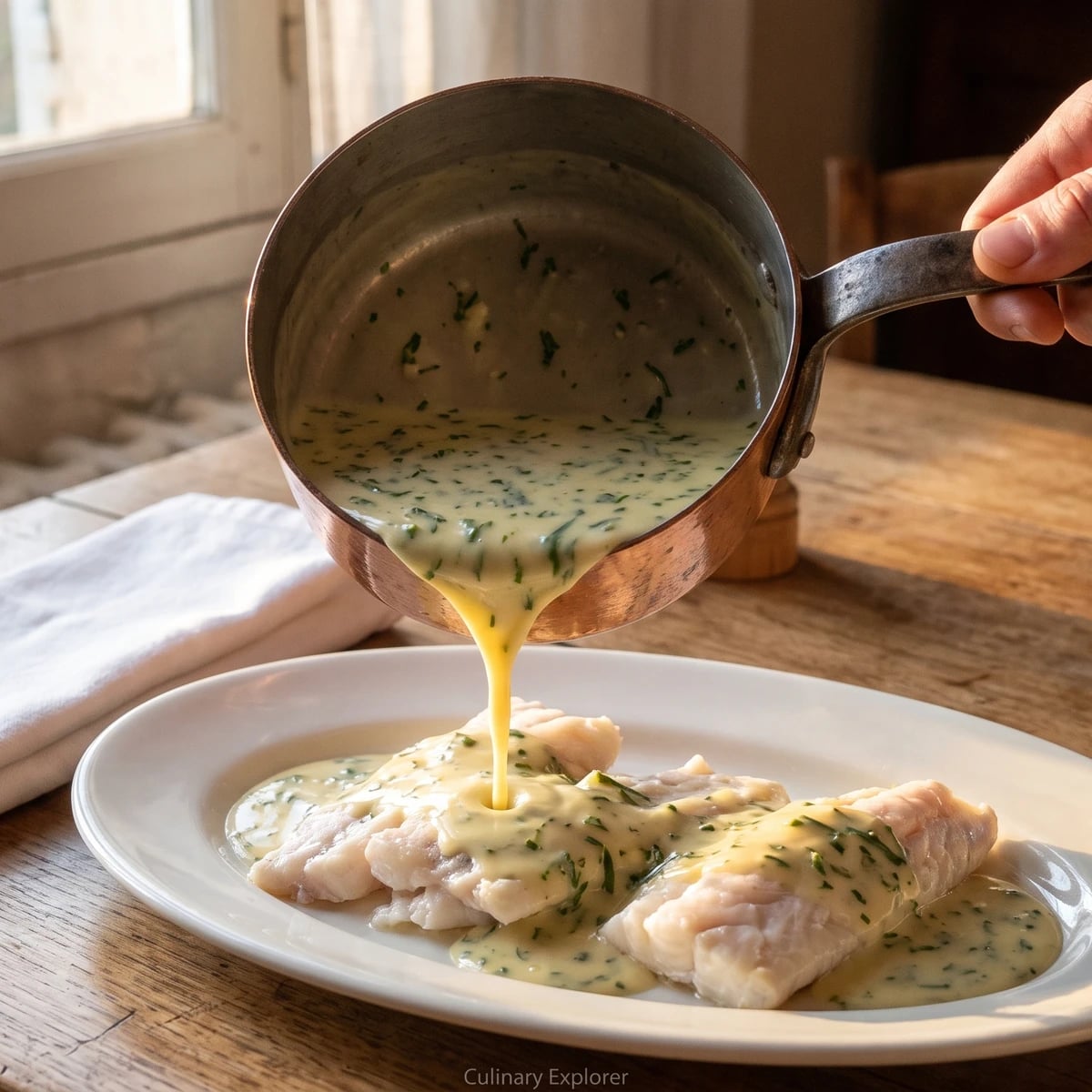
Venetian Sauce
Created by Chef Juliette
Sauce Vénitienne turns disciplined reduction into brightness: shallot, white wine, and tarragon vinegar sharpen a silken base, while herb juice and fresh leaves give poached fish its vivid green finish.
Sauce Vénitienne (Venetian sauce) teaches the order of a derivative sauce: reduce the acid first, join it to the finished base, then add the green finish away from hard heat. The one true thing to know before touching a pan is that vinegar cannot be rushed into a finished butter sauce and then bullied into balance. The reduction is the dish.
The original assumes a saucier on staff, a stockpot never cold, White Wine Sauce (No. 111) and Herb Juice (No. 183) already waiting, and a tammy for passing the finished sauce. At home, one wide saucepan and a fine-mesh sieve replace the separate station and the tammy. That is brigade scaffolding and can go. The four-to-one proportion of finished sauce to unreduced wine and vinegar, the measured reduction, and the cool herb finish must stay. The batch fits one four-quart pan and makes about two quarts: one cook, one stove, one evening.
When it is right, the sauce is nappant (silken enough to coat the back of a spoon), pale green rather than emerald, with shallot beneath the clean bite of tarragon vinegar and fresh herbs arriving last. Measure the reduction instead of trusting the clock. Two cups must become two-thirds of a cup before the White Wine Sauce (No. 111) goes in.
Ingredients
shallots
Quantity
1/4 cup (60 ml / 40 g)
finely chopped
fresh chervil for the reduction
Quantity
1/4 cup (60 ml / 8 g)
finely chopped
dry white wine
Quantity
1 cup (240 ml / 240 g)
| Ingredient | Quantity |
|---|---|
| shallotsfinely chopped | 1/4 cup (60 ml / 40 g) |
| fresh chervil for the reductionfinely chopped | 1/4 cup (60 ml / 8 g) |
| dry white wine | 1 cup (240 ml / 240 g) |
Where cooking meets culture.
Culinary guides, cultural storytelling, and the editorial depth that makes cooking meaningful.
Discover Culinary Explorer