
Chef Juliette
John Dory (St. Pierre)
John Dory has the delicacy of sole and the firmness of turbot. A light flouring, a quick butter sauté, and nut-brown beurre noisette show exactly why looks never mattered.
A cooking platform built around craft, culture, and the stories behind what we eat.
Created by Chef Juliette
Based on No. 1053, Filet de Bœuf Gastronome, from Le Guide Culinaire (1907) by Auguste Escoffier
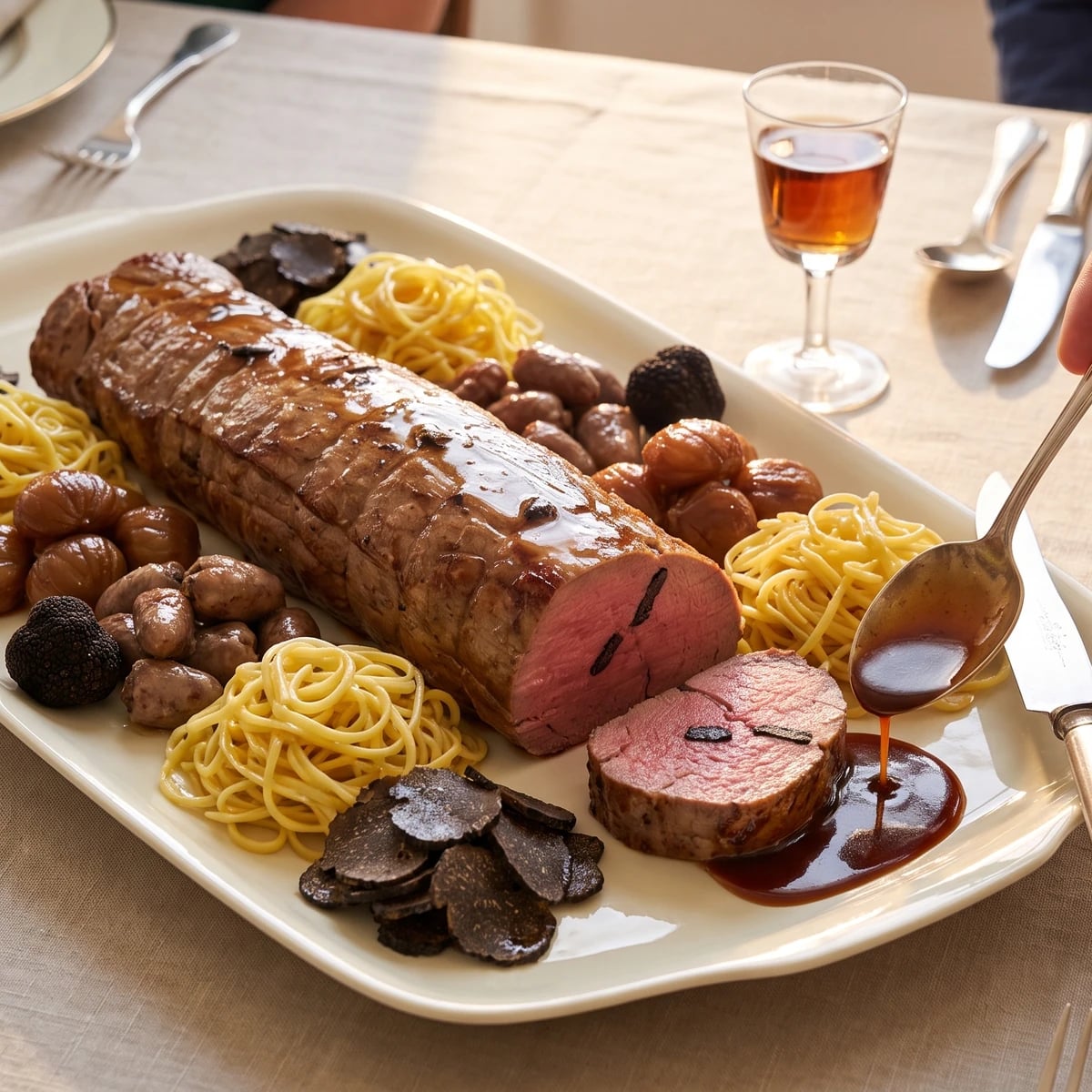
A truffle-studded fillet, gently braised in Madeira and brought to the table with Champagne-cooked truffles, glazed chestnuts, buttered noodles, and a deep sauce reduced from their fragrant liquor.
Filet de Bœuf Gastronome (truffle-studded beef fillet with Madeira garnishes) teaches restraint inside abundance. The one true thing to know before touching the pan is that tenderloin may be braised here, but it must never be treated like a tough braising cut. Its tenderness comes ready-made. The brief covered cooking carries Madeira and truffle into the meat, then stops before the fillet loses its rosy center.
The original assumed a larding needle, a saucier on staff, a stock never off the fire, a salamander, and enough hands to finish four garnishes at once. At home, a slim boning knife makes the truffle channels, a narrow covered casserole manages the short braise, prepared veal demi-glace supplies the saucier's foundation, and the broiler gives the final light glaze. Cocks’ kidneys are no longer ordinarily sold, so chicken hearts take their place after a short bath in the referenced marinade. The texture changes, and I won't pretend otherwise, but their small scale and rich offal note preserve the purpose of the original garnish.
Separate cooks and endless saucepans were brigade scaffolding, so they can go. The truffle in three forms, the Madeira, the glossy chestnuts, the buttered noodles, the distinct alternating garnishes, and the sauce served separately are the dish itself, so they stay. Prepare them in sequence and hold each gently. One cook, one stove, one evening. Pulling the beef at the right internal temperature is the step that decides everything.
Filet de Bœuf Gastronome belongs to the Parisian grand table rather than to a particular province, and its name signals a composed garnish devised for a devoted eater. From the professional dining room it passed into household manuals, while preserving its alternating garnish mounds and separately served sauce instead of collapsing everything into a stew. The cocks’ kidneys in the original are rooster offal, not beef kidneys, a distinction often lost when the dish is copied.
Quantity
1 fillet, 2 lb (900 g)
silverskin removed
Quantity
About 6, 5½ oz (155 g) total
1 cut into slender batons, 1 thickly sliced, 4 left whole
Quantity
1⅔ cups (400 ml / 395 g)
divided
Quantity
¼ cup (60 ml / 60 g) Cooked Marinade for Venison (No. 168)
chilled
Quantity
10 slices, 7 oz (200 g)
Quantity
½ cup (120 ml / 110 g) Mirepoix (No. 228)
Quantity
¾ cup (180 ml / 175 g)
Quantity
12 oz (340 g)
Quantity
1½ cups (360 ml / 360 g)
divided
Quantity
8 oz (225 g)
trimmed and halved lengthwise
Quantity
1¼ cups (300 ml / 315 g)
divided
Quantity
8 oz (225 g)
Quantity
5 tablespoons (75 ml / 70 g)
divided
Quantity
1 tablespoon (15 ml / 18 g)
divided
Quantity
1 teaspoon (5 ml / 2 g)
| Ingredient | Quantity |
|---|---|
| center-cut beef tenderloinsilverskin removed | 1 fillet, 2 lb (900 g) |
| small fresh black truffles or whole preserved black truffles1 cut into slender batons, 1 thickly sliced, 4 left whole | About 6, 5½ oz (155 g) total |
| medium-dry Madeiradivided | 1⅔ cups (400 ml / 395 g) |
| Cooked Marinade for Venisonchilled | ¼ cup (60 ml / 60 g) Cooked Marinade for Venison (No. 168) |
| thin unsmoked streaky bacon | 10 slices, 7 oz (200 g) |
| Mirepoix | ½ cup (120 ml / 110 g) Mirepoix (No. 228) |
| brut Champagne | ¾ cup (180 ml / 175 g) |
| peeled cooked chestnuts | 12 oz (340 g) |
| beef consommédivided | 1½ cups (360 ml / 360 g) |
| chicken heartstrimmed and halved lengthwise | 8 oz (225 g) |
| light veal demi-glace (half-glaze)divided | 1¼ cups (300 ml / 315 g) |
| fine dried egg noodles | 8 oz (225 g) |
| unsalted butterdivided | 5 tablespoons (75 ml / 70 g) |
| fine sea saltdivided | 1 tablespoon (15 ml / 18 g) |
| freshly ground black pepper | 1 teaspoon (5 ml / 2 g) |
Piquer means to stud the meat from within. Cut one truffle into slender batons about ⅛ inch by 1½ inches (3 mm by 4 cm), the shape of fine larding bacon. Following the grain of the beef, make narrow channels with the tip of a slim boning knife and push the truffle batons completely inside. Tie the fillet at 1-inch (2.5 cm) intervals, place it in a snug nonreactive dish, and pour over ⅔ cup (160 ml) of the Madeira. Cover, chill for 4 to 5 hours, and turn twice so the wine reaches every surface. Do not leave it overnight; the fortified wine will begin to tighten the tender exterior.
Reserve 2 tablespoons (30 ml) of the consommé for the chicken hearts. Put the chestnuts in a small saucepan with the remaining consommé and simmer gently until they are tender but still whole, 12 to 15 minutes. Lift them out, reduce their cooking liquid to about 2 tablespoons (30 ml), and swirl in 1 tablespoon (15 ml / 14 g) of the butter. Return the chestnuts and roll them carefully until their surfaces shine. If several break, keep the whole ones for the visible garnish and nestle the pieces beneath them. Ça se rattrape.
Combine the Mirepoix (No. 228) and Champagne in a small saucepan and bring them to the barest simmer. Add the thick truffle slices and cook gently for 6 to 8 minutes, then lift them out without tearing them. In a second small pan, cook the four whole truffles in the final ⅓ cup (80 ml) of Madeira for 8 minutes. Reserve all the truffles. Combine their Champagne and Madeira cooking liquors, then pass the liquid through a fine sieve lined with damp linen or two layers of damp cheesecloth. Press lightly, because forcing the mirepoix through would cloud the sauce.
Heat the oven to 325°F (160°C). Lift the fillet from its marinade, reserve the wine, and wipe the beef thoroughly dry. Season with 1½ teaspoons of the salt and half the pepper. Barder means to wrap lean meat in protective fat: overlap the bacon slices across the top and sides of the fillet, then secure them with kitchen string. Set the beef in a narrow lidded casserole and pour the reserved marinade plus another ⅔ cup (160 ml) of Madeira around it. The liquid should reach no more than one-third of the way up the meat. Cover and braise for 25 minutes, then begin checking the center with a thermometer. Lift the fillet out at 122 to 126°F (50 to 52°C); resting and glazing will bring it near 131 to 135°F (55 to 57°C). Tenderloin has no collagen to forgive overcooking. If it has already reached 131°F (55°C), remove the bacon immediately, rest it on a cool platter, and skip the broiler later, brushing on hot glaze instead. Ça se rattrape. Rest the beef loosely covered for 15 minutes and reserve 2 tablespoons (30 ml) of demi-glace for its final glaze.
While the beef braises, toss the trimmed chicken hearts with the Cooked Marinade for Venison (No. 168) and leave them for 20 minutes, no longer. Drain and wipe them very dry. Melt 1 tablespoon (15 ml / 14 g) of butter in a sauté pan, then cook the hearts cut-side down until browned and cooked through to 165°F (74°C), about 5 to 7 minutes. Thin 3 tablespoons (45 ml) of demi-glace with the reserved 2 tablespoons (30 ml) of consommé, add it to the pan, and roll the hearts in this pale, light meat glaze until just coated. Hold them warm without boiling the glaze.
Combine the strained truffle cooking liquor with all the demi-glace remaining after the portions for the hearts and beef have been removed. Pass the mixture once more through damp linen into a clean, straight-sided saucepan. Note its depth, then simmer steadily until only two-thirds remains and the sauce coats a spoon in a thin, glossy veil. Taste before adding salt. If it becomes too strong or salty, loosen it a spoonful at a time with hot water and bring it back to the proper body; if it remains thin, keep reducing. Ça se rattrape. Keep the finished sauce warm for serving separately.
Cook the noodles in well-salted water until tender but still distinct beneath the teeth. Drain thoroughly, return them to the warm pan, and toss with the remaining 3 tablespoons (45 ml / 42 g) of butter and enough pepper to wake them up. If they begin to cling before the platter is ready, loosen them with a spoonful of their cooking water. We don't apologize for butter.
Remove the bacon and strings from the rested fillet. Heat the broiler and place the beef 2 to 3 inches (5 to 7.5 cm) beneath it. Brush with the reserved demi-glace and broil for 30 to 60 seconds, watching without looking away, until the coating shines and takes a light bronze. This is the home equivalent of the salamander. If the beef was already at its final temperature, brush it with simmering glaze and omit the broiler. Set the fillet on a long warm platter. Arrange alternate generous heaps of Champagne-cooked truffle slices, glazed chestnuts, glazed chicken hearts, and buttered noodles around it, connecting the groups with the whole Madeira-cooked truffles. Send the reduced sauce in a warm sauceboat and carve the beef at the table. À table!
1 serving (about 650g)
Culinary guides, cultural storytelling, and the editorial depth that makes cooking meaningful.
Discover Culinary Explorer
Chef Juliette
John Dory has the delicacy of sole and the firmness of turbot. A light flouring, a quick butter sauté, and nut-brown beurre noisette show exactly why looks never mattered.

Chef Juliette
Fresh haddock proves its delicacy in the meunière pan: a fine flour crust, moist pearly flakes, and beurre noisette sharpened with lemon and parsley, ready from one skillet in half an hour.

Chef Juliette
Éperlans à l’Anglaise turns small fish into a lesson in disciplined coating: boned smelts under a close, crisp crumb, pan-fried in clarified butter and finished with bright, half-melted maître d’hôtel butter.

Chef Juliette
Tiny smelts, shallot, mushrooms, white wine, gratin sauce, and fine bread raspings meet a fierce oven, where the fish must turn tender in the same breath the buttered crust bronzes.